Catholic Church
DublinersThe Catholic Church in Dubliners is at once a system of demanding spiritual duties, a source of communal authority, and a framework woven into ordinary decisions about education, marriage, work, and personal conduct. The stories give particular weight to the priest’s obligations and the Church’s doctrines, but show those beliefs being handled by people with limited knowledge, practical concerns, and competing loyalties.
Religious Duties and the Priesthood
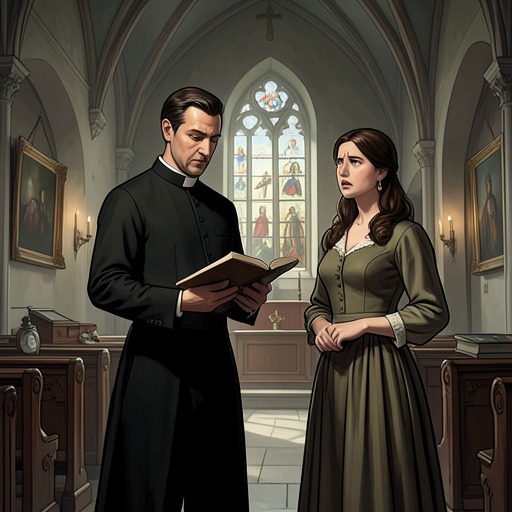
The narrator’s memories of Father James Flynn show how the Church’s responsibilities could appear both intricate and overwhelming to a child. Father Flynn had taught him Latin pronunciation, told him about the catacombs and Napoleon Bonaparte, and explained the Mass’s ceremonies and the priest’s vestments. He also tested the boy on whether particular sins were mortal, venial, or merely imperfections. These lessons made the Church’s institutions seem far more complex than their familiar outward forms. The narrator was especially struck by the priest’s duties toward the Eucharist and the secrecy of the confessional. Father Flynn described the questions involved as so intricate that Church fathers had written densely printed books to explain them. The boy sometimes could not answer, or answered haltingly; Father Flynn smiled and nodded, then made him rehearse the responses of the Mass. The teaching presents priestly service not simply as public ritual but as a burden of judgment, knowledge, and confidentiality. After Father Flynn’s death, his sisters connect that burden to the course of his life. Eliza says that he had always been too scrupulous, that the duties of the priesthood had been too much for him, and that his life had been crossed. The aunt calls him a disappointed man. The account does not explain the full causes of his disappointment, but the sisters’ interpretation makes spiritual responsibility and personal frustration inseparable in the family’s recollection of him.
Doctrine, Instruction, and Belief
The Church’s authority also appears through schooling. At college, Father Butler rebukes Leo Dillon for reading The Apache Chief instead of studying Roman history, condemning the book as unsuitable reading for educated boys. The episode sets institutional discipline against the boy’s desire for adventure: the reprimand diminishes the imaginative glory of the Wild West, but does not extinguish his hunger for escape. Religious education is thus part of a wider institutional routine that seeks to direct attention and conduct, even as youthful desires persist beyond its reach. In the episode involving Tom Kernan, religious instruction becomes a deliberate project undertaken by friends. Kernan had been raised in a Protestant family and converted to Catholicism when he married, but had stayed away from the Church for twenty years and made occasional barbed remarks about Catholicism. After his accident, his friends arrange to bring him back toward religious practice. Martin Cunningham, who is trusted for his judgment, reassures him that Catholicism is the old, original faith. The effort treats religious identity not as a settled fact of biography but as something friends believe can be renewed through persuasion and participation. Their conversation turns to the apparent moral failures of popes. Cunningham concedes that some were bad men, then argues that none taught false doctrine when speaking ex cathedra; Father Fogarty explains that the pope is infallible in that capacity. The distinction separates the office’s doctrinal authority from the personal conduct of its holders. It gives Kernan a way to accept the Church’s teaching without having to defend every pope’s character, and he responds warmly to Cunningham’s assurance about Catholicism.
Ritual, Family, and Social Consequences
In Maria’s Hallow Eve gathering, religious symbols enter a domestic game of divination. Blindfolded, she first touches a soft, wet substance, prompting a pause and whispered discussion; Mrs Donnelly has it removed and makes Maria try again. Maria then draws the prayer-book. The group interprets that result as a sign that she will enter a convent before the year is out. The scene makes a religious vocation part of a playful household ritual, where the prayer-book functions at once as an ordinary object and as a sign to be read for a possible future. The same gathering later turns toward music and hospitality. Mrs Donnelly plays a reel, Joe offers Maria wine, and he is unusually pleasant and talkative with her. At the children’s request, Maria sings I Dreamt that I Dwelt, standing beside the piano and singing shyly. In the context of the earlier divination, the prayer-book’s suggestion of convent life sits beside the warmth of family company; the story leaves the prediction as a social interpretation, not a confirmed decision or outcome. The Church’s moral language also informs Mrs Mooney’s response to Polly’s relationship with Bob Doran. Mrs Mooney believes that Polly’s youth and inexperience have been taken advantage of, and regards marriage as the only adequate reparation for the loss of her daughter’s honour. Her judgment draws strength from social opinion and from the unequal consequences she sees for men and women: a man may continue as before, while the girl bears the burden. She also considers the practical threat publicity poses to Doran, who has worked for thirteen years in a Catholic wine-merchant’s office. The episode shows religious respectability operating alongside family reputation, gendered expectations, and employment pressure; the Church is part of the social setting in which a private relationship becomes a public and economic crisis.
Institutions, Rules, and Limits of Responsibility
Other stories place religious or moral authority beside formal rules, without making the Church itself the deciding institution. At the railway inquest after Emily Sinico’s death, the company’s representative cites notices and spring gates intended to prevent people from crossing the lines except by bridges, and argues that the officials were not to blame. The coroner expresses sympathy for her family and urges stronger preventive measures, while the jury’s verdict follows the medical evidence and exonerates the railway employee. These findings show formal responsibility being assessed through procedure, even as the narrative presents a family and community confronted by the consequences of her death. A similar gap between formal obligation and personal expectation appears in the dispute over Kathleen Kearney’s concert contract. Mrs Kearney insists that the agreement covered four concerts and that her daughter should receive the stipulated sum even when the committee abandons the Friday performance. Later, the organizers offer to pay the remaining four guineas after a committee meeting, but say that if Kathleen does not perform in the second part they will regard the contract as broken and pay nothing. Mrs Kearney refuses to accept that condition and demands four pounds eight. This conflict concerns a musical society rather than a Church ruling, but it places questions of obligation, authority, and fair treatment within the same Dublin social world where Catholic respectability and communal judgment carry considerable force.
Narrative Significance
Across these episodes, the Church is neither a single character nor a uniform power. Its meaning changes with the setting: the narrator encounters it as a demanding body of priestly duties; the schoolboy experiences its educational discipline; friends invoke doctrine to draw Tom Kernan back toward religious practice; and domestic ritual turns a prayer-book into a possible sign of vocation. Elsewhere, religious respectability forms part of the pressures surrounding marriage and employment, while contractual and legal disputes reveal other systems of obligation operating alongside it. The stories repeatedly distinguish religious authority from the conduct and circumstances of the people who inhabit it. A priest may be remembered as scrupulous and disappointed; a pope’s personal failings do not, in Cunningham’s argument, invalidate doctrinal infallibility; and a drawn prayer-book can prompt a prediction without fixing Maria’s future. This separation between belief, institution, and lived outcome gives the Catholic Church its particular narrative force: it supplies language and rituals through which Dubliners interpret responsibility, but it does not make their conflicts simple or guarantee that their hopes will be fulfilled.