Society of Jesus
DublinersThe Jesuits are presented in Dubliners as an educated, influential, and unusually enduring Catholic order, admired by several of the men around Tom Kernan. Their institutional reputation helps draw Kernan toward a retreat, where Father Purdon addresses a congregation of professional and commercial men in the language of worldly conduct and religious responsibility. The order’s authority is thus both an explicit subject of conversation and a practical force in the social world of the story.
Reputation and Institutional Standing
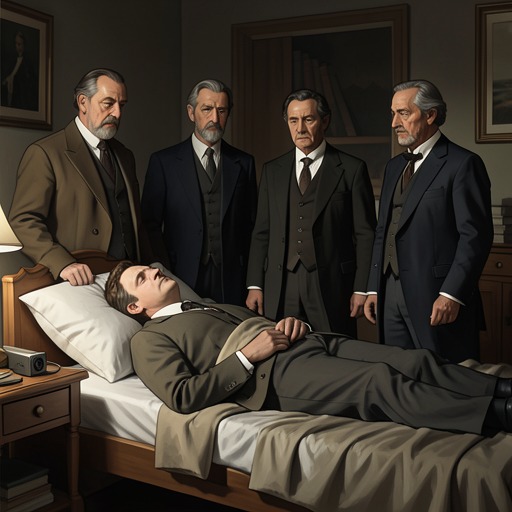
In conversation about the proposed retreat, Kernan describes the Jesuits as an educated order and says that he believes they mean well. Martin Cunningham answers with a more elevated estimate: the order is the grandest in the Church, and its General stands next to the Pope. These remarks establish a hierarchy of esteem. Kernan’s qualified approval is widened into Cunningham’s emphatic account of institutional rank, while the comparison with the Pope gives that prestige a recognizably ecclesiastical measure.
Cunningham also presents the order as exceptional in its history. He claims that other religious orders have had to be reformed, whereas the Jesuits have never fallen away or required reform. His statement is offered as historical fact and affirmed by the conversational group, not tested through a detailed account of the order’s past. In the scene, its force lies in the confidence with which Cunningham invokes continuity: the Jesuits are represented as an institution whose standing has endured where other orders have needed correction.
The surrounding conversation links this reputation to practical influence. One of Kernan’s companions says that the Jesuits are the men to approach when something must be done properly and without interference, then points to their influence as evidence. The exchange gives the order a dual character in the men’s imagination: its members belong to a religious institution, yet their authority is also described in worldly terms of competence and connections. The story records this as the companions’ assessment, revealing their assumptions about power as much as it establishes the Jesuits’ public image.
The Retreat and Kernan’s Decision
The Jesuits’ reputation becomes consequential when Cunningham explains that Father Purdon is giving a retreat for business men. Kernan has been listening while his companions discuss spiritual assistance on his behalf, though their proposal initially seems to mean little to him. He maintains a stiff-necked reserve, then asks for particulars after the praise of the order has impressed him. The retreat is presented not as a general devotional gathering but as an exercise directed toward men who lead commercial lives.
The congregation at the Jesuit Church on Gardiner Street gives that description a social setting. The transept is almost full, and well-dressed gentlemen continue to arrive, guided through the aisles by a lay-brother. Dark clothing and white collars dominate the assembly; the men settle with their hats and sit facing the distant red light before the high altar. Kernan attends with Cunningham, while other companions sit nearby. As he recognizes familiar faces among the congregation, he grows more at home in the church. The scene places the retreat within a recognizable urban network of business, civic, and professional men rather than isolating it from their ordinary social world.
Father Purdon’s sermon supplies the retreat’s central argument. He quotes the biblical counsel about making friends through the mammon of iniquity, then explains that the difficult text is particularly apt for people whose lot is to live in the world while wishing not to live merely as worldlings. He addresses business and professional men directly, presenting Christ as understanding that most people are not called to religious life and must conduct themselves within worldly affairs. The retreat therefore brings religious teaching into close contact with the occupations and ambitions of its audience.
Narrative Significance
The Jesuits’ importance in these scenes rests partly on how other characters speak about them. Cunningham’s praise of their education, rank, influence, and unbroken history persuades Kernan more effectively than the bare announcement of a retreat. Kernan’s movement from guarded silence to asking for details marks the practical effect of institutional prestige: a reputation shared among friends helps make religious intervention acceptable to a man who has not yet embraced it on his own terms.
The church gathering also shows how the retreat accommodates the social identities of its audience. The men enter in orderly fashion, recognize one another, and listen to a sermon that explicitly addresses commercial and professional life. Rather than asking them to leave the world behind, Father Purdon interprets a difficult scriptural passage as guidance for living within it. The Jesuits are consequently associated not only with religious authority but with a form of instruction calibrated to people whose public lives are governed by business and civic relationships.
The narrative does not provide a general history of the order or independently verify the claims made in conversation about its permanence and influence. Those assertions belong to the men’s spoken account of Jesuit standing. What the episode does show directly is that this standing shapes Kernan’s response, draws a substantial male congregation to the church, and provides the institutional setting for a sermon that recasts worldly activity as a field for spiritual counsel.