Eveline's promise to her mother
DublinersEveline's promise to her mother—to keep the home together for as long as she could—becomes a force in her attempted escape with Frank, but not a simple command that resolves her choice. Recalled through a street organ’s air and the memory of her mother’s final illness, the vow connects ordinary family duty to a life Eveline fears repeating. At the North Wall, with the boat to Buenos Ayres ready and Frank calling her onward, she clutches the iron railing and does not follow. The ending leaves the promise entangled with terror, obligation, and the prospect of happiness rather than reducing Eveline’s refusal to a single motive.
The Promise and Its Return
The promise enters Eveline’s crisis as a memory triggered by music. Sitting by the window, she hears a street organ playing an air she recognizes; its sudden appearance that night brings back the commitment she made to her mother, to keep the home together for as long as she could. The sound does not arrive as detached background: it carries the past into the present just as Eveline is weighing whether to leave.
That recollection opens onto the last night of her mother’s illness. Eveline remembers being in the close, dark room across the hall while the melancholy air of Italy sounded outside. Her father had ordered the organ-player away and given him sixpence, then returned to the sickroom and condemned the Italians for coming there. The remembered scene thus places the family promise amid illness, domestic strain, and her father’s response to the music that will later call the vow back to mind.
The memory is not only of a spoken commitment. The sight of her mother’s life as a succession of commonplace sacrifices, ending in what the narration calls “final craziness,” makes the promise feel bound to a feared pattern. Her mother’s repeated words, “Derevaun Seraun!”, return as part of the recollection, their meaning left unexplained. The text makes the vow powerful through this cluster of remembered suffering without supplying a definitive interpretation of the phrase or turning the promise into a fully articulated rule.
Family Duty and the Possibility of Leaving
Eveline’s decision is divided by more than the promise alone. Before she leaves, she thinks of her father becoming old and of how he will miss her; she also remembers moments when he had been kind, including reading her a ghost story and making toast when she was laid up. Memories of a family picnic at the Hill of Howth, where he put on her mother’s bonnet to make the children laugh, complicate any view of him as only a source of hardship. The promise to keep the home together therefore bears on relationships and memories that are not uniformly painful.
Against those ties stands Eveline’s urgent hope that Frank will save her. In a sudden impulse of terror, she thinks of escape and of the life, perhaps even love, he might offer; she also tells herself that she wants to live and has a right to happiness. The vow and the prospect of departure are not presented as a neat opposition between duty and indifference. Both are active in the crisis: the promise pulls her toward the household she has undertaken to maintain, while her imagined future with Frank makes leaving seem like a chance to live differently.
The remembered promise does not explicitly order Eveline to stay, and the narrative does not state that she consciously rejects or obeys it. Instead, the organ’s air brings the vow into the same narrowing present as her plans to depart. That distinction matters: the promise is a pressure on the choice, not a complete explanation of it. The text gives readers grounds to connect family obligation to her hesitation while leaving room for fear and the uncertain prospect of escape to shape her refusal as well.
The Departure at the North Wall
At the station, the decision becomes physical. Eveline stands among a swaying crowd at the North Wall; Frank holds her hand and speaks about the passage, while soldiers with brown baggage fill the station. Through the shed doors she sees the black boat beside the quay, its portholes lit. Their passage has been booked, and if she goes she expects to be at sea with Frank the next day, bound for Buenos Ayres. The departure is not merely imagined: it has reached a specific place, a waiting vessel, and a moment in which she can still draw back.
Eveline answers nothing. Her cheek feels pale and cold, distress turns to nausea, and she moves her lips in silent, fervent prayer, asking God to direct her and show her what her duty is. That appeal gives the crisis an explicitly moral and religious dimension, but it does not name a clear answer. Duty remains something she seeks to discern, with the promise to her mother among the memories that weigh upon her.
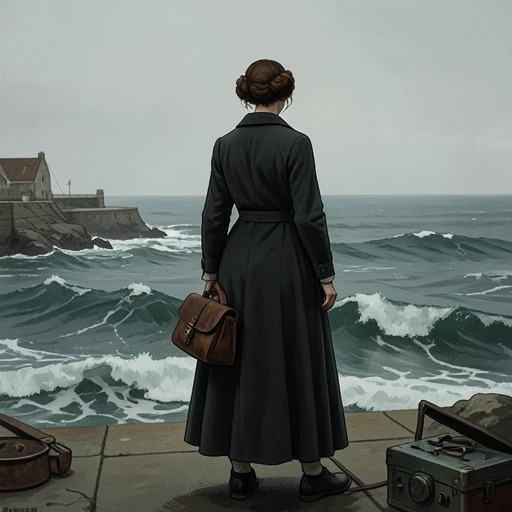
When Frank urges her to come, Eveline grips the iron railing with both hands. The narration figures the seas of the world as tumbling around her heart and Frank as drawing her toward them, where he would drown her. She cries out in anguish and refuses. In this moment, the expected movement toward a booked passage becomes a bodily arrest: her hands hold fast to the barrier while the boat waits beyond it.
Refusal and Unresolved Meaning
Frank rushes beyond the barrier and calls to Eveline to follow, continuing even as he is shouted at to go on. She turns her white face toward him, passive and compared to a helpless animal. Her eyes give him no sign of love, farewell, or recognition. The departure ends not in an explanation between the two but in a visible failure of response: Frank calls, while Eveline remains at the station and does not follow.
The promise’s consequence is therefore inseparable from the ending’s uncertainty. Eveline does not leave to begin the life she had imagined with Frank, but the narration does not say that she has calmly chosen domestic duty or that the remembered vow alone has kept her at home. Her prayer for direction, her physical terror, the childhood and family memories, and the returning music all remain part of the scene’s evidence. The text makes refusal unmistakable while withholding a single settled account of its cause.
As a remembered commitment, the promise links the story’s present crisis to the mother’s illness and the household’s history of sacrifice. Its return through the street organ gives the past an immediate presence; its collision with the booked passage makes departure feel both possible and perilous. The final image does not show Eveline carrying out an explicit decision to preserve the home, but it does show that she cannot cross the threshold into the future Frank offers. The vow matters less as a simple instruction than as one strand in a choice whose emotional and moral meaning remains open.