Father Flynn’s chalice
DublinersFather Flynn’s chalice is both a liturgical vessel and the material trace around which the account of Father James Flynn’s breakdown gathers. In death it rests idle on his breast; in Eliza’s recollection, its breaking marks the beginning of the change that led to his isolation and to his being discovered laughing softly in a dark confessional. The story never establishes exactly what happened to the chalice or what caused Father Flynn’s condition, and that uncertainty gives the object its force: a sacred thing appears at once as a sign of ritual, a damaged possession, and an unresolved explanation.
Appearance and Ritual Setting
When the narrator visits the house of mourning with his aunt, Father Flynn lies in his coffin, vested as for the altar. His large hands loosely retain the chalice, making the vessel the most conspicuous object in the dead priest’s grasp. The room’s candles, dusky golden light, and heavy smell of flowers frame the scene in the sensory language of mourning, while the chalice carries the priest’s public religious office into the private room of death.
The narrator first imagines that Father Flynn is smiling, then corrects the impression: the dead man is solemn and truculent. The contrast matters to the chalice’s presentation. It is not shown in use at an altar but resting on a motionless body, described as idle on his breast. Its familiar religious function is suspended; the object remains visible, but the ritual action that would make that function legible is absent.
The Breaking and Its Uncertain Account
After the visit, Eliza tells the aunt that it was the chalice Father Flynn broke and calls this the beginning of his trouble. She immediately qualifies the account: people said everything was all right because the vessel contained nothing, but they also said the boy was at fault. The narrative supplies no independent confirmation of the circumstances, and Eliza’s hesitant phrasing preserves competing versions rather than resolving them.
Her account makes the chalice’s break a turning point without specifying how it broke, what the boy did, or what the vessel’s emptiness meant. Its significance comes partly from that gap. A sacred vessel has been damaged, yet the reported reassurance that it contained nothing does not settle the matter; Eliza’s qualification, “But still....”, leaves the incident charged with unease. The chalice is therefore not simply evidence of a known offense. It is the focus of an explanation that cannot quite explain what followed.
From Damage to Isolation
Eliza connects the incident to a change in Father Flynn’s behavior: it affected his mind, after which he began to mope alone, speak to no one, and wander by himself. The chalice does not reappear as an object in these actions, but the remembered break structures the sequence. What had been held in the priest’s hands at his death becomes, in the sisters’ account, the point to which his solitude is traced.
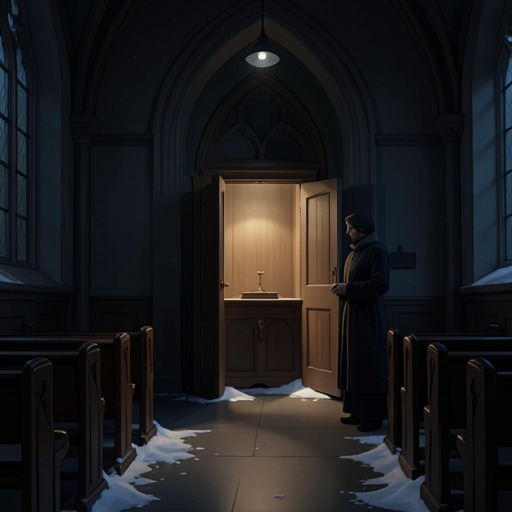
The consequence is narrated through a separate episode. One night Father Flynn was needed for a call, but no one could find him despite searching high and low. A clerk suggested looking in the chapel. The clerk, Father O’Rourke, and another priest brought a light and found Father Flynn sitting awake by himself in the dark in his confessional, laughing softly. The story does not say that the broken chalice caused this behavior in any demonstrable sense; rather, Eliza places the discovery in the chain of events that began with the break.
The Chalice as a Lingering Sign
The narrator listens as Eliza recounts the discovery, then recalls the visible contradiction between the episode she describes and the corpse he has just seen: Father Flynn lies still in his coffin, solemn and truculent, with the idle chalice on his breast. The remembered laughter and the death-room image meet around the same object, but the vessel supplies no final diagnosis. It links the priest’s ritual identity, the reported break, and the family’s effort to understand his decline without making those elements fully consistent.
The chalice thus shifts from a vessel associated with the altar to a broken object in a story of mental disturbance, and finally to a silent possession carried into death. Its physical presence is exact, while its meaning remains unsettled: the sisters repeat what others said, distinguish the disputed claims, and stop short of certainty. That tension lets the object serve as a material anchor for the episode while preserving the central ambiguity about what happened to Father Flynn and why.