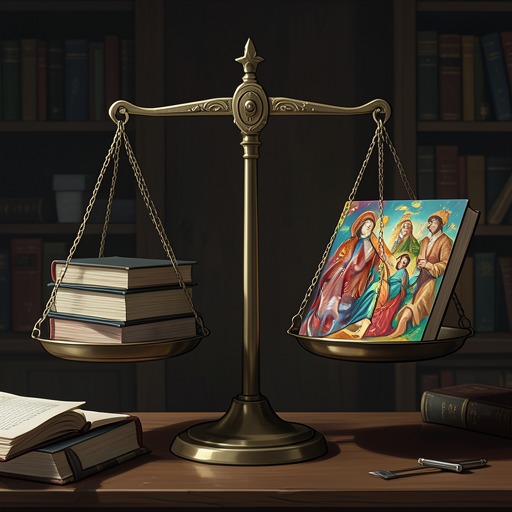
Segnius irritant animos demissa per aurem
Elements“Segnius irritant animos demissa per aurem” is a maxim attributed to Horace that gives visual perception priority over auditory reception. In Oliver Byrne’s discussion of mathematical teaching, the line is not an ornamental quotation but a concise statement of the pedagogical principle behind his coloured presentation of Euclid’s Elements: what the eye apprehends directly can impress the mind more powerfully and efficiently than what is communicated through hearing alone.
Wording and Meaning
The Latin expression appears in the form “Segnius irritant animos dcmijfa per aurem,” followed by the English rendering, “A feebler imprefs through the ear is made, Than what is by the faithful eye conveyed.” The spelling reflects the historical typography of the printed source, while the sense is clear: auditory communication has a weaker mental effect than visual evidence placed before a trustworthy observer. The maxim establishes a contrast between reception through the ear and apprehension through the eye, with the eye presented as the more dependable instrument for securing an impression.
The phrase belongs to a larger argument about how knowledge enters the mind. Byrne first observes that the initial communication of a science strongly influences a learner’s later attitude toward it. When instruction begins with forbidding formalities, repeated explanations, and demonstrations whose logical sequence is hidden by verbal complication, a subject capable of strengthening close reasoning can be reduced to a dry exercise of memory. Against that failure, the maxim supplies a compact defence of direct visual intelligibility.
Role in Coloured Geometry
Byrne uses the expression to justify a method in which colour carries part of the demonstrative burden. He argues that geometrical diagrams are not merely signs standing for something else, but materials of geometrical science: their parts display relative quantities through a reasoning process called demonstration. Traditional instruction had relied on words, letters, and black or uncoloured diagrams; Byrne instead adopts coloured symbols, signs, and diagrams because they make the reasoning more precise and the acquisition of knowledge more expeditious.
This application gives the maxim a specifically geometrical force. In an ordinary verbal demonstration, letters attached to points, lines, or other parts of a figure function as arbitrary names. In Byrne’s system, differently coloured parts are made to name themselves: their forms, corresponding through colour, represent them during the demonstration. The eye therefore does not merely receive an illustration after the reasoning has been stated. It encounters the relationships on which the reasoning depends, allowing the diagram to participate directly in the construction of understanding.
Pedagogical Consequences
The maxim also supports Byrne’s claim that visual instruction can shorten study and strengthen retention. He reports that, according to experiments conducted by the inventor and by others who adopted the method, the Elements of Euclid could be acquired in less than one third of the time usually employed, while memory of the material became considerably more permanent. The eye’s supposed advantage is thus presented not only as an aesthetic preference but as an observable educational consequence.
In this context, “Segnius irritant animos demissa per aurem” links sensory immediacy with intellectual economy. A learner spared endless verbal repetition can follow the succession of evidence more readily; a learner who sees distinctions embodied in colour is less dependent on memorising arbitrary labels. The maxim consequently becomes part of an argument for making geometry visible at the point where it is learned, rather than leaving the student to reconstruct its relations from language alone.
Rhetorical and Thematic Significance
The quotation gives classical authority to a modernizing programme of instruction. Byrne presents his method as one approved by scientific men in England, France, and the United States, yet the decisive support he invokes is an older poetic formulation by Horace. The juxtaposition suggests continuity rather than rupture: coloured geometry is innovative in its apparatus, but its central intuition is framed as an established observation about how the mind responds to representation.
The maxim’s structure also mirrors the contrast that organizes Byrne’s educational criticism. Conventional teaching is associated with auditory and verbal excess, with formalities that can conceal the reality of reasoning; coloured demonstration is associated with the faithful eye, direct apprehension, precision, speed, and durable memory. Its importance therefore extends beyond the literal superiority of sight over hearing. It states the book’s larger conviction that geometry should awaken curiosity and train the reasoning powers through perceptible relations, not degrade those powers into the passive recollection of words.