Battle of Farthen Dûr
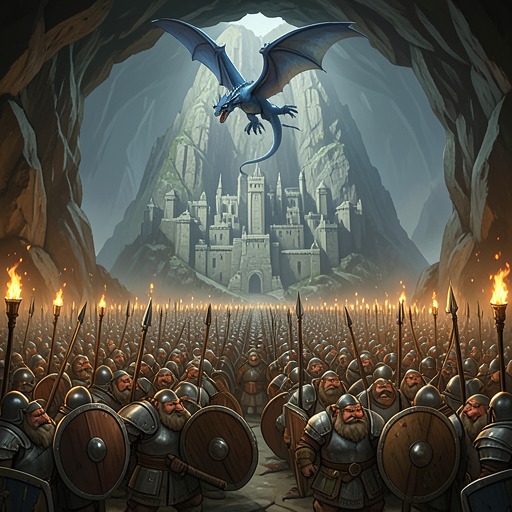
EragonThe Battle of Farthen Dûr is the great subterranean confrontation between the Urgals and the combined defenders of the Varden and the dwarves. Fought around the tunnels leading into Farthen Dûr beneath Tronjheim, it turns a concealed political refuge into a battlefield and places the survival of the resistance, the dwarven kingdom, Surda, and the elves on a single uncertain outcome. Its importance lies not only in its violence but in the way it forces Eragon, Saphira, Arya, Murtagh, Orik, Ajihad, and Hrothgar into a common struggle against an enemy whose numbers and command remain unclear.
Causes and Strategic Background
The battle begins with intelligence rather than an open declaration of war. A dwarf escapes from an abandoned tunnel under Tronjheim, bleeding and nearly incoherent, and reports that an army of Urgals is pursuing him. Ajihad gathers Eragon, Arya, Murtagh, Orik, and Jörmundur and explains that the attackers are not approaching across the surface: they are moving through the tunnels beneath the Beor Mountains. The discovery changes the defensive problem completely, because an enemy emerging inside the mountain could bypass ordinary fortifications and swarm directly into Tronjheim.
Ajihad identifies the likely source as Orthíad, an ancient dwarven settlement abandoned centuries earlier when Tronjheim was completed. Its age has allowed tunnels to collapse, apparently opening a route from the surface. Ajihad suspects that the Urgals have been using Ithrö Zhâda as a staging point and migrating through the mountains for the entire year. From there, they can travel wherever they wish within the Beor Mountains, giving them the power to destroy both the Varden and the dwarves.
The defenders do not know the Urgals’ exact numbers or whether Galbatorix’s troops are accompanying them. That uncertainty determines the battle’s political stakes. If the Empire has reinforced the Urgals, the defenders believe they have little chance; if the king has withheld his own soldiers to conceal his alliance with the Urgals, victory remains possible. Ajihad sends messengers to Surda and the elves, although neither can arrive in time to help. The warning is instead meant to ensure that those powers will not be caught entirely unprepared if Farthen Dûr falls.
Ajihad and Hrothgar settle on a containment strategy. The defenders will collapse the smaller and unnecessary tunnels, leaving three larger passages open so the Urgals can be channeled into Farthen Dûr instead of spreading through Tronjheim like locusts. Eragon is assigned to help the dwarves collapse tunnels outside the city, while Arya works with another group underground under Orik’s guidance. Women and children are evacuated into the surrounding valleys, with guides prepared to lead them toward Surda if the defense fails. Ajihad states the stakes without softening them: defeat will mean the downfall of the dwarves, the death of the Varden, and the eventual defeat of Surda and the elves.
Opening of the Assault
The battle opens after a scout reports that the Urgals are coming. The troops in the encampment stand ready with weapons drawn; Orik tests the space for his ax, Arya prepares an arrow, Murtagh mounts Tornac, and Eragon takes his place in Saphira’s saddle with Zar’roc in hand. The pause before contact stretches through several silent minutes, making the unseen army as threatening as the visible one. Then the Urgals’ shouts rise from the tunnel and break the stillness.
The first defensive weapon is pitch. Cauldrons are tilted into the tunnel, pouring the scalding liquid into the passage, and a torch turns it into a pillar of greasy flame. The Urgals howl and flail in the inferno, but the attack does not stop them. They tamp down the burning pitch and climb over the bodies of their own dead, forming a dense wall behind which the defenders’ arrows strike. The same fires burn at the other two open tunnels, confirming that the battle is occurring simultaneously at three entrances.
The Varden and dwarves combine ranged fire with prepared obstacles. Archers loose volleys from behind the palisade, while stakes impede the Urgals’ advance. The attackers cover themselves with shields and continue to pour out of the tunnels. When they finally reach the barriers, their vanguard is crushed against the posts, leaving blood and corpses across the defenses; yet the sheer pressure of the horde eventually carries the assault through.
Once the first lines break, the engagement changes from a controlled defense into direct melee. The men and dwarves rush forward with a roar, and Saphira dives into the confusion. She tears through Urgals with her jaws and talons and uses her tail as a mace, while Eragon protects her wings from the back of the saddle. He parries an Urgal chief’s hammer with Zar’roc. Nearby, Orik cuts through Urgal ranks with his ax, Murtagh fights from Tornac with furious force, and Arya moves through the combat with lethal precision.
Eragon and Saphira in the Battle
Saphira’s presence gives the defenders an aerial weapon and gives Eragon a mobility that ordinary soldiers cannot match. They attack isolated groups from above, striking before the Urgals can respond. In one assault, Eragon kills two archers while Saphira disembowels three others, after which she rises rapidly beyond bow range. They repeat the maneuver on another flank, using her speed, stealth, and the dim light to make their next target unpredictable.
The tactic is effective but limited. Eragon uses his bow while Saphira is airborne and soon exhausts his arrows, leaving magic as his only remaining reserve. He is reluctant to spend it before necessity demands, so the battle steadily narrows his available choices. The scene therefore turns his extraordinary abilities into resources that must be rationed rather than limitless advantages.
Flight also gives Eragon a broader view of the battle than any ground-bound fighter can possess. He sees three separate engagements, one beside each open tunnel. The dispersal of the Urgal forces prevents them from bringing the entire army to the surface at once, but the advantage is insufficient to stop their advance. The Varden and dwarves are slowly driven back toward Tronjheim while the Urgal numbers continue to grow.
The Urgals are organized under several clan standards, yet no single commander is visible. The clans do not appear to coordinate with one another, as though orders are reaching them from somewhere beyond the immediate battlefield. Eragon wishes he could identify the overall leader so that he and Saphira could kill him. Instead, he follows Ajihad’s instructions and relays his observations to the Twins. Their communication is brief and efficient, and they redirect him toward Hrothgar because the fight around the dwarf king is going badly.
Command, Coalition, and Historical Weight
The battle’s immediate command structure reflects the larger coalition it defends. Ajihad directs the Varden’s response and coordinates with Hrothgar, whose authority rests on the ancient dwarven realm beneath Farthen Dûr. When Eragon first meets Ajihad in Tronjheim, the Varden leader welcomes him and Saphira directly, presenting the hidden resistance as an organized political power rather than a scattered band of fugitives. Hrothgar, in turn, warns that the internal clans had demanded Eragon’s expulsion before he secured sanctuary for him, so the battle takes place against both an external army and unresolved internal divisions.
The conflict also inherits the burden of earlier history. Brom’s account describes the Dragon Riders as an ancient order formed to protect the land, whose power maintained peace while cities and towers rose from living stone. Their golden age ended when Galbatorix turned against the order, manipulated Morzan into treachery, learned forbidden magic, and helped bring about the Riders’ fall. The present battle is thus not an isolated clash: it is one consequence of the political and military world created by that collapse.
That history gives Eragon’s participation a symbolic dimension. Zar’roc, the red Rider’s sword presented to him by Brom, is a weapon from the vanished order whose blade is eternally sharp and never stains. Eragon carries it into a war fought by the remnants of peoples once allied with the Riders. The sword’s beauty and inherited power contrast with the crude physicality of the battlefield, linking an older age of guardianship to the uncertain resistance of the present.
The wider geography reinforces the same pattern of ruin and survival. Vroengard, the ancestral home of the Riders, is remembered as a once-glorious island reduced to a looted, empty shell haunted by strange beasts, with the abandoned city of Dorú Areaba at its center. Farthen Dûr stands in a different condition: not a dead relic but a living refuge whose survival still matters. The battle tests whether a hidden remnant can remain a political future rather than become another abandoned monument.
Consequences and Narrative Significance
The battle converts fear of the Empire and its allies into immediate physical experience. Earlier rumors claim that the Varden have formed a pact with the Urgals and are massing an army, while the Varden are known more generally as rebels who raid the Empire and shelter fugitives and enemies of Galbatorix. At Farthen Dûr, the political question becomes unavoidable: the resistance must prove that it can withstand an army entering through the earth itself, even while its enemies’ alliances remain partly concealed.
For Eragon, the battle is an ordeal that exceeds the scale of his previous fights. He knows he can face a few opponents with Zar’roc and magic, but the prospect of a large conflict fills him with dread because anything can happen. The battle confirms that individual skill cannot control a mass engagement. His value lies in the combination of mobility, magical potential, observation, communication, and cooperation with Saphira and the allied commanders.
The encounter also produces a decisive moral and narrative reversal. The defenders begin with preparation, fire, palisades, stakes, and the tactical advantage of forcing the Urgals through three passages. They nonetheless lose ground as the attackers’ numbers increase. The battlefield therefore refuses the simple heroic pattern in which courage immediately restores order. Victory, if it comes, must be understood against overwhelming pressure, incomplete intelligence, and the possibility that the enemy is being directed by a hidden power.
After Eragon has helped drive the conflict toward its larger confrontation, an unseen figure reaches him through the turmoil of the battle. The voice identifies itself as Osthato Chetowä, the Mourning Sage, and Togira Ikonoka, the Cripple Who Is Whole. It tells Eragon to seek it in Ellesméra, where it promises answers and safety, and declares that he has rid the land of a great evil and accomplished a deed no one else could. This revelation expands the battle’s meaning beyond the immediate defense of Farthen Dûr: Eragon’s actions have entered the history of the resistance and summon him toward the next stage of his training and destiny.
The battle’s deepest significance lies in its fusion of military crisis, political legitimacy, and inherited myth. Galbatorix’s Empire relies on force and propaganda; the Varden must turn sanctuary into collective defense; the dwarves must defend both their ancient home and their right to determine who may enter it. In the middle stands Eragon, carrying a Rider’s sword and fighting beside a dragon whose existence revives a broken tradition. Farthen Dûr is therefore both a battlefield and a threshold: the place where the old order’s memory becomes an active weapon against the power that destroyed it.