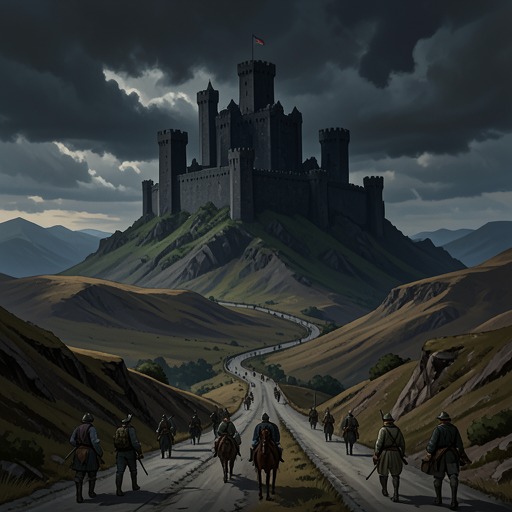
Yazuac massacre
EragonThe Yazuac massacre is the slaughter of the inhabitants of Yazuac by a large Urgal force, an event that confronts Eragon with indiscriminate violence and immediately changes his understanding of the world beyond Carvahall. What begins as a cautious approach to a silent settlement becomes a scene of mass death, an ambush, and Eragon’s first deliberate magical victory. The massacre therefore joins political history to personal initiation: the violence that has previously been discussed as rumor or legend becomes a physical reality before Eragon’s eyes.
Approach to the Ruined Village
Eragon and Brom approach Yazuac expecting food and drink, having seen smoke rising from a dozen chimneys. Instead, they find no one in the streets and an abnormal silence surrounding the small houses. Their caution grows from the absence of ordinary signs of habitation, especially the lack of barking dogs. Brom identifies the main entrance as the likeliest place for an ambush and directs them around the side, where they enter slowly with Brom’s sword drawn and Eragon’s bow ready. The village itself reveals that the silence is not peaceful. A fox darts through empty streets lined with dark, foreboding houses. Windows are shattered, doors hang from broken hinges, and the horses react nervously. Eragon’s tingling palm, already associated with the strange power awakening in him, adds a bodily warning to the architectural evidence of destruction. The setting withholds the dead until Eragon and Brom reach the center, making the massacre emerge from a sequence of small abnormalities rather than from immediate spectacle.
The Massacre and Its Victims
In the center of Yazuac stands a mountain of bodies. The corpses are stiff and grimacing, their clothes soaked in blood, while the churned ground is stained around them. The dead include men who fell over the women they tried to protect, mothers still clasping their children, lovers shielding one another, and victims of every age. Black arrows protrude from the bodies, denying the scene any sense of selective combat or honorable contest. The most horrifying image is a barbed spear driven through the white body of a baby at the peak of the pile. The arrangement of the dead makes the massacre a record of failed protection as much as a display of slaughter. People are shown dying in relation to one another—men over women, mothers around children, lovers in an embrace—so that the destruction of the village becomes the destruction of families and mutual obligations. Eragon’s tears blur his sight; he wonders how life can end so easily, then succumbs to nausea and vomits over Cadoc’s side. His physical reaction marks the limits of heroic distance. He cannot yet interpret the massacre as strategy or history because he is still trying to endure its immediate presence. Brom supplies the first explanation without reducing the horror. He says that those responsible are people who love the pain and suffering of others, calling them evil and insisting that the victims must be pitied and honored. His judgment distinguishes moral responsibility from mere military description, while his later inspection supplies a more precise account: the Ra’zac passed through the area, but the massacre was not their work. The spear is Urgal-made, and the evidence suggests that as many as a hundred Urgals had gathered there. The distinction matters because Yazuac is not simply an unexplained atrocity; it is evidence of a larger and unusually concentrated Urgal movement.
The Ambush and Eragon’s First Magic
Brom’s discovery that Urgals remain in the village turns mourning into immediate survival. He orders Eragon to ride, and both men flee through the streets. Before they reach the edge of Yazuac, Eragon senses movement and is struck from his saddle by a huge Urgal fist. The attacker is broad as a doorway, gray-skinned, yellow-eyed, and armed with a short sword, roundshield, iron cap, and ram’s horns. A second Urgal carrying an ax blocks Brom, forcing the companions apart while Brom commands Eragon to run. Eragon deliberately draws the Urgals away from Brom. He slips into a narrow passage between two houses, only to discover that it ends blindly and that the Urgals have sealed the entrance. Trapped, he sees again the murdered villagers and the baby impaled on the spear. The massacre becomes the emotional and imaginative pressure behind his response: his rising power is not presented as detached technique, but as his whole being rebelling against death and against the fact that he, too, will cease to exist. At the decisive moment, fear disappears. Eragon raises his bow, aligns the arrow as he has done hundreds of times, and releases the gathered force with the word “Brisingr!” The arrow travels with a crackling blue glow, strikes the leading Urgal in the forehead, and produces an explosion whose shock wave kills the second attacker as well. The force passes through Eragon without harming him, but the victory is not costless. His gedwëy ignasia glows like white-hot metal, then fades, and exhaustion leaves him weak, as though he had not eaten for days. Yazuac is consequently both a massacre and an initiation: Eragon learns that he can kill through Magic, but also that power consumes the body that uses it.
Consequences and Historical Meaning
The immediate consequence is Eragon’s survival and the continuation of his journey with Brom, but the psychological consequence is more lasting. Before Yazuac, the conflict involving the Empire, the Ra’zac, and the Urgals can still seem remote, part of the dangerous world Brom understands and Eragon is only beginning to enter. At Yazuac, that distance collapses. The murdered villagers have no role in a heroic legend and no chance to defend themselves; their deaths force Eragon to recognize that ordinary people bear the consequences of forces operating far beyond their control. The massacre also foreshadows the wider history Brom later recounts. In his public storytelling, Brom describes the Dragon Riders as guardians whose unmatched strength once protected the land, while their fall allows the old golden order to become catastrophe. He explains that Galbatorix and the Thirteen Forsworn destroyed the Riders through betrayal, forbidden knowledge, and successive killings. Yazuac gives that history a present-tense image: a community that should have been protected instead becomes a sign of a world where organized power has turned against the vulnerable. The event’s meaning is sharpened by the book’s competing forms of historical preservation. Brom’s account of the Riders is transmitted through performance, with minstrels acting out stories and an older Brom turning communal entertainment into remembrance. He later explains that the Riders’ history is too vast for a complete telling and must be reduced to a manageable length. Written records offer another form of memory in The Domia abr Wyrda, a rare history of Alagaësia condemned by the Empire as blasphemy, while Eragon initially cannot read and is excluded from that archive. The dead of Yazuac possess neither the authority of a book nor the protection of an institution; their bodies become the first record Eragon is forced to interpret. Brom’s testimony and Eragon’s memory preserve what the killers attempted to make into anonymous destruction.
Narrative Significance
Yazuac is the first major value reversal in Eragon’s outward journey. The expectation of hospitality becomes silence, the village becomes a grave, and the need to honor the dead becomes a fight for survival. The sequence moves from anticipation, through delayed revelation, into visible horror and then violent action, making the massacre function as both a scene of terror and a threshold crossing. Eragon does not return to ordinary life after witnessing it: he has seen the political crisis in its most defenseless form and has crossed from inherited stories into participation. The massacre also establishes a contrast that will recur in Eragon’s later moral conflicts. During the rescue from the slavers, Eragon objects when Murtagh executes the defenseless Torkenbrand, arguing that violence without necessity destroys empathy. Murtagh answers that survival requires protecting oneself and what one cherishes regardless of the cost. Yazuac stands behind this disagreement as its most terrible background: Eragon’s first killing is made in immediate defense against armed attackers, after he has witnessed the murder of noncombatants, whereas Torkenbrand’s death becomes an argument about execution and alternatives. The distinction does not make violence simple, but it gives Eragon a standard by which to judge the conduct of allies and enemies. Later battles expand the scale of the same conflict. Eragon fights beside Hrothgar and the dwarves while Saphira faces the Urgals, and he eventually believes that the Varden and dwarves have been destroyed when Durza wounds him. Against that larger military landscape, Yazuac remains intimate and formative: a single village, a mountain of bodies, a barbed spear, and two Urgals in a dead-end passage. Its decisive legacy is that Eragon’s heroism begins not with triumphal glory but with grief, revulsion, and the desperate refusal to accept death as an ordinary fact.