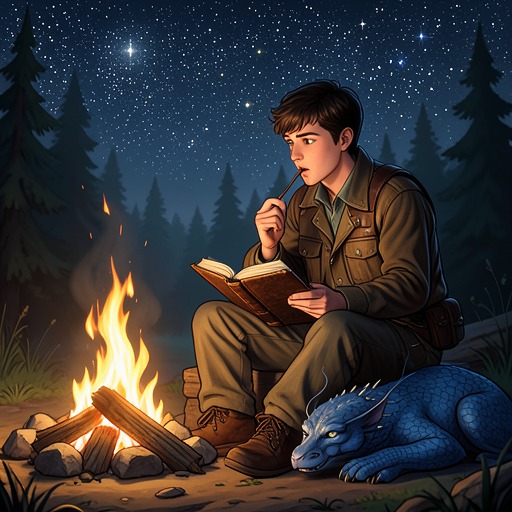
Prohibition on resurrection
EragonThe Prohibition on resurrection is the rule that forbids Magic from restoring the dead to life. Brom presents it to Eragon as one of the clearest boundaries of the Dragon Riders’ power: injury may sometimes be repaired, but death lies beyond the reach of safe healing. The rule makes mortality a genuine limit within a magical world otherwise capable of extraordinary feats, and it shapes the ethical difference between healing the living and attempting to reclaim the dead.
Definition and Magical Boundary
The rule is introduced when Eragon asks whether the same Magic that might repair Brom’s injured arm could bring someone back from death. Brom answers that resurrection is one of the projects that would kill the practitioner. He explains that the dead lie beyond an abyss where Magic has no meaningful purchase; anyone who reaches into it risks losing both physical strength and the soul’s integrity. Wizards, sorcerers, and Dragon Riders have all failed at that threshold and died, making the prohibition an accumulated warning rather than a mere matter of incomplete knowledge.
Brom therefore distinguishes between the scale of a wound and the condition of death. Cuts, bruises, and perhaps broken bones may be treated, but even successful healing consumes as much energy as natural recovery would require. Resurrection is categorically different: it does not simply demand more power, but crosses into a realm where power cannot accomplish its intended purpose. The danger lies not only in exhaustion but in spiritual dissolution, so ignorance or ambition can turn an attempted cure into the practitioner’s own death.
The Rule Against Overreaching
The prohibition belongs to a broader discipline of magical restraint. Brom repeatedly insists that Eragon must understand what he is doing before attempting a difficult spell, because a magician who reaches beyond his capacity may die. His warning about resurrection gives that lesson its most severe form. Magic is not defined by whatever its user desires; it is governed by energy, knowledge, and limits that remain in force even for the Riders, whose powers once helped protect Alagaësia and whose strength was legendary.
This restriction also separates benevolent power from unchecked mastery. The Dragon Riders were remembered as guardians whose abilities were used for good, yet their history shows that power without moral or practical restraint can become destructive. Galbatorix’s rise began within the same Rider tradition that once protected the land, and his later use of forbidden knowledge demonstrates the danger of treating inherited power as permission to violate every boundary. Against that history, the prohibition on resurrection functions as a limit that even exceptional individuals must acknowledge.
Death, Violence, and Ethical Consequences
The rule gives particular weight to the many deaths witnessed or caused during the story. At Yazuac, Eragon sees an entire community slaughtered: men, women, children, mothers, and lovers lie among the bodies, with even a baby impaled on a spear. His horror is intensified by the knowledge that no act of healing can undo such devastation. The scene is not a temporary medical crisis awaiting a sufficiently skilled magician; it is an irreversible human loss.
The same finality informs Eragon’s dispute with Murtagh after Murtagh beheads the defenseless Torkenbrand. Eragon regards the killing as an unnecessary execution, while Murtagh argues that survival requires protecting oneself and what one values at any cost. The argument does not challenge the prohibition directly, but it exposes the moral world created by the rule: once a person is killed, the decision cannot be repaired by Magic. Violence therefore carries a permanent consequence, and the difference between combat, execution, and mercy cannot be erased afterward.
On the battlefield beneath Farthen Dûr, Eragon kills Urgals and Kull while defending Saphira and the dwarves. The violence is presented as part of an active battle rather than an attempt to restore anyone afterward. Hrothgar’s defense of the dwarves and Eragon’s own desperate fighting show how the living may be protected, but they do not weaken the boundary around the dead. Even amid heroic rescue and overwhelming force, the rule preserves a hard division between saving a life before its end and reversing death once it has occurred.
Narrative and Thematic Significance
The Prohibition on resurrection prevents Magic from cancelling consequence. The story contains Dragon Riders, immortal beings, enchanted weapons, dragons, spirits, and powers capable of altering bodies and minds, yet death remains the boundary that such wonders cannot reliably cross. This contrast keeps the world’s legendary history from becoming a promise of unlimited recovery: the Riders’ golden age has ended, their cities have been looted, and the dead of earlier wars remain part of history rather than material for magical restoration.
The rule also deepens the meaning of memory and inheritance. Brom’s account of the Dragon Riders preserves a lost age through narration rather than physical return; Vroengard survives as the Riders’ abandoned ancestral home, while Dorú Areaba stands as a ruined reminder of what has vanished. The past can be remembered, taught, and carried forward by figures such as Eragon, but it cannot simply be resurrected. That distinction makes succession more important than restoration: Eragon must become responsible for what the Riders represented without literally bringing their fallen order back to life.
Finally, the rule prepares the reader to understand survival as transformation rather than reversal. After Durza wounds Eragon and the battle seems lost, the decisive intervention comes from Saphira and Arya, whose actions defeat the immediate threat; Eragon is not restored from death because he has not crossed that boundary. A later voice identifies itself as Osthato Chetowä, the Mourning Sage, and Togira Ikonoka, the Cripple Who Is Whole, and directs Eragon toward Ellesméra for further answers. The promise is instruction and change, not resurrection. In this world, the future must be made by the living, while the dead remain a source of grief, warning, and memory.