Rider selection rule
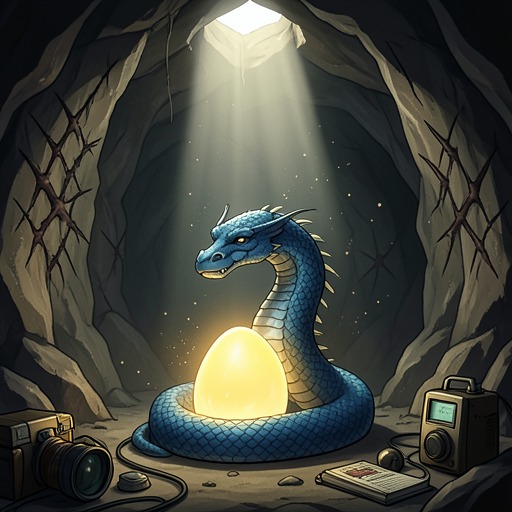
EragonThe Rider selection rule defines how a dragon egg chooses the human or elf destined to become its Rider. A dragon inside an egg is already ready to hatch, yet may remain dormant for years until the proper circumstances arise. In the Rider tradition, those circumstances are not determined by ownership, wealth, or political appointment: the infant dragon waits until the person meant to bond with it enters its presence, and the egg then hatches only if the dragon accepts that individual. The rule therefore turns hatching into an act of recognition, making the Rider’s authority dependent on a relationship established by the dragon itself.
Definition and Operation
The rule begins with the unusual condition of the dragon egg. When a dragon lays an egg, the infant within is ready to hatch, but it can delay hatching for years. In the wild, the timing was generally connected to the availability of food. After dragons formed an alliance with the elves, however, the eggs acquired a different institutional role: usually no more than one or two were given to the Riders each year, and prospective Riders would line up to touch them, hoping that one might choose them.
The decisive condition is the presence of the destined person. The dragon inside the egg somehow senses its future Rider, although the means of that perception remains unknown. Hatching is therefore neither a mechanical response to age nor a reward granted by the Rider order. It is a selection made by the unborn dragon. Brom makes the consequence explicit when Eragon asks whether Saphira might have failed to hatch for him: she might indeed have remained within the egg if she had not liked him.
Eragon and Saphira
The rule becomes personal when Eragon discovers the egg and Saphira eventually hatches. Eragon initially treats the dragon as an animal that requires shelter and instruction. After building a crude hut high in a rowan tree, he uses his mind to press one command upon her: to stay there. The contact reveals an immense, unsettling consciousness, and the tentative acknowledgment he receives suggests that Saphira understands more than he expects, even though he retreats from the link believing that she may be only an animal.
That encounter shows the bond developing before Eragon fully understands its meaning. He does not simply train a creature captured from the wild. His mental contact reaches across a boundary between two minds, and Saphira’s response is neither wholly obedient nor wholly inert. She watches him as he leaves, her head protruding from the shelter, while he remains uncertain about what she has understood. The selection rule gives this small exchange a larger significance: the dragon’s acceptance is the foundation of the relationship, even before Eragon has the knowledge or language to interpret it.
When Brom explains the rule, Eragon recognizes the honor implied by Saphira’s choice. Of all the people in Alagaësia, she selected him. His response is not merely pride in possessing a rare creature; he wonders how long she may have waited in darkness inside the egg. The image recasts the earlier discovery as a long-delayed meeting between two destined partners. Saphira’s hatching is consequently both a private beginning and the restoration of a bond that the fall of the Riders had interrupted.
Historical and Institutional Context
The selection rule is inseparable from the history of the Dragon Riders. Brom describes the Riders as an ancient order formed to protect and guard the land. For thousands of years they used their extraordinary strength and powers for good, helped maintain peace, and presided over a golden age in which cities and towers were built from living stone, the elves were allies, the dwarves were friends, and human prosperity expanded. The rule explains how that order could continually acquire new members without reducing dragons to ordinary property: each new Rider arose from a dragon’s own choice.
The same history also shows what happens when the Rider bond is placed within a political and military struggle. Galbatorix was accepted by the Riders after testing revealed great power in him, but the death of his first dragon drove him into madness and resentment. When the council refused his demand for another dragon, he came to blame the Riders for his loss. He later recruited Morzan, entered the Riders’ citadel through a gate Morzan left unbolted, and stole a dragon hatchling. With forbidden instruction and dark magic, he eventually possessed the black dragon Shruikan and used that power against the Riders.
Galbatorix’s history creates a sharp contrast with the ordinary operation of the rule. Saphira’s egg waits for the person it accepts; Galbatorix, by contrast, acquires a hatchling through theft after being denied the relationship he demanded. His seizure of Shruikan turns the Rider ideal inside out. Where the rule implies mutual recognition and a bond that cannot be ordered into existence by institutional authority, Galbatorix seeks power through force, appropriation, and the exploitation of a dragon outside the normal pattern of selection.
Bond, Mind, and Consequences
The rule also clarifies why the first mental contact between Eragon and Saphira is so important. Eragon reaches into her consciousness and experiences it as vast and open, a sensation that presses upon him with almost physical weight. The bond is not represented as a simple command channel. It exposes the difference between the human mind and the dragon’s presence, while allowing an exchange in which Saphira can acknowledge his intention. Eragon’s withdrawal reflects both fear and inexperience, but the connection itself marks the beginning of his transformation into a Rider.
Because the dragon chooses, the rule places a limit on human ambition. Eragon cannot make himself a Rider merely by wanting the title, finding an egg, or mastering a weapon. His possession of Zar’roc, the red Rider’s sword that Brom gives him, confirms the cultural and martial inheritance associated with the order, but the sword alone does not confer the identity. The decisive fact is that Saphira hatches for him and establishes the bond. The weapon is a sign of the role; the dragon’s choice is its source.
The consequences extend beyond Eragon’s private life. The return of a bonded dragon and Rider threatens the political order established by Galbatorix, whose rule is already contested by the Varden. The Varden are a rebel group that has raided the Empire for years, accepts fugitives and enemies of Galbatorix, and has survived repeated efforts to destroy it. Later, when the Urgals threaten Farthen Dûr, Ajihad declares that the Varden must hold the city because defeat would lead to the death of the Varden and the eventual defeat of Surda and the elves. Against that background, Eragon and Saphira’s bond is not merely a personal wonder: it restores a form of power capable of altering the balance between rebellion and empire.
Narrative Significance
The Rider selection rule combines destiny with consent. Saphira is destined to meet Eragon, yet the bond still depends on whether she likes and accepts him. That tension prevents destiny from becoming simple compulsion. Eragon is singled out, but he is not entitled to the dragon; he is chosen by her. The rule thus makes the emergence of a hero relational rather than solitary, binding Eragon’s growth to an intelligence that can resist, respond, and judge.
It also converts ancient history into present action. Brom’s account of the Riders’ golden age, Galbatorix’s betrayal, the fall of the order, and the elves’ retreat gives Saphira’s hatching the shape of a historical recurrence without making it a mere repetition. The old system collapsed through internal corruption, while its possible renewal begins with a boy and a dragon whose connection is founded on acceptance rather than conquest. Later guidance identifies Eragon as greater than he knows and directs him to seek the hidden sage Togira Ikonoka in Ellesméra, reinforcing the sense that his bond has opened a path larger than his original intentions.
The rule’s deepest importance lies in its refusal to separate power from relationship. The Dragon Riders’ strength, longevity, weapons, and political influence emerge from an alliance between species, not from human control over dragons. Saphira’s delayed hatching, tentative first response, and eventual recognition of Eragon establish that principle at the story’s foundation. Against the stolen dragon, the fallen order, and the Empire’s coercive power, the Rider selection rule offers a different model of authority: power becomes legitimate when it is freely joined to another living will.