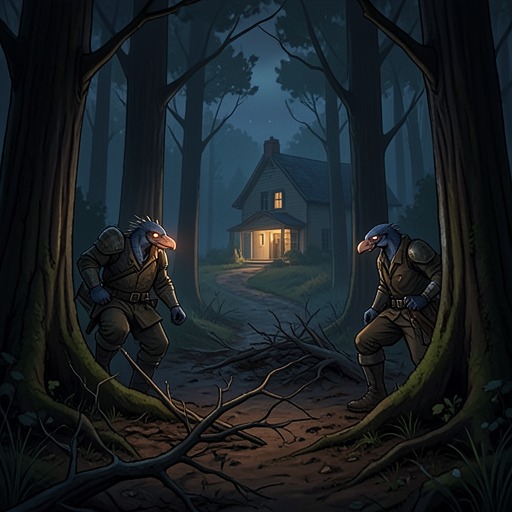
Ra'zac capture Eragon and Brom
EragonRa’zac capture Eragon and Brom is the turning point in which the pursuit of the Ra’zac briefly becomes their victory: Eragon is drugged into helplessness, Brom is bound beside him, and Saphira is physically restrained as the captors prepare to take their prisoners to their master. The rescue that follows restores freedom only partially. Brom survives the immediate attack long enough to protect Eragon, but the dagger meant for the captive strikes the mentor instead, transforming an attempted execution into the wound that leads to Brom’s death.
Causes and Background
The capture follows the travelers’ movement through a landscape already marked by systematic violence. Earlier, Eragon and his companions discover Yazuac reduced to a mountain of bodies: men, women, children, and lovers lie together beneath black arrows, with even a baby impaled upon a barbed spear. That image establishes the scale and character of the threat confronting them. The Ra’zac are not merely pursuing Eragon as an individual; they belong to the machinery of Galbatorix’s Empire, the same political order whose history includes the destruction of the Dragon Riders and the subjugation of the land.
Brom’s earlier account of the Riders’ fall gives the capture a deeper historical frame. The Riders had been formed to protect the land, and for thousands of years their power helped produce peace and prosperity. Their collapse began when Galbatorix, driven by grief, madness, resentment, and the desire for revenge, manipulated Morzan, stole the dragon hatchling that became Shruikan, and gathered the Thirteen Forsworn around him. The Ra’zac therefore appear as agents of a much older catastrophe: the immediate captors embody the surviving reach of a regime born from the corruption of guardianship into domination.
The travelers also carry an object that makes Eragon especially valuable. Brom has given him Zar’roc, a former Rider’s blade with a wine-red sheath, a gold pommel surrounding a ruby, silver wire on the hilt, and a black symbol repeated on the sheath and blade. The sword is eternally sharp and never stains, and its appearance marks Eragon as connected to the vanished Rider tradition. When the Ra’zac discover the symbol on Zar’roc, their interest changes from casual looting to recognition. They tell Eragon that he will serve their master well, implying that both his identity and the sword have strategic importance.
The Capture at Camp
The seizure begins with concealment and sudden bodily collapse. Eragon notices a small patch of color in the darkness and assumes that it may have been a bird. At that instant pain erupts in the back of his head, Saphira roars, and he falls unconscious. The apparent uncertainty of the first sighting gives way to an unmistakable assault: when Eragon awakens, a throbbing headache accompanies every pulse of blood, a bright lantern blinds him, and his hands are tied behind his back.
His first realization is that Brom is bound as well. The thought that the captors would not tie up a dead man briefly reassures him that Brom is alive, but the reassurance only clarifies the danger. A pair of black boots enters his vision, and he looks directly into the cowled face of a Ra’zac. The drug has impaired more than his strength. Eragon reaches for magic and tries to remember the word that could kill the creature, but the word slips beyond his grasp each time. The capture thus attacks his defining advantage at its source: he remains conscious enough to understand the threat but cannot reliably command the power that might resist it.
The Ra’zac have also neutralized Saphira. One of them fits a muzzle over her head while the other watches her wings pinioned to her sides by black chains and sees shackles on her legs. Eragon attempts to contact her and feels nothing. The bond that normally makes them a coordinated pair has been interrupted, not by distance but by force and intimidation. The Ra’zac explain that Saphira became cooperative after they threatened to kill Eragon, turning the connection between dragon and Rider into a weapon against both of them.
The captors search Eragon’s bags and remove Zar’roc, mocking its beauty and suggesting that their master might permit Eragon to polish it if he behaves. Their contempt is part of the domination: the sword that signifies the Rider’s inheritance is treated as confiscated property, while its owner is reduced to a disposable servant. When the Ra’zac recognize the black symbol, however, their mockery gives way to excited attention. The weapon confirms that Eragon is more consequential than their insults suggest, even as they insist that his life is expendable.
The Threat to Brom and the Reversal
The immediate value at stake is life, and the scene reverses it through a sequence of failed expectations. The Ra’zac first consider giving Brom more of the drug, then discuss killing him because he has caused them trouble. They drag him to the center of the camp and shove him to his knees. Eragon strains against ropes too strong to break while a Ra’zac prods him with a sword, making his physical freedom and his ability to intervene equally impossible.
The execution is interrupted at the last moment. One Ra’zac yanks Brom’s head back and sweeps a dagger toward his exposed throat; then a low buzz is followed by a howl as an arrow strikes the attacker’s shoulder. A second arrow forces the other Ra’zac to drop aside. The unseen attackers do not appear as a named rescue party in the scene. Their arrows instead create confusion, first from one direction and then from the opposite side, piercing the Ra’zac’s cloaks and burying one arrow in an arm. The captors’ control of the camp collapses into defensive flight.
Brom staggers upright while arrows continue to hiss through the darkness. The smaller Ra’zac flees toward the road and kicks Eragon viciously in the side as he passes. The other hesitates, retrieves the fallen dagger, and follows. In that retreat the Ra’zac abandon the immediate attempt to kill Brom, but they do not relinquish their violence. One throws the dagger at Eragon, converting the escape into a final attack on the incapacitated prisoner.
Brom’s response is immediate and physical rather than strategic. A strange light burns in his eyes, and he throws himself in front of Eragon with his mouth open in a soundless snarl. The dagger strikes him with a soft thump, and he falls heavily onto his shoulder, his head lolling limp. Eragon screams, still doubled over and unable to act. The scene’s reversal is therefore incomplete: the captors are driven away and the prisoners are no longer under their direct control, but the person who has protected Eragon throughout the journey has been mortally injured while protecting him again.
Consequences and Aftermath
The capture exposes the vulnerability of Eragon’s new identity. He has magic, a Rider’s sword, and a mental bond with a dragon, yet a drug, ropes, a muzzle, and chains reduce these powers to inaccessible potential. Saphira’s strength cannot be brought to bear while she is restrained, and Eragon’s knowledge of a lethal spell is useless when the drug prevents him from recalling its word. The scene makes the cost of incomplete mastery concrete: power exists, but control and freedom determine whether it can matter.
The event also turns Brom’s role from mentor into sacrifice. During the capture, Eragon’s first concern is to free himself and prevent Brom’s execution; during the rescue, Brom places his own body between Eragon and the dagger. His action preserves Eragon’s life but transfers the violence of the Ra’zac’s attack onto himself. The capture therefore does not end when the prisoners escape the camp. Its decisive consequence is the beginning of Brom’s final decline and the emotional rupture caused by losing the guide who carried knowledge of the Riders, Galbatorix, the elves, and the wider history of Alagaësia.
The event’s later meaning is sharpened by the contrast between Eragon’s moral instincts and the harsher survival logic he encounters after Brom’s injury. When Murtagh later kills the defenseless Torkenbrand rather than leaving him behind, Eragon condemns the act as wanton violence, while Murtagh insists that survival and the protection of what one cherishes justify lethal action. Brom’s intervention at the camp belongs to a different moral register: he does not kill an incapacitated enemy or seek advantage; he accepts the blow intended for someone under his protection. The capture thus becomes an early measure of the difference between violence for domination, violence for survival, and self-sacrifice for another’s life.
Narrative Significance
As a plot structure, the episode combines pursuit, captivity, rescue, and sacrifice. Its first movement changes the travelers’ condition from movement to enforced stillness; its middle movement strips Eragon and Saphira of their usual means of resistance; its final movement changes a possible rescue into irreversible loss. The unseen arrows supply the peripeteia, but Brom’s decision supplies the event’s tragic recognition: Eragon learns, through the wound rather than through explanation, that his survival can demand an unbearable price from the person who has protected him.
The capture also echoes the larger history Brom has narrated. The Dragon Riders once guarded a flourishing world, but their power was corrupted by betrayal from within. In the camp, the Rider tradition survives in miniature through Eragon, Zar’roc, and Brom, yet all three are rendered vulnerable by forces operating beyond their control. The sword is taken, the dragon is bound, and the mentor falls. Against that pattern of defeat, the rescue remains a fragile continuation rather than a victory. Eragon lives, but the old order cannot simply be restored; it must be carried forward through loss, memory, and the consequences of choices made under pressure.