Saphira's hatching and bond with Eragon
EragonSaphira's hatching and bond with Eragon is the decisive threshold between Eragon's ordinary life and the dangerous history of the Dragon Riders. The object he has treated as a troublesome stone breaks open in the moonlight, revealing a blue dragon; when Eragon touches her, a violent current passes between them and opens a channel of thought. The encounter gives physical form to an ancient inheritance and places both dragon and human under the threat of Galbatorix’s Empire.
The Egg and the Hatching
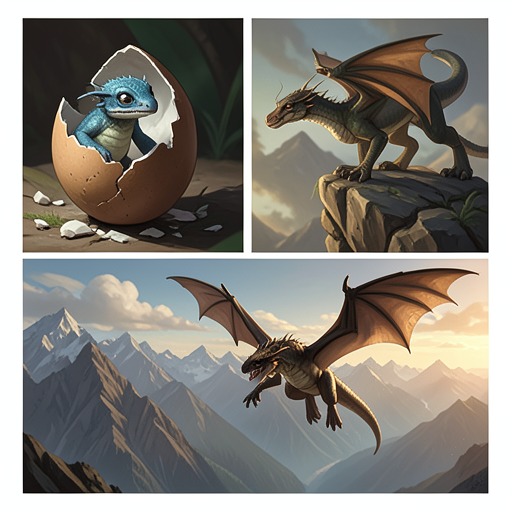
The event begins with the egg’s unexplained agitation. After disturbing Eragon’s sleep with squeaks, the blue object rocks rapidly on its shelf, knocks against the wall, and finally rolls onto the floor. Cracks spread across its surface until a piece at the top rises and falls away. A small dark head emerges, followed by an awkwardly angled body, and the creature skitters into the moonlight. Eragon first sees only an unfamiliar animal, but the membrane-covered form resolves into a dragon.
The hatchling is no longer than Eragon’s forearm, yet its appearance already combines fragility with inherited majesty. Its scales are deep sapphire blue, its wings are disproportionately long and ribbed with thin bones, and white fangs and serrated claws give its small body a dangerous edge. Spikes run from the base of its head to the tip of its tail. It explores the room clumsily, bumps into furniture, climbs onto Eragon’s bed, and searches for food with the helpless cries of a young creature. Its behavior makes the dragon seem dependent, but its eyes and bodily features announce a species associated with power, legend, and political danger.
The First Contact
Eragon’s first touch converts curiosity into ordeal. When he tentatively places his right hand on the hatchling’s flank, icy energy surges into his hand and races up his arm like liquid fire. Pain seizes his entire body; his limbs become immobile, his hand turns numb, and a diffused white oval forms in the center of his palm. The mark is not merely an injury. It is the visible sign of a transformation that Eragon does not yet understand.
The physical shock is followed by a mental opening. Something brushes against Eragon’s consciousness, then becomes a tendril of thought carrying the dragon’s growing curiosity. The protective boundary around his mind seems to fall away, and Eragon fears that he might lose his bodily self and drift into the ether. He withdraws, causing the new sense to vanish, but later contact is gentler. The dragon nuzzles him while he touches her head and wing membranes, and the connection returns with a different emotional force: an overpowering hunger. The bond therefore begins not as effortless communion but as a negotiation between fear, pain, curiosity, and need.
The hatchling’s immediate dependence draws Eragon into practical care. He feeds her meat while keeping his fingers out of reach, watches her consume an entire handful, and carries her back to the bed after she curls against his chest. She emits a puff of dark smoke and later hums in contentment, wrapping her tail around the bedpost. These small acts establish a reciprocal relation before either character can explain it: Eragon supplies food and protection, while the dragon brings companionship, wonder, and access to a consciousness beyond ordinary human experience.
Choice and Consequence
Once the first shock has passed, Eragon recognizes that the hatching has created a lethal dilemma. Raising the dragon could make him a Rider, an identity preserved in treasured myths and stories; if the Empire discovers her, however, Eragon and his family may be put to death unless he submits to the king. The apparent solution would be to kill the hatchling, but Eragon rejects it because dragons are too revered for him to contemplate destroying one. His decision is therefore both emotional and ethical: he chooses protection even though the choice places his household in danger.
Eragon also understands that the bond cannot remain an abstract legend. The dragon eats more than a small hidden animal can easily be supplied, may soon outgrow concealment, and might not survive the cold outside. He considers hiding her from Garrow and Roran, wonders whether the family will accept her, and nevertheless resolves to do everything possible to protect her. The event’s value shift is clear: what first appears to be an unwanted problem becomes an object of chosen responsibility. Eragon does not become heroic by receiving certainty; he becomes committed while still afraid of the consequences.
The relationship acquires a name when Eragon proposes Saphira. He tests several possibilities, remembers a name Brom had muttered, and asks whether the dragon accepts it. Saphira looks at him with intelligent eyes, and Eragon feels her satisfaction within his mind. Her affirmative response makes the bond reciprocal in a new way. She is not merely an animal he has found or a weapon he might someday command; she participates in the naming that identifies her as an individual and confirms a shared mental language.
The Bond in Historical Memory
The private scene carries the weight of the Dragon Riders’ lost history. Brom recounts that the Riders were formed before the grandfathers’ fathers of his listeners, with a mission to protect and guard. For thousands of years they kept peace, aided the flourishing of the land, and lived during a golden age when elves were allies, dwarves were friends, and cities and towers were raised from living stone. Their strength, longevity, and command of power made them unmatched in battle, yet their history ended through internal betrayal rather than an external enemy.
That fall gives Eragon’s contact with Saphira an ominous historical frame. Galbatorix, once accepted by the Riders after testing revealed his great power, blamed them for the death of his dragon and turned revenge into a plan. He recruited a sympathetic Rider, used dark secrets learned from a Shade to inflame rebellion, and killed both an elder and his temporary ally. Later he persuaded Morzan to leave a gate unbolted at Ilirea, now called Urû’baen, stole a dragon hatchling, and returned with his black dragon Shruikan. Twelve Riders joined him, becoming the Thirteen Forsworn with Morzan, and the Riders fell beneath their assault. Saphira’s hatching thus revives not only a species but the possibility of resistance to a regime born from the corruption of Rider power.
The event also echoes an older origin story. Brom explains that a five-year war between elves and dragons ended when an elf called Eragon found a dragon egg and created a bond between the peoples. The human Eragon’s own naming after that figure makes his discovery part of a recurring pattern: an individual encounter with a dragon can interrupt a history of violence and create a new political relationship. The earlier bond reconciled enemies; the new one begins in secrecy, but it likewise joins lives that cannot remain separate from the wider fate of the land.
The Rider’s Inheritance
The hatching changes Eragon’s relation to objects associated with the vanished order. Later, Brom unwraps Zar’roc, a former Rider’s sword with a gold pommel, a ruby, a silver-wrapped hilt, and a wine-red sheath marked by a black symbol. The blade is iridescent red, eternally sharp, resistant to staining, and balanced as though it were an extension of its wielder’s arm. Brom explains that Rider swords were presented after training and traditionally matched the color of the Rider’s dragon. Zar’roc’s presence beside Eragon and Saphira links the newborn bond to a material inheritance of discipline, violence, and authority.
The wider geography reinforces what has been awakened. Vroengard, the ancestral home of the Riders, is remembered as a place of former glory that has become a looted, empty shell haunted by strange beasts, with the abandoned city of Dorú Areaba at its center. Urû’baen, by contrast, is the center of Galbatorix’s Empire, where the king rules beside Shruikan. Between those ruined and occupied spaces, Saphira’s birth creates a living alternative to both the Riders’ dead past and the Empire’s monopolized power.
The bond’s consequences extend beyond Eragon’s first understanding of it. After Eragon has rid the land of a great evil, an unseen helper identifies himself as Osthato Chetowä, the Mourning Sage, and Togira Ikonoka, the Cripple Who Is Whole. He tells Eragon to trust Arya and go with her to Ellesméra, promising that he will be there, and declares that Eragon is greater than he knows. That later summons confirms the hatching’s long reach: the first touch in a darkened room is not an isolated marvel but the beginning of a destiny recognized by powers and histories far beyond the farm where Saphira emerged.