Alzheimer's disease
ErasureAlzheimer’s disease enters the story not as a settled explanation but as a possibility raised when Agnes Ellison’s lapses become impossible for her son, Thelonious Ellison, to manage as isolated incidents. The diagnosis gives medical language to a changing pattern of memory, recognition, and safety risks, but it does not make the course predictable or lessen the emotional burden of care. Agnes can seem clear-headed at one moment and fail to recognize her son at another; the family must make consequential decisions in the space between those states.
Diagnosis and Uncertainty
Thelonious takes Agnes to a doctor, who orders a chest X-ray and a CAT scan. The examinations do not show a lung infection or stroke, and the doctor finds no brain shrinkage or vitamin B-12 deficiency. He does identify tangled nerve fibers. After speaking with Agnes and repeating the same conversation, the doctor hears her ask why they are going over it again. Thelonious is told that she is probably showing the early stages of Alzheimer’s disease, though hardening arteries, poor circulation, or other causes could be involved. The doctor stresses that the cause is not known and that, if this is Alzheimer’s, nothing can stop it.
The prognosis is cautiously framed but stark in its implications. The doctor says the condition could change overnight and that Agnes’s failure to recognize Thelonious suggests it is progressing somewhat rapidly. He advises that she should not be left alone: she might wander, fall, injure herself or someone else, or create danger through fires or unlocked doors. Institutional care is presented not as an immediate medical cure but as an eventual safety requirement. The distinction matters to Thelonious, who asks whether he can continue caring for her at home and is forced to confront the limits of what he can reliably supervise.
Episodes of Disorientation and Recognition
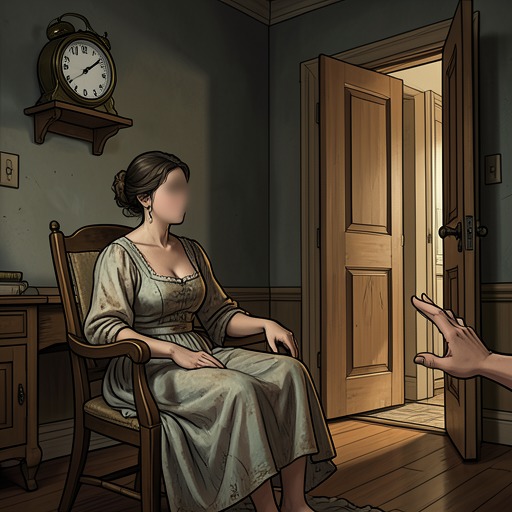
Agnes’s changing awareness appears in incidents that put the doctor’s warning into concrete terms. She is found standing in a light-blue skiff on the still pond, apparently having drifted out on her own. Thelonious swims toward her because there is no other way to reach the boat. When he tries to approach, she strikes at him with an oar. He recognizes that she is having an episode, in part because his mother had always hated the water and had needed their father’s persuasion to get into a boat. This time she is out there without him knowing how far she has gone.
Thelonious cannot restore her recognition simply by telling her who he is. He sees that she does not recognize him, though she remains his mother. Rather than reach for her again, he takes hold of the boat’s rope and guides it back toward the dock. She raises the oar when he draws near, but sits when he addresses her formally as Mrs. Ellison and tells her that standing in the boat is not allowed. The episode shows recognition as unstable and communication as contingent: a familiar relationship does not guarantee that she can identify him, while a change in how he addresses her can still secure a safer response.
That instability is not constant. After the difficult night of Lorraine’s wedding, Agnes wakes, recognizes Thelonious for a few seconds, and calls him Monksie. Her brief greeting does not undo the danger he has been watching for, but it complicates any simple picture of continuous absence. He has spent the night afraid that he will wake to find her gone or hurt, and her moment of recognition arrives within the same uncertain pattern of care.
Family Care and the Decision to Move
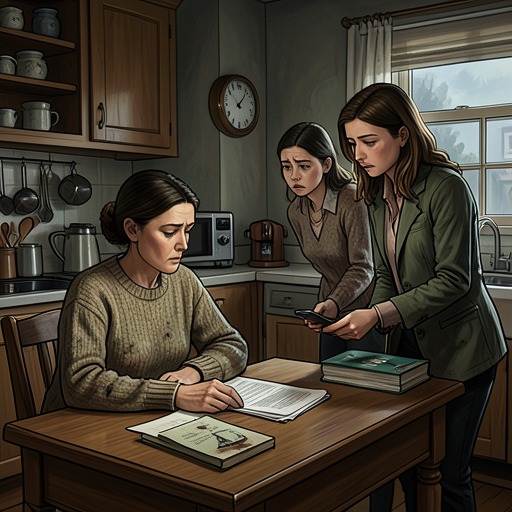
The illness reshapes the lives of both Thelonious and Lorraine, who has long helped care for Agnes. Thelonious acknowledges that it is not fair for Lorraine to have to do everything for his mother. He knows her pay because he now writes her checks, and he asks what will happen when Agnes dies. Lorraine replies that she will stay and take care of him. The exchange reveals how care has become a shared domestic arrangement, while also exposing the uncertainty of Lorraine’s own future and the limits of treating her continued labor as an answer to every need.
Thelonious’s thinking about Lorraine’s future becomes entangled with his decision about Agnes. When Lorraine’s wedding is in crisis, he recognizes that part of his plan has been to marry her off so that he will not have to look after her in her remaining years. He also admits to himself that, despite telling himself otherwise, he does want to place Agnes in care, partly for his own sake. He is troubled by the finality he associates with committing her to a retreat in Columbia. His wish to protect his mother is real, but so is his desperation to end the constant fear of what might happen if she is left without supervision.
The night of the wedding makes that conflict immediate. Thelonious stays awake beside Agnes, unable to trust the apparent stability she showed that evening. He fears she might leave her bed and end up in the creek or at the bottom of the stairs. The decision for institutional care therefore follows not from a single diagnosis alone but from accumulated episodes, the doctor’s warning, and a caregiver’s exhaustion. His vigilance is an expression of attachment, yet it cannot make the house safe through attention alone.
Life at the Care Home and Continuing Change
Thelonious takes Agnes to her new home in Columbia. During the admission process she is clear-headed enough that he considers taking her back to the beach, but the administrator continues through the questions and forms. Agnes is given a suite—more than a room, though without a kitchen—and touches the institutional furniture with a slight frown. Thelonious offers to bring things from home, leaving the choice of what to bring to himself at her request.
The grounds make the move’s meaning harder for him to avoid. An elderly woman reaches toward him from a wheelchair as he passes, apparently seeking some sign that he knows her. Agnes then wanders toward the fence. When Thelonious turns her around, her face shows no recognition; he understands himself to be a blank space in her world. A nurse helps him put Agnes to bed and stays with her after guiding him out. Seeing that the furniture has rounded, soft edges, Thelonious decides not to bring furniture from home. The setting is organized around safety in ways his own house could not be, while the move confirms the emotional cost of making safety institutional.
Later, Agnes needs more assistance with daily care and no longer chooses to move around even when she seems physically able. During one visit, a nurse and an orderly are changing her bed. Thelonious steps into the corridor, still aware of Agnes looking toward him without recognition. He remembers the woman who once described seeing colors while listening to Mahler, distinguishing her artistic sensitivity from her present dependence on caregivers who do not know that part of her life. The contrast makes the decline visible without reducing Agnes to it: her needs have changed profoundly, but her history remains part of who she is to her son.
Significance
Alzheimer’s disease reorganizes the family story around uncertainty, supervision, and the difficult allocation of care. The doctor can name a likely condition and outline hazards, but cannot predict exactly what will happen or offer a way to stop it. Thelonious must act without the reassurance of a stable day-to-day measure of Agnes’s abilities: her momentary clarity coexists with wandering, loss of recognition, and increasing dependence.
The move to Columbia is both a practical response and an intimate loss. Thelonious’s fear is not simply that Agnes will forget him; it is that he will be unable to keep her safe while living alongside a version of their relationship that shifts unpredictably. Yet the novel preserves the difference between a person’s recognition of others and the relationships those others continue to carry. Agnes may not know her son, but her earlier life, her preferences, and the care he owes her do not disappear with that recognition. The disease makes care more urgent while making its emotional completion impossible.