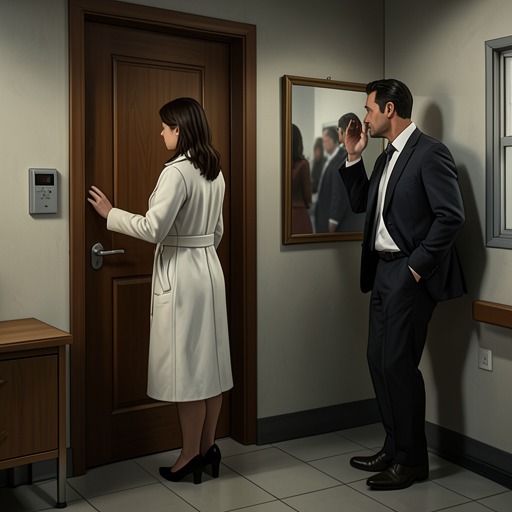
Monk discovers his half-sister Gretchen
ErasureThe discovery that Thelonious Ellison (Monk) has a half-sister, Gretchen Hanley, comes through a small box of papers rather than a meeting. Inside are Fiona’s letters, a postcard announcing a daughter, and an unsigned letter Benjamin Ellison wrote to that child but could not send. The documents disclose a concealed relationship and a family connection Benjamin never managed to make known to Gretchen. For Monk, the revelation changes not only what he knows about his father’s past, but also the shape of his own family: he has another sister, and the man he thought he knew is present in the box in a newly tender voice.
The box and its chronology
The papers appear as Monk is looking through the box and reflecting on his father. Just before opening it, he has answered Benjamin’s question about whether something had to do with Bill Ellison. Monk tells him no, and recognizes that no is the only answer he can give. Looking back years later, he wonders whether he may unknowingly have affected his father’s view of his older brother. That uncertainty frames the discovery: the box contains evidence of a family history Monk had not been able to discuss openly with his father.
The box is modest, neither large nor deep, and not particularly full. Its few contents nevertheless establish a sequence across several years. A letter dated 2 February 1955 begins the surviving correspondence. Another is dated 18 September, and a further letter is dated 12 November. A postcard mailed from Chicago bears the date 2 July 1956. The dates and documents let Monk reconstruct pieces of a relationship that had remained secret, while their gaps leave some of its circumstances unrecorded. The papers are not a complete account: they preserve what Fiona and Benjamin chose to write, along with the limits of what either could say or locate.
Fiona and Benjamin's correspondence
In the February letter, Fiona writes to Benjamin after receiving a brief letter from him. She says she had doubted that he would find time to write, though not the sincerity of his feelings. She has just returned from Southampton, where her mother is seriously ill after what doctors describe as a minor stroke. Fiona sees a greater change in her mother than the doctors’ account suggests, while acknowledging that age may also be affecting her. This concern for her mother sits beside the intimate address and personal questions Fiona directs to Benjamin: she refers to their parting roughly six months earlier and asks after his wife and children. Her letter makes clear that she knows he has a family and says she bears his wife no ill will.
The September letter records that Fiona and Benjamin have seen one another again. Fiona describes the meeting as thrilling and says that the prospect of being held by him again would make life too much for her. The letter conveys the force of the reunion without explaining where it took place or what led to it. Its emotional openness also sharpens the contrast with the brief, separated communications surrounding it: the relationship has resumed, but it remains outside the family life Benjamin has with his wife and children.
By 12 November, Fiona writes that she is pregnant. She calls the news wonderful and anxiety-making, says she wants nothing from Benjamin, and insists that she will not complicate his life. She is moving from her address, will not have her mail forwarded, and asks him not to write again because another person might receive the letter. Fiona presents the separation as a choice made to protect the family Benjamin loves, even as she acknowledges that it will hurt him. Her message makes her disappearance from the correspondence deliberate rather than accidental: she is ending contact and removing the means of reaching her.
The daughter named Gretchen
A postcard mailed from Chicago on 2 July 1956 supplies the fact that transforms the letters into a family revelation: the child is a girl named Gretchen. The papers also contain an unsigned letter addressed to Gretchen. Benjamin explains that Fiona had taken herself and their daughter out of his life because she believed that was the right and moral decision. He recognizes her strength, while acknowledging that he could not fully understand it. The letter therefore does not portray Fiona simply as an obstacle; Benjamin’s account preserves his respect for her decision even as he grieves its consequences.
Benjamin writes that he does not know where Gretchen is. Fiona’s sister in New York will not take his calls, and the Chicago postmark on the birth announcement gives him no address. He wishes he could tell his daughter that he loves and misses her, but cannot send the letter anywhere. His regret reaches beyond the practical failure to find her: he names ordinary details of her life that he does not know, including whether she is left- or right-handed and what color her hair is. The unknowns make the distance between father and daughter concrete without suggesting that Benjamin has ever met or raised her.
In the letter, Benjamin admits that he was married with two children when he met Fiona and says he should have left with her, though he did not. He identifies Thelonious as his nearest-in-age son and writes that he loved him best of the three. This disclosure places Monk inside the history of the affair, not merely as its later reader: Benjamin connects his own decision to remain with his family to the son Monk became. The confession does not resolve the moral or emotional costs of the past, but it gives Monk direct evidence of his father’s attachment to him alongside the father’s regret over Gretchen.
Monk's response and the revelation's significance
After reading the papers, Monk recognizes a voice in Benjamin that he had not heard directly in life: tender and open. The letters unsettle his previous image of the father who had gone to New York to have an affair, but the discovery does not make him angry. Even as he considers his mother’s feelings and worries about the pain the affair may have caused her, he finds himself feeling more compassion for Benjamin and more interested in him. Monk also knows that his mother had read the letters and wanted him to read them, though he does not know when she read them.
The realization that he has another sister is brief in wording but large in implication. The box supplies no evidence that Monk meets Gretchen or that she learns of Benjamin’s letter; the discovery is of her existence and of the father’s unsuccessful attempt to reach her. Its emotional force lies in that asymmetry. Benjamin’s love is preserved in a message with no destination, while Monk, reading it later, receives a more complicated inheritance: a concealed branch of the family, his father’s remorse, and evidence of affection that had not been spoken to him directly in life.