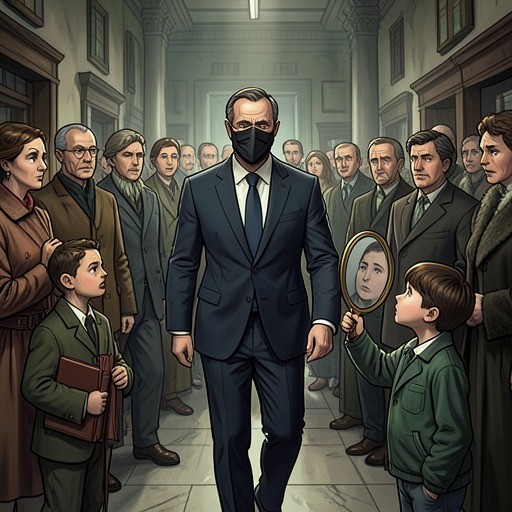
Stagg Leigh appears on the Kenya Dunston Show
ErasureStagg R. Leigh appears on the Kenya Dunston Show because the selection of Fuck for Kenya Dunston’s book club comes with a condition: its author must appear on television. The appearance brings the prospect of a large payment and the threat of exposure into the same studio. For Thelonious Ellison, the screen can conceal his face, but it cannot keep the public from deciding what his invented author and novel mean. The show turns the commercial success of Fuck into a crisis of authorship, identity, and interpretation.
Commercial Stakes and Reluctant Arrival
The book-club selection is treated at the publisher’s offices as a major financial opportunity: the expected proceeds would be shared, and the money is substantial, nearly doubling the advance. But the television appearance is not a welcome celebration. Thelonious fears being exposed and feels hatred directed at himself; he distinguishes the choice before him as what Stagg R. Leigh will do, not simply what he himself will do. The persona is both a marketable author and a means of evading the public gaze, yet the show’s condition makes that evasion harder to sustain.
On the journey to the studio, Stagg R. Leigh takes the subway. His stomach rumbles with hunger, as do the stomachs of the other Black men in the train car; above ground, the day is golden, while they travel underground toward their destinations. At the studio, producer Tod Weiß greets him with confident hospitality and says he is glad Stagg made it, since they had heard he might not appear. Weiß immediately offers to take him to makeup. Stagg refuses. The exchange establishes a conflict between the guest’s deliberate opacity and television’s expectation that a guest be prepared, presented, and made available to viewers.
The Screen and the Interview
As the broadcast approaches, Dana calls through the door to warn that there are ten minutes remaining. Thelonious asks Yul whether it is too late to hide, and Yul answers that it is; he predicts that the ordeal may later seem laughable and may even help sales of Thelonious’s other books. The reassurance does not settle the question of who is about to appear. Thelonious puts on Stagg R. Leigh’s dark glasses and invokes the persona again, while the narration turns inward to wonder whether Stagg has acquired an individuality of his own and whether silencing him would require killing him. The disguise is no longer merely clothing for a performance: the possibility that the character has become distinct is itself part of the scene’s unease.
Kenya Dunston welcomes Stagg warmly, hugging him as if they were already friends, and praises the novel. The show introduces its guest as the author of a forthcoming bestseller whose movie rights have been sold. Kenya tells viewers that he is shy and will remain behind a screen, then announces the title, Fuck. The arrangement offers concealment without privacy: Stagg is present as a silhouette, introduced by name and book title before a mass audience. His body is withheld, but his public identity is being actively constructed in front of him.
Kenya asks how the story came to him and whether it is true, inviting him to explain what in his life prompted such a gripping, realistic tale. Stagg answers briefly and does not offer the personal disclosure the questions solicit. After the commercial break, he is asked whether he feels more like talking; he says he does not. The silence produces visible discomfort: the audience makes restless noises, Dana giggles into her fist, and the production staff panic. Weiß kneels beside Stagg and urges him to open up or at least tell viewers to buy the book. The exchange makes the commercial purpose of the interview explicit, while showing that Stagg’s refusal frustrates both the demand for autobiography and the demand for promotion.
The Reading and Its Reception
Unable to draw out her guest, Kenya takes up Fuck and reads from it. The chosen passage gives voice to a narrator divided between an argument for Cleona’s education and future and an impulse toward sexual violence and retaliation. Its first-person language presents coercion not as an abstract subject but as the narrator’s own immediate, brutal intention. The passage’s specific subject matters: Kenya’s question about whether the novel is true has already invited the audience to treat the work as evidence about the author’s life, and her response to the reading reinforces that invitation.
Kenya praises the book’s talent and realism, acknowledges that its language is rough, and suggests that the intensity of Stagg’s shyness should be forgiven. The audience applauds and endorses her response. In this moment, Fuck is received not as a deliberately constructed work whose voice might require interpretation, but as an unfiltered, authentic account. The audience’s approval therefore confirms the book’s success as television entertainment while sharpening Thelonious’s discomfort with the persona and the assumptions attached to the novel. The show’s framing does not merely present Stagg R. Leigh; it tells viewers how to understand him.
Departure and Significance
From behind the screen, Thelonious sees Yul backstage. Yul applauds lightly, nods, shrugs, and gives a thumbs-up. Rather than comfort him, the gesture makes Thelonious sink; he looks down and imagines his reflection in the leather of his shoes. Kenya continues speaking, but what she says no longer matters to him. He gets up and walks away. The exit is the appearance’s decisive consequence: the guest who had been kept behind a screen finally refuses the show’s terms by leaving its stage.
The event binds a financial gain to a failure of control. Thelonious has agreed to appear because the book-club selection promises money, but he cannot control how Kenya, the audience, or the television format translate the novel into a claim about real life. His silence is intended to withhold personal access; the program turns that silence into bashfulness and supplies the interpretation he will not provide. The screen preserves his anonymity only in a narrow visual sense. His invented author becomes more publicly legible even as the man behind him feels increasingly diminished, and his departure marks the point at which commercial participation gives way to refusal.