Monk places his mother in a dementia-care home
ErasureMonk places Mother Ellison in a dementia-care home after her cognitive decline makes it increasingly difficult to keep her safe at home. The move to a facility in Columbia, Maryland, is not a response to a single diagnosis or incident: it follows a doctor’s warning, a series of frightening episodes, and the moment Monk recognizes that his mother may no longer know who he is. Even after the admission, however, her lucidity returns in brief intervals, making the decision feel less like a clean transition than an ongoing negotiation with loss.
Diagnosis and the limits of home care
A medical examination gives Monk evidence of decline without a simple explanation or remedy. The doctor rules out a lung infection, a stroke, and a vitamin B-12 deficiency; a CAT scan shows no brain shrinkage, though it does reveal tangled nerve fibers. When the doctor repeats a conversation with Mother Ellison, she asks, “Why are we going over this again?” In private, he tells Monk, “You’re probably seeing the early stages of Alzheimer’s disease.” He stresses that the cause may involve hardened arteries or poor circulation, that the doctors do not know, and that they cannot stop the disease if that is what it is. The possibility of slowing it down also meets a shake of the head.
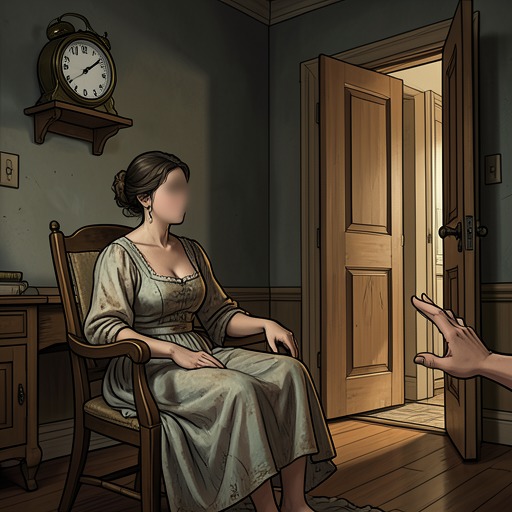
The practical forecast is as stark as the uncertainty about cause. The doctor says that things are not yet so bad, but that they could change overnight; Mother Ellison’s failure to recognize Monk suggests that the disease may be progressing rapidly. Eventually, he says, she will have to be institutionalized. At home, she should not be left alone: she might wander, fall, start a fire, leave doors unlocked, injure herself, or hurt someone else. The recommendation turns care into a question of safety as well as affection. Monk is not told that his mother has ceased to be herself; he is warned that familiar surroundings and family attention may no longer be enough to protect her.
Episodes that make the danger tangible
The danger becomes concrete when Lorraine points through the kitchen window toward the pond. Mother Ellison is standing in the light-blue skiff on its still surface, apparently calm. Monk knows that she hates the water and that getting her into a boat had always been a major undertaking, even when her father persuaded her. Now she has drifted out alone. With no other boat to take, Monk goes into the cold water and swims toward her as Lorraine and unfamiliar neighbors watch from the dock.
When Monk reaches the skiff, Mother Ellison strikes at him with an oar. He circles until he can see her eyes, but recognizes that she does not recognize him. Instead of approaching her again, he takes hold of the tie rope and swims back toward the dock, repeating, “It’s okay, Mother.” When reassurance does not get her to sit, he addresses her formally: “Mrs. Ellison, there’s no standing allowed in the boat.” She sits, and his movements in the water immediately relax. Lorraine and Maynard help Mother Ellison out of the boat; Marilyn tends to Monk as he lies on his back, panting. The episode shows both the immediate physical risk and the strange, practical adjustments required to reach her when her son’s identity means nothing to her.
Other incidents gather weight in retrospect. When Monk later explains the move, he reminds Mother Ellison that she rowed herself out into the pond, locked Lorraine out of the house, came into the study carrying Father’s pistol, and locked herself in the bathroom at Lorraine’s wedding. At that wedding, Monk had stayed awake through the night, exhausted and afraid that he would find her bed empty and her body injured or dead after a fall or a wandering. The doctor’s warning that she should not be left alone is therefore attached to particular events, not merely to a diagnosis.
The decision and admission
Monk calls Bill Ellison to say that Mother Ellison will be committed the next day. Bill says he will fly in; Monk tells him not to bother because he is not needed, but Bill insists on coming. Monk says the visit will be difficult enough and that he plans to take their mother and stay with her for the day. Bill proposes that they visit her together. Their exchange leaves the decision in Monk’s hands while showing that his brother intends to share its burden.
Before the move, Monk tries to explain what is happening. Holding Mother Ellison close and looking toward the water, he tells her that her condition has been worsening and recalls the pond episode. Her laugh and question, “What?”, make clear that she has no memory of it. He then recounts the other incidents and says he is afraid she will get lost and hurt. He tells her that he is taking her to a new place to live that day. She pulls at the edges of her sweater and asks, “Is it time to go?” Her calm question does not erase the seriousness of the move; it marks the gap between Monk’s accumulated fear and her limited grasp of what is changing.
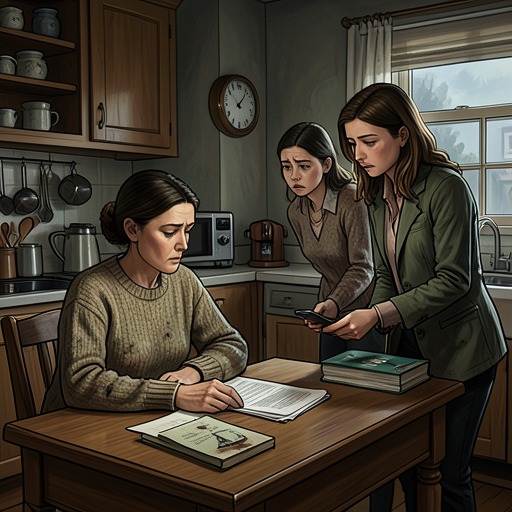
The admission process briefly unsettles his certainty. Mother Ellison is so clear-headed during the paperwork that Monk feels ready to take her back to the beach. The administrator, however, proceeds without hesitation, asking questions and completing forms. Mother Ellison’s new suite is more like an apartment than a room, though it has no kitchen. She touches the institutional furniture and frowns slightly. When Monk offers to bring belongings from home, she says, “That would be nice. You decide what.”
Recognition, care, and continuing decline
The facility’s grounds bring the cost of the decision into view. An old woman in a wheelchair reaches toward Monk with her eyes, apparently hoping he can tell her that he knows her. The residents are old and waiting; some seem cheerful, most are women. Against the broad lawn and wrought-iron fence, Mother Ellison begins wandering away. Monk calls to her and turns her around, but her face shows no recognition: he is a blank space in her universe. A young nurse helps him lead her back, puts her to bed, and then gently takes over, telling Monk she will sit with her for a while. The room’s rounded, soft furniture makes the safety provisions visible. Monk decides he will bring no furniture from home.
The story does not treat admission as proof that Mother Ellison has lost every capacity or every connection. After one night of anxious watching, she briefly recognizes Monk when she wakes and calls him “Monksie.” Later, when he tells her that she is going to a new home, she can respond to the immediate question of leaving even though she cannot remember the events that led to it. These intervals coexist with episodes of profound disorientation; they do not undo the risks or restore the continuity Monk longs for.
Her later dependence makes that change still more painful. Incontinence becomes more pronounced, and although she seems physically strong enough to move herself, she chooses not to. Monk arrives while a nurse and an orderly change her bedding and clean her. He turns away, but still sees her vacant eyes. He remembers the woman who described Mahler’s Fourth Symphony in colors: “I see autumn in the fourth symphony,” she had said, imagining ashen greens giving way to reds and ochre beneath a darkening sky. The contrast does not reduce her to either the remembered artist or the present patient. Instead, it measures what care now entails and what Monk must hold together: his mother’s changing needs, the person he remembers, and the recognition that love alone cannot make a dangerous home situation safe.