Nouveau Roman Society
ErasureThe Nouveau Roman Society is a literary organization and conference-going circle of experimental writers whose members regard Thelonious Ellison as an adversary. Its meeting in Washington gives the novel a setting for a clash over literary taste and legitimacy: Ellison arrives with little sympathy for the Society, while its members resent both his realist success and his outspoken criticism of their work.
Organization and literary circle
The Society is associated with writers who describe their work as innovative and whose literary careers, in Ellison’s account, were built through mutual publication. They had survived the 1960s by publishing one another’s stories in their periodicals and one another’s books collectively. Those publications helped them accumulate credits, gain tenure at their universities, and establish a measure of credibility beyond their own circle. Ellison’s description makes the Society more than a set of shared aesthetic preferences: it is a network whose members’ professional support for one another helped create institutional standing.
Linda Mallory belongs to this innovative-writer circle, and Ellison identifies many of its members with the Society. Her presence at the Washington meeting gives that network a personal as well as professional dimension. She is on a panel with Davis Gimbel, Willis Lloyd, and Lewis Rosenthal. The panel and conference bring together writers who share literary affiliations, even as Ellison’s account emphasizes how sharply he stands apart from them.
The Washington meeting
Ellison travels to Washington to present a paper at a conference of the Nouveau Roman Society. He has only moderate affection for the paper and little affinity for the organization, its members, or its mission. The trip is motivated in part by family: his mother and sister still live in the city, and three years have passed since his previous visit. The conference is therefore not the sole purpose of his journey, but it places him in a literary setting he would not otherwise have sought out.
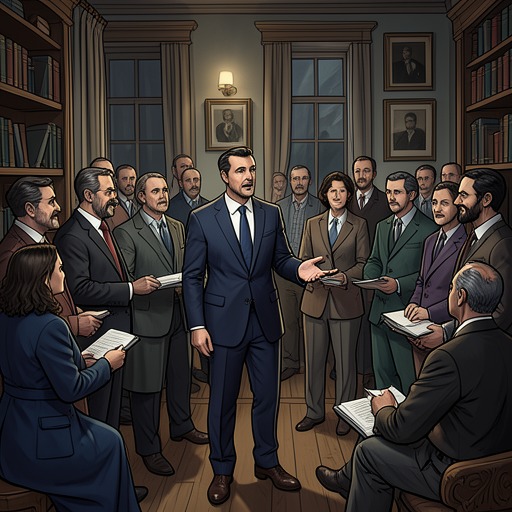
The gathering takes place at the Mayflower Hotel. On the chilly, gray morning of his session, Ellison feels lost and questions why he made the trip. He has persuaded himself that nothing is at stake, yet he takes the paper seriously and expects that it will offend some listeners, even if their irritation takes time to surface. Before his turn, the audience hears a paper about what Samuel Beckett might have written had he lived longer and received a different kind of acceptance. When Ellison begins, the clearing of throats and restrained muttering signal that his reputation has arrived with him. The conference thus makes aesthetic disagreement tangible in the room: reception begins before the argument itself has been fully heard.
Conflict with Thelonious Ellison
The Society’s members dislike Ellison for several connected reasons. He published a realist novel that achieved moderate success, while they favor innovative writing. He has also made his negative opinions of their work known in print and in radio interviews. His position is sharpened, in his view, by the fact that the French, whom the Society members admire, appear to regard his work highly. What Ellison treats as a quiet, limited distinction becomes, to them, an affront. The mismatch between his own sense of an obscure career and the Society’s resentment of his recognition makes literary prestige itself part of their conflict.
The Society’s hostility does not mean that Ellison regards himself as a triumphant opponent. He attends without great interest in the organization and approaches his presentation with a mix of detachment and seriousness. He expects to provoke offense but also believes his audience may take time to recognize the insult. That delay matters: the conference is not presented as a clean debate with a declared winner, but as a room where professional reputations, aesthetic loyalties, and old grievances register through small signs of response.
Significance and limits of the Society’s judgment
A résumé-like passage in the novel lists the Nouveau Roman Society alongside the Modern Language Association and Associated Writing Programs, placing it among the professional and literary affiliations recorded in Ellison’s career. The listing complements the conference scene: the Society is at once an organization in a professional landscape and a group whose members’ judgments of Ellison are strongly personal and aesthetic.
The book also sets the Society’s rejection of Ellison’s work against other kinds of literary valuation. His agent later reports that three editors have turned down a novel, calling it too dense, unsuitable for their lists, or unsupported by the market. Later, a publisher offers six hundred thousand dollars for a novel by Stagg R. Leigh, and the National Book Association’s judges select Fuck for its Book Award. These later developments do not establish a change in the Society’s view; rather, they show that its response is one judgment among several competing systems of taste and recognition. The Society’s importance lies in the way its meeting concentrates that disagreement: the writers who regard Ellison as an affront occupy a visible professional circle, but their opinion does not settle the value or reception of his work.