We’s Lives In Da Ghetto
ErasureWe’s Lives In Da Ghetto, the runaway bestseller by Juanita Mae Jenkins, becomes a conspicuous object in Thelonious Ellison’s life: a book promoted as an authentic account of Black America that he regards as an exploitative caricature. Its prominence in bookstores, reviews, and television brings that disagreement into public view, while its presence at home turns it into a source of intimate conflict. The book’s success and Thelonious Ellison’s reaction to it help precipitate the creation of My Pafology and expose the distance between commercial recognition and his own sense of literary representation.
A bestseller in the wrong section
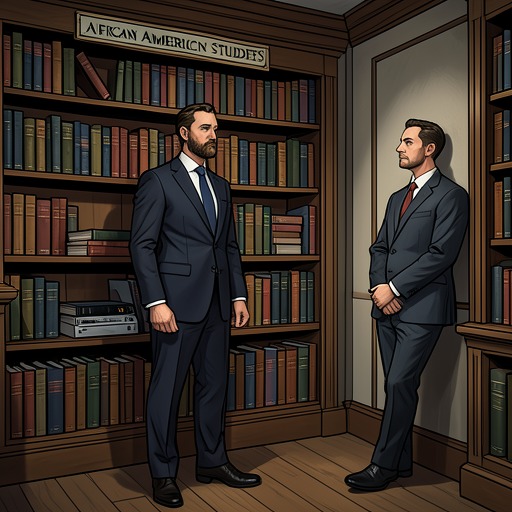
At Border’s, Thelonious Ellison searches for his own books and finds four of them, including Persians, shelved in African American Studies rather than Literature or Contemporary Fiction. He objects to a classification that treats a jacket photograph as an adequate guide to a book’s subject. In his view, the placement is likely to mislead both readers looking for African American Studies and readers seeking his work, making a sale less likely. This encounter establishes the commercial setting in which he later notices We’s Lives In Da Ghetto: a store whose categories, to him, shape what readers can find and what books they may be expected to represent.
A display copy catches his attention beside a poster advertising a reading by Juanita Mae Jenkins. The opening presents a young narrator responsible for reminding her younger brother to brush his teeth and helping keep the family together while their mother cleans white people’s houses. The deliberately rendered dialect makes Thelonious Ellison close the book with a visceral sense of revulsion. When Lisa Ellison asks what he thinks, he does not explain his reaction; she instead tells him the book is going to be made into a movie and that its author received something like three million dollars. The money and visibility sharpen his response: the work is not merely on a shelf but is being rewarded and circulated at a scale he finds difficult to accept.
Sharonda’s story and its public reception
A review Thelonious Ellison reads on a flight describes the novel as a masterpiece whose voices convey an experience that can only be Black America. Its central character, Sharonda F’rinda Johnson, is fifteen and pregnant with her third child, by a third father. She lives with a drug-addicted mother and her brother Juneboy, described in the review as mentally deficient and devoted to basketball. Juneboy is killed in a drive-by shooting; the bullet passes through his cherished Michael Jordon-autographed basketball. Watching her mother grieve, Sharonda decides that she needs a voice in the culture.
The review recounts Sharonda’s subsequent rise and reversal. She becomes a hooker to earn money for dance classes at a community center. Her athletic ability in tap is noticed by a Broadway producer, and she is discovered and rises to the top. She buys her mother a house, but her limitations eventually catch up with her and she falls back down. At the close, she is trying to raise enough money to get her children back from the state. The reviewer calls the novel’s depiction hauntingly verisimilar and presents Sharonda as an emblem of Black matriarchal strength. The account therefore makes the book’s claims about representativeness explicit: a particular, highly dramatic life is praised as an image of Black America as a whole.
That critical language reaches a popular audience as well. Kenya Dunston welcomes Juanita Mae Jenkins to her talk show and identifies the book as a selection for her book club. She praises it, then reads a passage in which Sharonda is asked where she is going and replies that she is going to the pharmacy. Kenya Dunston singles out Sharonda’s first tap-dance performance as especially moving, and the audience responds with applause and cheering when Juanita Mae Jenkins says that Black people should also get some of the money. The segment turns literary endorsement into a public celebration of the book’s voice, plot, and commercial reward.
From reading to My Pafology
The book’s reception presses on Thelonious Ellison’s own creative impasse. Sitting in what had been his father’s study, he stares at Juanita Mae Jenkins’s face on Time magazine. The response is physical before it becomes a considered argument: pain rises from his feet through his body, his hands shake, and remembered works and popular representations converge in his mind. He imagines himself on a park bench counting his switchblades, then hears himself answering a question in the dialect that has so angered him. The scene connects the image of the successful author to the language Thelonious Ellison believes does not describe his own family or himself.
He puts a page into his father’s old manual typewriter and begins a novel he knows he cannot publish under his own name: My Pafology. We’s Lives In Da Ghetto is not simply a book he criticizes from a distance; its presence in his thoughts and its public acclaim help set in motion a work of his own. The contrast is pointed. He has just encountered a novel celebrated for offering readers an unmistakable voice of Black life, while his own response is to write under a name separate from his identity as Thelonious Ellison.
The book between Thelonious Ellison and Marilyn Tilman
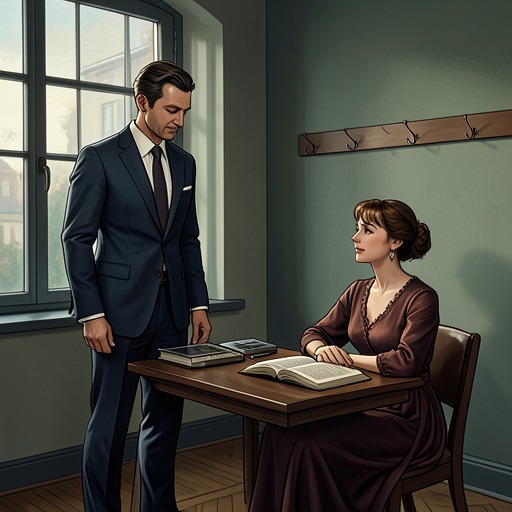
We’s Lives In Da Ghetto returns in a more private setting when Thelonious Ellison sees a copy on Marilyn Tilman’s night table. They have been kissing and moving toward sex; the book stops him. Marilyn Tilman has just finished it and says she thought it was pretty good. When he asks what she liked, she calls it a good story, lightweight but fun. He presses her about whether it offended her and whether she has known anyone who talks like the characters. She says she has not, but dismisses the dialect as something she read through.
The exchange becomes a rupture because Thelonious Ellison turns his judgment of the book into a judgment of Marilyn Tilman’s response. He calls it an idiotic, exploitative piece of crap and says he cannot see how an intelligent person could take it seriously. Marilyn Tilman, confused by the sudden change in their encounter, tells him to leave. He apologizes, but the scene shows that the disagreement cannot be contained as literary criticism: the book has become a test of what each of them recognizes, tolerates, or considers worth taking seriously.
Significance
The novel’s recurring appearances give it several distinct kinds of force. In the bookstore, its prominent display and Thelonious Ellison’s experience of shelving make literary classification and access visible. In the review and on television, its plot is framed as an authoritative, moving account of Black life. In the study, its success and image coincide with the bodily shock that precedes Thelonious Ellison’s work on My Pafology. At Marilyn Tilman’s bedside, the same book interrupts intimacy and exposes a difference that leads her to end the encounter. The evidence does not resolve the dispute over the novel’s literary value; instead, it shows how its public acclaim and private effects make that dispute consequential.