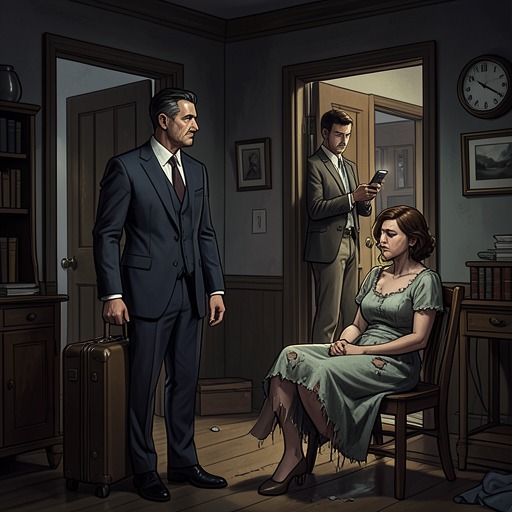
My Pafology·Fuck manuscript
ErasureThe My Pafology/Fuck manuscript is the novel Thelonious Ellison submits without his own name, using the pseudonym Stagg R. Leigh. Its movement through publishing—from an unqualified submission called My Pafology to a book retitled Fuck—turns the manuscript into more than a text for sale. Thelonious understands it as a functional object, designed to confront readers and mark a boundary between the art he wants to make and the racial expectations he believes the publishing world places on Black writers.
Identity and Submission
The manuscript first enters the publishing process in the humid middle of July. Sitting in his study in Washington, with the air-conditioning unit marking the passage of time, Thelonious calls his agent about the work he has sent. The agent recognizes his voice and immediately questions whether he is serious. The exchange establishes the manuscript’s double condition: its author knows that it will be received as a provocation, while the agent must consider how to present it in a publishing town where he also has a professional reputation to protect.
Thelonious confirms that he means to submit the work, emphasizing that he has not put his own name to it. The agent points out that anonymity does not remove the risk for the person trying to sell it. The manuscript is thus detached from Thelonious’s public identity but not from the practical relationships through which a book reaches readers. His insistence that the agent send it out without qualification makes that separation part of the experiment: he does not want the manuscript introduced in advance as parody or softened by an explanatory frame.
The agent asks whether to describe the work as satire. Thelonious refuses the qualification and directs him to send it straight, reasoning that readers who fail to recognize its parody are not the audience he intends to reassure. That decision leaves interpretation to the people who encounter the manuscript. It also makes the submission itself a test: the book will arrive without an authorial label explaining how it should be read, and the responses to it will expose what its readers and prospective publishers expect from it.
A Book Made to Function
Thelonious’s later account of the manuscript gives its form a striking material analogy. He contrasts a painting, whose canvas provides a place for the picture, with a chair, which occupies and fills space in its own right. He says that My Pafology is more like the chair: he did not design it as a work of art alone, but as a functional device whose appearance is meant to be noticed and whose purpose is to mark something. The comparison shifts attention from whether the novel meets an abstract standard of artistic achievement to what it does in the world that receives it.
The object’s intended functions carry different weights. Thelonious calls it a warning and, more finally, a gravestone. Those terms make the manuscript’s usefulness deliberately uneasy: it is meant not simply to entertain or represent, but to register a danger and to stand as a marker of loss. The chair analogy also refuses a clean division between appearance and purpose. The book’s look matters, but its visible form is tied to the work it is meant to perform. This reasoning helps Thelonious face his reflection and accept the deal his agent presents, linking his understanding of the manuscript as an object to his willingness to let it enter commercial circulation.
Commercial Recognition and Its Terms
The agent’s reports give the manuscript a rapidly expanding market presence. One call delivers the figure of six hundred thousand dollars and the news that Paula Baderman, a senior editor at Random House, wants to meet Mr. Leigh. The name attached to the meeting is not Thelonious’s own; the manuscript’s anonymity has produced a separate authorial identity with whom an editor can negotiate. The manuscript therefore creates not only a reading problem but a public role that its author must inhabit.
Later, Yul tells Thelonious that Wiley Morgenstein wants to pay three million dollars for the movie rights. The proposed price concerns the film rights, not the book itself, and signals that the manuscript has acquired value beyond its initial publishing prospects. Thelonious’s response is brief: he confirms that he is listening and asks how the offer sounds. Against his earlier hesitation about looking at himself in the mirror, this exchange shows the scale of the commercial success he is being asked to consider. The manuscript’s transformation into a possible film property extends the distance between the private author and the marketable work.
Retitling as a Further Provocation
During an editorial exchange, Stagg R. Leigh asks whether he will see galleys and is told there is no need to bother with them. He then requests one change: the title. The new title is Fuck. The editor warns that it might hurt sales; Leigh answers that he can return the money and take the book elsewhere if necessary. The exchange frames the title not as a minor production detail but as a point on which the author is prepared to risk the existing arrangement.
The printed presentation makes the decision explicit: FUCK, A Novel, by Stagg R. Leigh. The title is blunt, while the designation A Novel identifies the work as fiction. Together they place a potentially alienating word in the most prominent position and provide a simple formal label rather than an explanation of the book’s intentions. The manuscript’s original name remains important to Thelonious’s reflection on its purpose, but Fuck is the title he chooses for its public life. The editor’s concern about sales and Leigh’s readiness to withdraw the book if the title is refused expose the tension between marketability and authorial control without resolving it in favor of either.
Race, Authorship, and the Manuscript’s Significance
Thelonious’s reflection on the manuscript situates its reception within the racial categories he resists. He says he did not write it as testimony or social indignation, did not set out to portray the life of his people, and did not consider himself qualified to paint such a picture. He also recognizes an irony: in refusing to have his art defined as racial self-expression, he may still be marginalized because of that refusal. The manuscript’s anonymity and the Stagg R. Leigh persona do not dissolve this problem; they create a means of entering the market while requiring Thelonious to meet an editor as the person the work has made legible to the industry.
The work’s changing names and commercial fortunes sharpen that contradiction. It is a parody that Thelonious refuses to introduce as parody, a book he describes as a warning and gravestone but accepts as a source of money, and a manuscript that becomes valuable enough to attract both an editor and a film-rights proposal. Its decisive significance lies in this collision of artistic intention, public interpretation, and commercial appetite. For Thelonious, the book is not simply a disguised version of himself; it is an object whose reception forces him to negotiate the identity and racial meaning that publishing would attach to it.