Underwood house fireplace
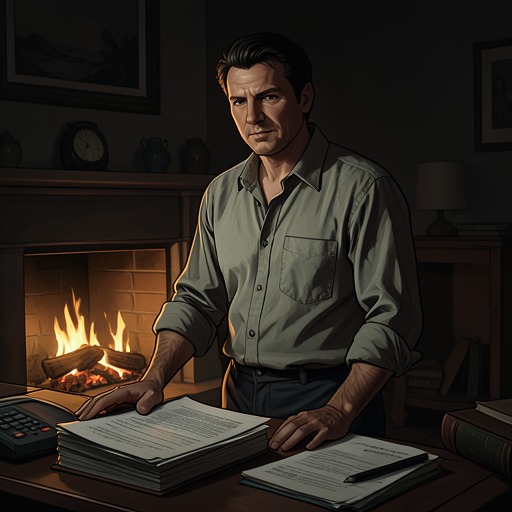
ErasureThe Underwood house fireplace is both a fixture the family has kept unused and a place where the consequences of family history become visible. Mother Ellison’s fear of fire had kept it cold for years; when she finally burned papers left by Ben Ellison, smoke and ashes made that avoided domestic danger tangible. Later, the mantel above the same fireplace became the resting place of Lisa Ellison’s ashes. The fireplace thus links a delayed promise to destroy the past with the family’s effort to live beside a recent loss.
An Unused Fixture in the Family Home
For fifteen years, the photographs on the mantel had remained unchanged: Ben Ellison posed in his uniform from the Korean War, Mother Ellison pictured as a glamorous figure, and the children made to look sweeter and cleaner than they remembered being. The fireplace beneath those photographs had an equally settled place in the house, but for a different reason: it had never been used. Mother Ellison was so afraid of fire that she insisted on electric stoves and electric baseboard heat throughout the home. The room’s arrangement held family images above a hearth that existed without serving its ordinary purpose.
That contrast matters when ashes are suddenly found inside it. While Lisa Ellison was away getting ready to go out to dinner, her sibling noticed the ashes in the fireplace and called attention to them. The discovery interrupts an ordinary family visit and turns an overlooked part of the room into a question. Since the fireplace had never been used, the ashes could not be explained as the residue of a customary fire. They signal that something has happened in a house where fire was deliberately kept at a distance.
The Papers and the Delayed Promise
Mother Ellison explains that she had promised Ben Ellison she would burn some of his papers after he died. He had been dead for seven years, but she had only now carried out the promise. Her explanation joins the papers to both a prior intention and a long delay: the papers remained in the house after his death, while her fear of fire made their destruction difficult to undertake. The ashes mark the point at which that postponed task has finally become an action.
The delay is made more striking by Mother Ellison’s own explanation of it. She acknowledges that she hates fire, and later makes clear that the papers were in a blue box on the counter and that she had burned what was in it. The family’s electric heating and cooking arrangements were not just incidental household details; they expressed a fear that had kept the fireplace unused. Now the papers have been destroyed in the very place that fear had kept cold. The fireplace becomes the instrument of a promise fulfilled, but not without revealing the difficulty and risk of fulfilling it.
Smoke, Risk, and Recognition
When the subject of the burning comes up again, the narrator warns Mother Ellison that the fireplace should not be used because its flue may be stuck shut. Mother Ellison confirms that the living room became smoky. The warning gives the smoke a concrete cause: this was not simply a symbolic return to the hearth, but a fire made in a fireplace that had never been tested in use. The house’s long avoidance of the fireplace has left its condition uncertain, and that uncertainty now has practical consequences indoors.
Mother Ellison says she had not thought about the flue and recalls that fear of fire was why the family never used the fireplace. The narrator answers that this fear was already known. Their exchange makes clear that the danger did not arise because Mother Ellison had forgotten her fear; she had acted despite it, to burn the papers. Her action therefore carries two facts at once: she has kept her promise to Ben Ellison, and the familiar household arrangement has not made the fireplace safe. The smoke brings the suppressed material fact of the unused hearth into the room, just as the ashes expose the papers’ destruction.
The Mantel After Lisa’s Death
Later, the fireplace’s association with ashes changes. Lisa Ellison had wanted to be cremated, and after her death her body was cremated; the family collected her ashes in an urn and brought it home. They set the urn on the mantel over the fireplace that had never been used. The earlier ashes were evidence of papers burned in secretive, belated circumstances; Lisa’s ashes are gathered, carried home, and placed where the family can keep them in view. The same part of the house holds two very different forms of aftermath.
The family’s return home from Lisa’s service makes the placement especially resonant. Patients, coworkers, colleagues, and Lisa’s ex-husband attended the service at an Episcopal church the family had never attended; afterward, family members sat together at the kitchen table. The urn remained above the unused hearth, connecting the public rituals of mourning to the familiar house. The fireplace does not itself resolve grief or become a source of comfort, but its changing role gives the family’s history a material location: first a place where a dead father’s papers were finally burned, then the base beneath a mantel that holds a dead daughter’s ashes.