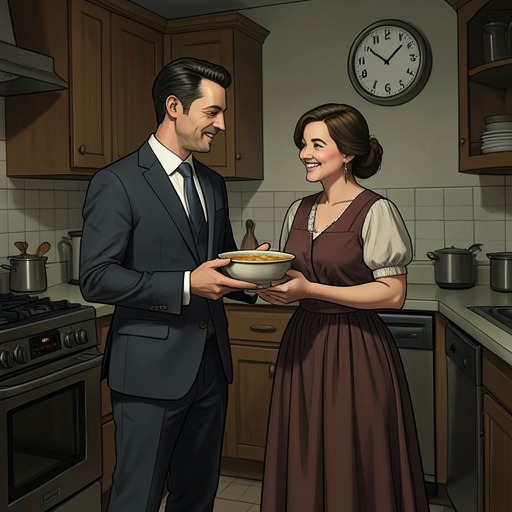
Die Vergangenheit biegt um die Ecke
Fabian“Die Vergangenheit biegt um die Ecke” is an expression that gives the past a physical entrance into the present. When Fabian meets Eva, the remembered world returns in the form of a woman now accompanied by two children, making the phrase a compact image of recognition, distance, and change.
The Expression in Context
The phrase appears as the heading for a chapter whose listed episodes include a visit to the children’s barracks and bowling in the park. Its recurrence in the scene with Eva turns that heading into more than a general reflection: the past arrives through a specific encounter during Fabian’s return to familiar surroundings.
Eva’s Appearance
After the children take their leave with their mother, Fabian remains standing for a while. The narration says that the past has turned the corner with two children by the hand, unfamiliar and barely recognizable. Eva has told him that he has not changed at all; the contrast makes the reunion asymmetrical, with Fabian seeming unchanged to her while she appears to him as the embodiment of a life that has moved on.
Memory and Change
The expression makes memory an event in the present rather than a private recollection. The corner suggests a sudden appearance, while Eva’s children give that return a visible, concrete form. When Fabian later tells his mother that he met Eva and that she has two small children and a husband who is a doctor, the encounter’s changed circumstances become explicit. The phrase therefore holds together familiarity and estrangement: the past can be recognized, but it no longer looks as it once did.