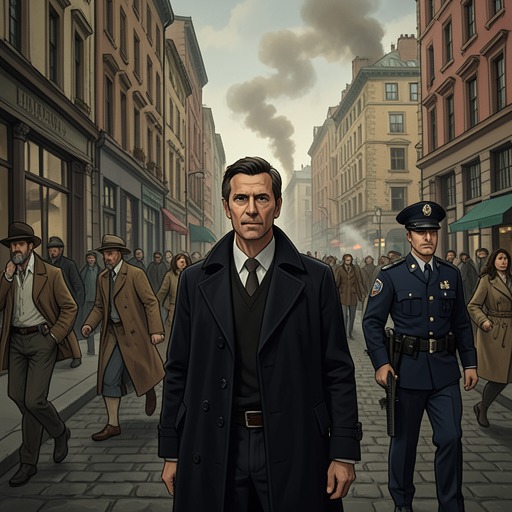
Der Kontinent hat den Hungertyphus
Fabian“Der Kontinent hat den Hungertyphus” is a doctor’s diagnosis of a society in crisis: hunger has become a fever of agitation, and people are beginning to strike out at one another. The phrase condenses the novel’s movement from material hardship to political violence, while its medical image reverberates against Fabian’s memories of the war’s mutilated survivors.
The Doctor’s Diagnosis
The expression comes at the close of a night of political shootings near the Märkisches Museum. The doctor reports that nine people have been admitted, including one with a serious abdominal wound; they are workers and clerks, often suburban residents who know one another. To him, these clashes resemble fights at a dance hall and are another outgrowth of German associational life. He darkly suggests that the participants seem intent on reducing unemployment by shooting one another. Fabian concedes that popular agitation is understandable, and the doctor answers with the diagnosis: “Der Kontinent hat den Hungertyphus.” The patient, he adds, is already beginning to rave and lash out.
The comparison turns a political crisis into a bodily illness without treating the violence as inexplicable. Hunger is the condition; delirium and blows are its symptoms. The doctor’s metaphor gives the scene a grim causal force: people wounded in the street are not isolated cases, but signs of a wider social sickness. His farewell and the closing portal end the exchange without offering a cure.
Street Violence and Political Failure
The immediate context makes the diagnosis concrete. A wounded young man explains that a quarrel began in a tavern after another patron drew a swastika on the tablecloth. The two argued, the young man struck him, and after the landlord threw them out, the other man followed and fired. A shot had already drawn Fabian and Labude toward the scene; Labude disarmed the injured man and tried to bind his wound, while Fabian went to fetch a taxi.
Fabian then tries to speak to the opposing men as political actors rather than merely combatants. He condemns the attempt to preserve intolerable conditions through cold dictatorship, but also insists that shooting one another in distant parts of the body achieves nothing. The fascist party, he says, knows only what it opposes—and does not even understand that clearly; the worker answers that his party fights the exploitation of the proletariat and calls Fabian a bourgeois. Fabian accepts the label of petty bourgeois. The diagnosis of continental fever thus follows a scene in which political identities are forceful, yet mutual recognition and any shared route out of the crisis remain absent.
The violence recurs on a larger scale at Weddingplatz. Police block Reinickendorfer Straße as workers approach; mounted police wait behind the barrier, while uniformed proletarian policemen face civilian workers. Songs become angry shouting, the police advance, and the lines collide. The police strike, horses charge, shots ring out, windows break, stones fly, and a police officer is stabbed. Reinforcements arrive in trucks, and the workers flee before gathering again at the edges of the square. Fabian leaves the scene; only a few streets away, order seems to have returned. The doctor’s phrase names the pattern visible in both episodes: agitation repeatedly erupts into violence, while apparent calm conceals how little has changed.
War’s Bodily Afterlife
The image of sickness also touches Fabian’s own physical vulnerability. As he runs to find a taxi, his heart pounds under his jacket, in his throat, and beneath his skull; he stops to wipe his forehead. The effort summons memories of photographs of men disfigured in the First World War, images that sometimes return in his dreams. He imagines wounded soldiers left in isolated provincial institutions, fed through glass tubes inserted into scarred openings where their mouths once were. Their families have been told that they are missing; fifteen years later, wives have remarried, while the men survive as photographs above the sofa.
This recollection sharpens the doctor’s metaphor without making the injuries equivalent. The street wounds are immediate and politically charged; the soldiers’ injuries expose the protracted human cost of an earlier war, including lives maintained by care yet severed from family and ordinary speech. Fabian’s question about when war will come again connects that remembered aftermath to the current gunfire. In the phrase “Der Kontinent hat den Hungertyphus,” social crisis is therefore not only a matter of political disorder: it is a condition in which deprivation, violence, and the memory of bodily destruction feed one another.