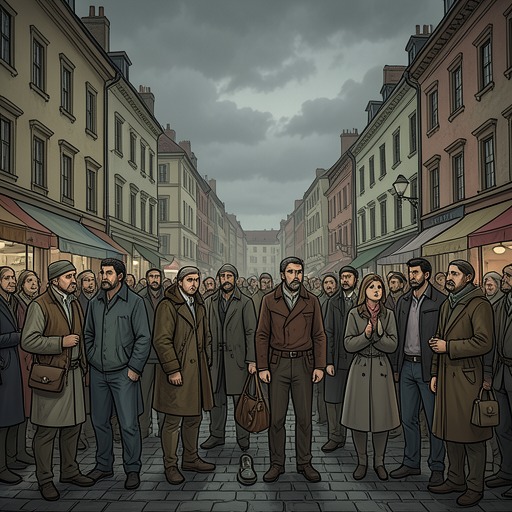
Europa als Wartesaal
FabianEuropa als Wartesaal is Jakob Fabian’s recurring metaphor for a society living provisionally, unable to know what will come next and unable to turn that uncertainty into effective action. First rooted in his memory of waiting for the First World War, the image returns to describe a Europe facing a seemingly endless crisis; its final irony is that the habitual observer at last acts, and drowns while saving a child.
The Image of a Waiting Continent
The waiting room is not a refuge from history but a place inside it: people are already caught up in events, yet do not know their destination or when departure will come. For Fabian, that condition explains both the unsettled hunger of his earlier life and his present spectatorship. He tells Stephan Labude that his wandering is not simply curiosity about whether the world can become decent; beneath it lies a compulsion to wait, as though a crisis were approaching whose shape cannot yet be seen.
His image of Europe as a schoolroom during a long recess extends the same diagnosis. The teachers have gone, the timetable has disappeared, and the old continent will not reach its assigned destination. The metaphor makes the crisis more than a passing disturbance: the structures that should give direction and purpose have fallen away, while those left behind remain suspended without a reliable plan.
The phrase also belongs to the novel’s warning rather than to a claim of neutral reportage. Its author’s foreword describes the book as satire, a deliberately distorted mirror of urban conditions, meant to warn readers of the abyss toward which Germany and Europe were moving. The waiting room therefore names a historical danger and a moral failure: the threat is not merely that the future is unknown, but that people may settle into passivity while it approaches.
War Memory and the Return of Suspense
On a bridge over the Spree, Fabian recalls the period before he and his classmates were called up for war. Their lessons continued, but they seemed pointless because the future had already been decided for them: they would be sent to fight. He remembers the feeling as being under a glass bell from which the air was slowly, steadily pumped out. Their agitation was not exuberance but the response of people running out of air, unwilling to let anything pass because they believed they were living through a condemned person’s last meal.
The memory sharpens the waiting-room metaphor through a specific interval of forced uncertainty. Half a year later Fabian was ready to march. Given eight days’ leave, he went to Graal, a place he had visited as a child, and wandered through the autumn woods. The Baltic seemed mad, and the holiday visitors could be counted. He recalls sleeping with six of ten women he considered passable, while the immediate future threatened to turn him into blood sausage. Reading, improving his character, or earning money all seemed inadequate responses to a life whose next stage was already approaching.
He describes that leave as sitting in a great waiting room called Europe. He knew the train would leave eight days later, but neither where it was going nor what would become of him. The recollection makes the image at once historical and personal: a continent’s uncertainty is experienced through a young man’s body, appetite, fear, and enforced delay. The recollected departure does not resolve the uncertainty; it carries him into the war.
A Crisis Without a Timetable
When Fabian returns to the metaphor in conversation with Labude, he insists that the present has reproduced the old suspension. They are again in the waiting room called Europe, he says, again unable to know what will happen, and living provisionally through a crisis that does not end. The repetition of “again” binds the prewar wait to the novel’s unsettled present, making the earlier experience feel less like a closed episode than a pattern that has returned.
The surrounding social picture gives that pattern material causes. The foreword identifies mass unemployment, the emotional depression following economic decline, the desire to numb oneself, and the reckless activity of political parties as warning signs of an approaching crisis. It also names a quieter danger: the epidemic-like inertia of hearts. In that account, public alarm and emotional paralysis coexist. The metaphor’s waiting room holds both the storms gathering outside and the stillness that keeps people from resisting them.
A conversation about short-term loans supplies a concrete instance of danger concealed beneath apparent stability. Malmy tells Fabian that Reich and the economy are becoming increasingly dependent on outside interests, and that a single crack could bring down banks, cities, corporations, and the Reich if large sums were suddenly called in. Yet the newspaper does not print the warning. The scene turns the abstract uncertainty of the waiting room into an information problem as well: the danger can be described privately while public life proceeds without hearing it.
Fabian and Labude differ over what to do with this knowledge. Labude objects that if everyone thinks as Fabian does, stabilization will never come; he acknowledges the provisional character of the age but says that he tries to act reasonably. Fabian counters that the reasonable and the just are unlikely to gain power. Their exchange does not supply a way out of the waiting room. Instead, it exposes a conflict between an attempt at purposeful action and Fabian’s conviction that the forces shaping the future will defeat it.
Waiting, Satire, and Moral Warning
Fabian’s private sense of suspension is joined to the foreword’s account of a society being led toward disaster. Those who tried to oppose the storm and its preceding stillness were pushed aside, while crowds listened to demagogues selling quick, poisonous solutions. The waiting-room image thus does not mean that nothing is happening. It marks the danger of watching events accumulate while other voices and forces take control of the departure.
The novel’s satirical form intensifies that warning. Its author explains that the book exaggerates rather than simply records, because the moralist holds a distorting mirror before an age. The image of Europe’s missing teachers and vanished timetable is part of that distortion: it makes a historical condition sharply visible by turning a continent into a schoolroom without guidance. The exaggeration is not an escape from reality but an attempt to make readers notice what familiar routines conceal.
The same contrast between waiting and action appears in the novel’s public violence. At Weddingplatz, police block the Reinickendorfer Straße as workers approach. Police on horseback wait behind the barrier; uniformed proletarians face proletarian civilians. As the workers’ songs give way to furious shouting, the police advance, then the groups collide. Shots, broken windows, stones, a knife wound to a police sergeant, and advancing reinforcements follow. Fabian pushes through the living wall and goes on his way. The scene shows a crisis that is already in motion, not a future event merely awaited, while Fabian remains the passing observer of violence around him.
The Ending of the Waiting
The novel’s ending gives the metaphor its starkest reversal. When a boy falls into the water, Fabian bends over the railing, takes off his jacket, and jumps in to save him. The boy swims crying to shore; Fabian drowns because he cannot swim. The man who had described himself as standing behind the fence, watching and despairing by installments, finally crosses from spectatorship to action. The shift is decisive, but it brings no safe arrival or settled future: his intervention saves the child and costs him his life.
That ending does not turn Fabian into a successful reformer or resolve the social crisis he has watched. It makes his change painfully concrete: he acts in a moment when another person is in danger, without control over the outcome for himself. The waiting-room image persists in the gap between intention and consequence, but the novel refuses to let waiting define every act. Fabian leaves the position of the observer only at the instant when action becomes urgent, and the price is irreversible.
In the foreword, the book’s stated purpose is to warn Germany and Europe of the abyss toward which they were moving, using satire to force attention and reflection. Europa als Wartesaal condenses that purpose into an image of life suspended between warning signs and catastrophe. Its force comes from the collision between the repeated uncertainty of Fabian’s historical diagnosis and the ending’s sudden, uncalculating deed: a life can be spent waiting for the future, yet the final test arrives not as a timetable but as an immediate human need.