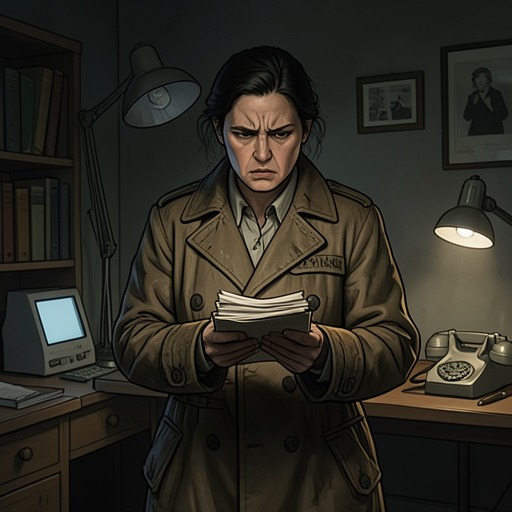
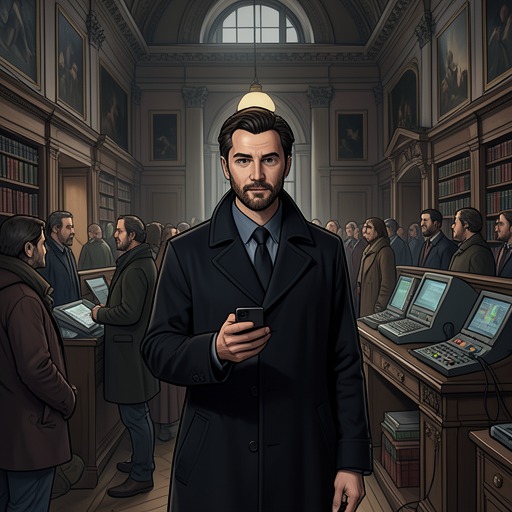
Charlie escapes Germany
FatherlandCharlie escapes Germany by crossing into Switzerland while Xavier March, hunted and on foot, watches her get through the border. The scene brings two outcomes into sharp contrast: Charlie passes the checkpoint by making a plausible story hold under scrutiny, while March finds scorched brick fragments that confirm the reality of what the regime has tried to erase. Her escape is real; his deliverance remains uncertain.
The Border Crossing
At the customs post, Charlie presents her passport and says that she is leaving to attend a friend’s wedding in Zürich. The guard compares her photograph with her face and checks the visa dates before asking whether she is traveling alone. She explains that her fiancé was meant to accompany her but has been delayed in Berlin, where he is doing his duty. Her composed, natural manner makes the explanation sound ordinary, even as the detail about her absent companion accounts for why she is by herself.
The inspection becomes more pointed when one guard questions Charlie and another walks around the car. Asked about her luggage, she says she has only overnight clothes and a wedding present. She offers to unpack, beginning to open the door, and acts puzzled that the guards might have a reason to search. The gesture puts the burden of explaining suspicion back on them: if they have no specific reason to detain her, a search would be difficult to justify.
The guards consult the search sheet, which describes an American, a brunette, whom Berlin wants to trace. Charlie does not fit that description. The mismatch, together with her performance as a traveler on a holiday, gives the guards a reason to let her go; one returns her passport and winks to his colleague. The barrier lifts, and the exchange of the regime’s required salute closes the encounter without exposing what is at stake for her.
March’s Discovery and Charlie’s Passage
The border sequence is intercut with March’s search for something to substantiate what he has uncovered. He has walked for a little over five minutes and is nearly at the birch woods when he hears a helicopter. Looking back across the waving grass and along the overgrown tracks, he sees the Mercedes joined on the road by a dozen other cars, with a line of black figures beginning to move toward him. He turns away and keeps walking, scanning the ground for evidence.
Near a sapling, March finds a red brick almost hidden in the grass. It is pitted with yellow lichen, scorched by explosives, and crumbling at the corners, but solid enough to prove that it exists. When he scrapes it with his thumb, carmine dust gathers beneath his fingernail like dried blood. Looking down, he sees more pieces—first several, then tens and hundreds—partly concealed in the pale grass. The scattered fragments turn the ground itself into material evidence: the truth he has been pursuing is not only a claim that can be denied but something physically present.
As the guards release Charlie, March imagines her driving onward and urges her on in his thoughts. She turns her head toward the East, in his direction, and appears to dip it in acknowledgment as the car moves across the bridge. The white cross of Switzerland and the morning light on the Rhine mark the passage from German control into safety. March knows with absolute certainty that she has escaped.
Outcomes and Significance
Charlie’s success depends on a narrow distinction between what the authorities are looking for and who stands before them. The sheet specifies an American brunette; Charlie is a blonde, and the guards’ attention to her passport, visa, and luggage never uncovers the purpose beneath her wedding story. Her escape is achieved not by force but by controlling the details the border officials can check and by meeting their questions with an appearance of ease.
The escape does not resolve March’s danger. A helicopter has found him, the cars have gathered, and the line of black figures is approaching. After Charlie passes into Switzerland, a voice orders March to stay where he is, and the helicopter flaps above him. The scene therefore separates their immediate fates: Charlie reaches the far side of the border, while March remains exposed to capture.
The alternating action binds personal attachment to the struggle over evidence. March’s attention moves between the brick fragments at his feet and the imagined sight of Charlie continuing toward Switzerland; the scene makes her escape an outcome he can know even as his own remains unsettled. The red dust under his nail and the white cross beyond the bridge offer contrasting signs of what the characters carry away: proof of a concealed crime, and a passage out of the state that sought to control them.