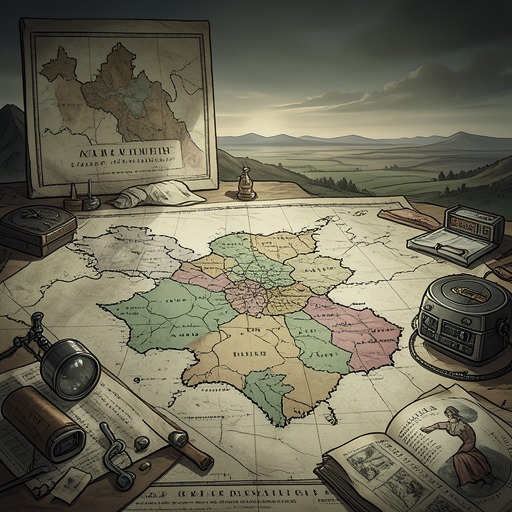
Germany and the United States make peace in 1946
FatherlandThe 1946 peace between Germany and the United States is presented as a settlement secured by mutual nuclear threat, not as a restoration of peace in any broader sense. In Xavier March’s world, the United States has defeated Japan with an atomic bomb; Adolf Hitler answers by sending a V-3 rocket to explode over New York, demonstrating that Germany can retaliate. The fighting between the two powers dwindles, while conflict continues on the margins of the German Empire and the state preserves its authority by controlling what can be remembered.
The settlement and its balance of terror
The peace is one of the regime’s carefully managed public victories. In a compulsory gathering at the Werderscher Markt Detective Headquarters, employees assemble in the canteen to hear government announcements together. The Propaganda Ministry times its broadcasts to suppress private skepticism and associate the regime with a small convenience: workers may be released early. When the settlement with the Americans is recalled, it is framed as a triumph of Adolf Hitler’s scientific genius. The announcement’s self-congratulation masks the underlying bargain: after the United States demonstrates atomic power in Japan, Germany demonstrates a means of striking New York.
The settlement does not end violence. March’s recollections place it after Germany’s victory over Russia and peace with Britain, and describe the later conflict as a nuclear stalemate that diplomats call the Cold War. Bloody guerrilla fighting continues at the borders of the new German Empire, including on the Urals Front. The regime’s broadcasts continue to present war, victory, sacrifice, and revenge as recurring features of public life, while people in the canteen watch the screens with apprehension about relatives serving in the East. Peace with the United States therefore means a change in the form and geography of conflict, rather than its disappearance.
Public history and the silenced past
The settlement belongs to a world where official history is made visible through state ritual and monumental design. The Great Hall of the People’s memorial arch, described as 118 meters high and bearing the names of three million soldiers who died defending the Fatherland in the wars of 1914–1918 and 1939–1946, turns military sacrifice into public commemoration. March passes the carved names of his father and grandfathers. This immense memorial honors the state’s account of wartime loss, while the regime’s public language gives no comparable place to the people it has erased.
That erasure is made explicit in Charlotte Maguire’s account of searching for her mother’s former theater friends in Berlin. Many, she suspects, had been Jewish or homosexual; they had not simply disappeared from their old homes but had been made to seem as though they had never existed. The contrast between a monumental roll of honored dead and vanished neighbors exposes how the regime’s control of history depends on deciding whose absence will be acknowledged and whose will be concealed.
The evidence behind the official story
The novel sets the state’s controlled broadcasts against documentary evidence that makes the concealed history legible. The minutes of the January 20, 1942 conference at Wannsee, Berlin, refer to approximately eleven million Jews and describe their supposed direction east for labor. In the draft minutes, however, March finds a section recording discussion of mass killing: shooting, gas trucks at Kulmhof, and experiments with Zyklon B at Auschwitz. Reinhard Heydrich’s handwritten objection appears in the draft, while the final minutes reduce the discussion to a single phrase. Administrative revision has removed the method from the official record without undoing the policy it served.
Martin Luther’s inspection notes provide a different kind of evidence: an eyewitness account of the camp’s operation. They record a railway siding, a transport of nearly two thousand people, and the division of those arriving between forced labor and the killing process. The notes then describe the crematorium’s processing of bodies and the removal of hair and valuables. A separate order from the SS Economic Administration Main Office turns the hair into a reported resource, specifying industrial uses and monthly accounting. Together, the records connect conference language to transport, killing, disposal, and appropriation, revealing a system rather than an isolated atrocity.
Witnesses, denial, and the meaning of peace
The state’s effort to dictate memory is bound to the elimination of witnesses. Of the fourteen men invited to the Wannsee conference, thirteen are dead and Martin Luther is missing. Against that pattern, an SS officer’s quoted warning states that the perpetrators intend to destroy evidence and ensure that survivors will not be believed. The novel’s dramatic force comes from setting that deliberate program of denial against March’s discovery of surviving papers: the documents meant to be buried become evidence of both the crimes and the attempt to erase them.
Germany and the United States make peace in 1946, but the settlement is no moral resolution. The nuclear balance restrains direct war between the powers while the regime continues its eastern conflict and protects its version of the past. The peace is thus part of the novel’s wider account of state power: victory is proclaimed, public memory is staged, and the truth survives precariously in records that contradict the official story.