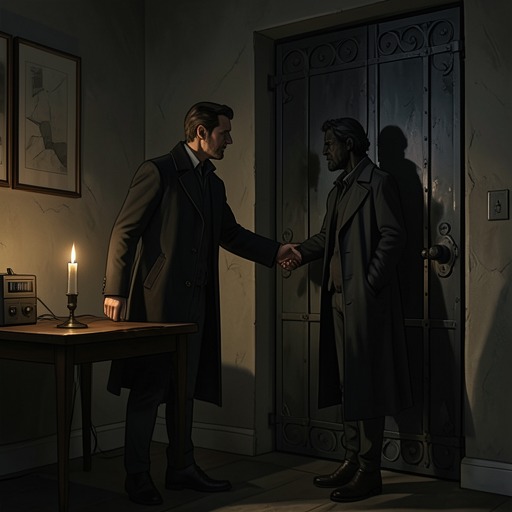
Faust’s pact and wager with Mephistopheles
FaustFaust’s pact and wager with Mephistopheles combine a bargain for service with a wager over the precise moment Faust might surrender his striving. Mephistopheles offers to obey Faust in this life and claims reciprocal service in the next; Faust sets the condition that would release him: if pleasure ever makes him wish a moment to last, the Devil may bind him and declare his ruin. The wager makes satisfaction, rather than any single pleasure, the perilous measure of Faust’s freedom.
Terms of the Bargain
Faust refuses to accept help without knowing its price. He calls the Devil an egotist, skeptical that he would assist anyone without a reason, and insists that Mephistopheles state his conditions plainly. The suspicion matters: Faust is willing to enter an alliance, but not to mistake service for generosity. He recognizes that a servant of this kind brings danger with him.
Mephistopheles answers with a specific exchange. He will be an “unwearied slave,” wear Faust’s tether, and obey his every nod; when they meet again in the other world, Faust must do the same for him. The terms thus divide the bargain across two states of existence: present obedience in return for future reciprocity. Mephistopheles promises not merely assistance but access to experiences and arts no human has seen, while Faust is asked to accept a debt whose eventual setting lies beyond this life.
Faust says that the prospect of the other world does not increase his scruples. His pleasures and sorrows belong to the earth beneath the sun, and he refuses to spend the present bargaining over whether a soul may later love or hate, or whether a hierarchy awaits it in the spheres beyond. The bargain is therefore made in the face of uncertainty, not on the basis of a settled account of the afterlife. Faust treats the life he can experience as the immediate stake and leaves the ultimate destination unresolved.
What Faust Demands
The promised marvels do not satisfy Faust’s standard. He challenges Mephistopheles to show that he can give what a human soul seeks at the height of its endeavor, doubting that a spirit such as the Devil can understand such striving. His examples are pleasures that defeat possession: food that never satiates, quicksilver-like gold that runs through the fingers, a game whose winnings remain unknown, and a woman who turns from Faust’s breast toward a neighbor’s glances. He adds honor, a meteor-like delight that lasts only a moment, fruits that rot before they are gathered, and trees that renew their leaves each day.
The images make the demand more complicated than a request for luxury. Each object carries its own instability: appetite remains hungry, wealth escapes the hand, victory cannot be known, desire shifts elsewhere, honor vanishes, and fruit decays even as trees begin again. Mephistopheles says these treasures are available and can be shown, yet also anticipates a time when Faust may want peace and a more luxurious diet. The disagreement is not simply over how much pleasure the Devil can provide. It is over whether any provision can answer a desire that continually outgrows what it receives.
The Wager’s Condition
Faust names the moment that would count as defeat. If he ever lies quietly on an idle bed, he says, let his record end at once. If flattery can make him pleased with himself, or rich enjoyment can deceive him into contentment, that day should be his last. The condition turns the bargain into an explicit wager: Mephistopheles need not prove his power by offering a particular reward; he must bring Faust to a state of satisfaction that Faust himself acknowledges.
Faust makes the test unmistakable by specifying what he would say if the decisive moment arrived: “Ah, still delay--thou art so fair!” Should he hail the passing moment in those terms, Mephistopheles may bind him in undying bonds and declare his final ruin. The signal is both inward assent and spoken formula. Faust does not lose merely because pleasure occurs; he loses if he asks the moment to remain. Until that point, even extraordinary enjoyment cannot by itself establish that his striving has ended.
The death bell and the stopped clock give the condition its consequence and its image. Once Faust has uttered his surrender to the moment, the death-bell is to sound as the token of the end of Mephistopheles’s service; the clock may stop and its hand be broken, as though time itself had ended for Faust. The wager makes a fleeting experience capable of fixing an ultimate outcome. Its danger lies in the gap between being delighted and choosing to remain delighted: Faust reserves the right to continue, but names the instant when that right would be forfeited.
Stakes and Dramatic Design
The pact draws its force from the contrast between Mephistopheles’s promise of inexhaustible novelty and Faust’s refusal to regard novelty as fulfillment. Food, gold, games, love, honor, harvest, and renewal span bodily appetite, possession, chance, desire, reputation, and nature. Yet the examples repeatedly expose limits: what is consumed does not satiate, what is held slips away, what is desired may turn elsewhere, and what ripens may already be rotting. Mephistopheles may be able to display every proposed treasure, but Faust’s condition asks whether any display can end the motion of wanting.
The bargain also makes its own language an instrument of action. Faust first demands the conditions, then supplies a test, and finally names the words that would activate the penalty. His speech sets the terms by which the service will be judged, while Mephistopheles accepts the wager with a brief agreement and then cautions Faust to consider it carefully, noting that his memory is good. That warning gives the exchange a legal edge: the condition is not casual bravado but a commitment the Devil intends to remember.
As a concept, the pact is therefore both a compact for supernatural service and a trial of Faust’s capacity for contentment. Its decisive measure is not whether pleasure is intense, or whether Mephistopheles can fulfill particular desires, but whether Faust will call one passing instant perfect enough to stop time. The terms set restless striving against the wish to possess a moment forever, and make that wish the point at which service, time, and Faust’s freedom would end.