Margaret's madness
FaustMargaret’s madness is presented not as a detached condition but as a crisis in which imprisonment, grief, and guilt fracture her sense of what has happened. In the dungeon, her speech and song move between remembered family losses, uncertainty about her child, and an urgent attempt to save that child; the scene makes the cost of the tragedy audible through repetition and disorientation.
In the Dungeon
Before opening the iron door, Faust hears Margaret singing from inside. Her song recounts a family marked by death: she blames her mother and father, recalls her little sister laying her bones in the wood, and transforms the sister’s burial into the image of a bird flying away. The song does not provide a calm account of events. Its compressed, shifting images show how memory and loss have become entangled in Margaret’s mind.
When Faust enters, Margaret says that she is wholly in his power, then asks first to nurse her baby. She believes the child was taken from her to vex her and reports that people say she killed it; she cannot reconcile that accusation with her own recollection. Her repeated grief and questions about why people sing about her reveal a mind struggling to organize both what has happened and what others say happened.
Memory and Repetition
Margaret’s language returns to earlier family losses as if they were present. In particular, she pictures her mother sitting on a stone, her head continually nodding, and then recognizes that her mother has slept so long that she will not wake. She connects that death to the time when she and Faust were caressing, recalling those days as blessed. The passage places remembered intimacy beside the irreversible loss of her mother, without allowing the past to settle into a stable chronology.
The prison song also turns private suffering into a repeated, singable form. Its images of family members and the child are not delivered as orderly explanation; they surface in fragments, while the child’s fate and the accusation against Margaret remain central to her distress. That form makes her breakdown legible through recurring images and broken connections rather than through an external diagnosis.
The Attempt to Escape
As Faust urges her to leave, Margaret suddenly gives practical directions for rescuing her child. She tells him to follow the ridge by the brook, cross the bridge, and go into the wood, to the plank placed in the pool. She believes the child is trying to rise and struggling, and repeatedly urges Faust to save it. The urgency of her instructions contrasts with the uncertainty she expressed moments earlier: the imagined rescue gives her a clear immediate purpose, but it does not resolve her confusion about the child’s fate.
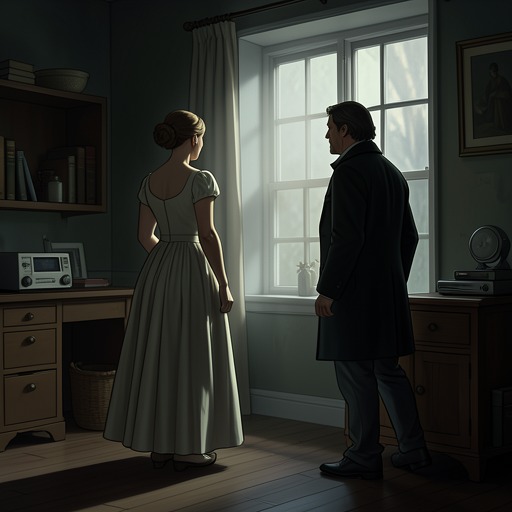
Her thoughts then return to her mother. Margaret says that they should have passed the mountain and again describes her mother seated on a stone, beckoning with a heavy, falling head. She recalls that her mother slept while she and Faust were together. Faust answers that words and prayers are useless there and says he will carry her out, but Margaret’s attention remains divided between escape, the child, and the mother she cannot bring back.
Significance in the Tragedy
The dungeon scene gathers the consequences of Margaret’s tragedy into her speech: separation from her child, the deaths within her family, and her inability to distinguish remembered events from present realities. Her madness is therefore both a condition of her imprisonment and a dramatic form through which the losses become visible. The repeated appeal to save the child gives the attempted escape its emotional urgency, while the return to her mother’s death shows why simply leaving the dungeon cannot restore the life she has lost.