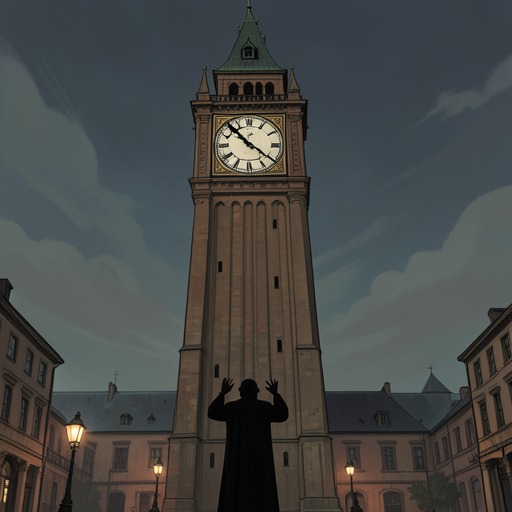
The Lord–Mephistopheles wager
FaustThe Lord–Mephistopheles wager is the opening framework for Faust’s spiritual trial: Mephistopheles receives permission to tempt Faust, but the Lord treats human striving and the possibility of error as compatible with an eventual return to the right path. The wager makes their disagreement consequential. Mephistopheles sees restless desire as an opening for capture; the Lord sees the same restlessness as evidence that Faust has not settled into lifeless repose.
The Dispute over Faust
The contest begins when the Lord asks Mephistopheles whether he knows Faust. Mephistopheles identifies him as the Doctor Faust and describes a man dissatisfied with ordinary food and drink, whose agitated spirit reaches for the fairest stars in Heaven and the highest raptures Earth can offer. Neither what is near nor what is distant can quiet the turmoil in his breast. This portrait gives the wager its specific subject: Faust is vulnerable not because he is content with evil, but because his desires exceed any satisfaction he can find.
The Lord does not deny that Faust’s service to Him is confused. Instead, He compares Faust’s future to a gardener’s tree, in which the coming years’ flowers and fruit are already implicit in the budding present. Mephistopheles interprets the uncertainty differently. He asks for leave to win Faust and to guide him gently along his own road, offering a bet on whether he can claim the man for himself. The Lord’s confidence rests not on Faust’s present clarity, but on the possibility that his unfinished striving will lead him toward a clearer morning.
Terms and Stakes
The Lord grants Mephistopheles freedom to act for as long as Faust lives on Earth. His condition is grounded in a broad account of human nature: as long as people desire and aspire, they cannot avoid error. The permission is therefore not a declaration that Mephistopheles is right about Faust; it allows the trial to proceed while leaving open what Faust’s errors will ultimately mean.
Mephistopheles accepts because he prefers the living to the dead. His interest is in those whose blood is still warm and whose lives remain open to influence; a corpse, he says, brings his enterprise to a close. He is confident that his probation will be brief and imagines Faust ending in abasement, reduced to eating dust with relish. The confidence and the limit are both essential: Mephistopheles expects to possess Faust, but his opportunity lasts only within Faust’s earthly life.
The Lord’s View of Striving
The Lord allows the attempt without treating Mephistopheles as an absolute enemy. He says that the bold, denying spirits have not moved Him to hatred, and describes Mephistopheles as the least troublesome among them. The explanation is functional: human beings, when their active nature flags, can begin to crave unqualified repose. The Lord has therefore given them a companion who works, excites, and must create, even when that companion takes the form of the Devil.
This account makes opposition part of the wager’s structure. Mephistopheles is permitted to unsettle and tempt; the Lord’s confidence is that the human impulse to seek will not be exhausted by the Devil’s influence. The wager is thus less a simple contest between power and power than a test of whether restless aspiration can survive misdirection and remain oriented toward the one true way.
Dramatic Function and Meaning
The wager places Faust’s individual story inside a dispute about human error, activity, and moral direction. Mephistopheles reads dissatisfaction as leverage: because Faust cannot be satisfied by what is near or far, he believes he can lead him downward. The Lord reads that same dissatisfaction as unfinished potential. He expects that even obscure aspiration can preserve an instinct for the right path.
The Lord’s final challenge gives the bet its decisive measure. Mephistopheles may plant snares and lead Faust downward, but the encounter will expose whether a good person, through obscure aspiration, still retains an instinct for the one true way. The outcome is not resolved in this exchange. Instead, the wager establishes the terms by which Faust’s later choices will be understood: the danger of error is real, but so is the possibility that striving can outlast the force that seeks to divert it.