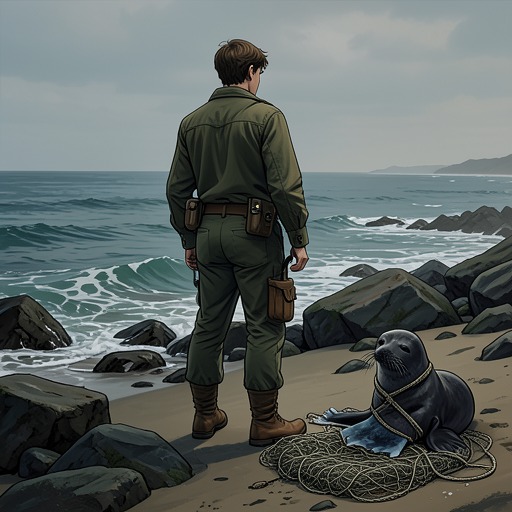
Selkies
FirebugSelkies are seal-like beings who can remove their skins to become human, a transformation that makes control of the skin a matter of freedom as well as form. In the novel, their most personal significance emerges through Ryan’s mother: her return to the water after recovering her skin leaves Ryan with a lasting wound over his human identity and his place in her life.
Nature and Folklore
Ava knows Selkies through stories Lilia told her. They resemble seals but can strip off their skins and become human. In many of the stories Ava remembers, someone steals a Selkie’s skin and hides it, trapping the creature in human form. That pattern gives the skin a double meaning: it enables transformation, but its loss can also become a means of captivity.
Ryan’s family history echoes that folklore. He identifies his biological mother as a Selkie who got her skin back and left long ago. Ava’s recollection connects the stories of stolen skins to Ryan’s father, suggesting that the folklore’s pattern of captivity has a counterpart in Ryan’s family without fully detailing how his mother lost her skin.
Ryan’s Mother and Son
Ryan says he has seen his biological mother only once since she left. She came out of the water, saw that he had taken after his father and was human, and told him he belonged on land. She then swam away without apology or tears. Her return to the water follows the recovery of her skin, but for Ryan it also fixes the memory of being judged as someone who did not share her nature and then left behind.
Ryan looks down at his hands as though staring might change them. His longing is not simply to have a Selkie mother; he tells Ava he wanted what she has. The disclosure gives his account of his mother’s departure an added force: his human appearance is bound up with a sense of exclusion, while Ava’s supernatural inheritance is something he envies.
Inheritance and Belonging
Ryan’s story places Selkies within the novel’s broader concern with children whose identities cross the human and supernatural boundary. He is the child of a Selkie, yet describes himself as human because he takes after his father. Ava, reflecting on his account, considers how it might feel to know a supernatural world intimately but not belong to it. Her own firebug sparks can be burdensome, but they also feel like one of the few things she has left of her mother.
The contrast prevents supernatural inheritance from being treated as a simple advantage. Ava’s powers mark a connection she values even when they complicate her life; Ryan’s human nature, by contrast, is part of the estrangement he associates with his mother’s rejection. Selkies therefore matter not only as shape-changing beings but as part of a story about how bodily inheritance can shape a child’s sense of family and belonging.
Narrative Significance
The Selkie stories prepare the reader to understand Ryan’s disclosure through the language of skin, transformation, and captivity. The folklore gives Ava a framework for recognizing the possible history behind his mother’s return to the water, while Ryan’s own account shifts that framework from a tale about stolen skins to a painful relationship between parent and child.
The episode also complicates the boundary between human and supernatural identity. A Selkie can take human form, while Ryan, born to a Selkie, identifies with the human side of his inheritance. His mother’s recovered skin marks her departure; his hands, which he studies without being able to change them, mark the difference he cannot undo. The species’ limited appearance in the novel thus carries weight through the family consequences of transformation and return.