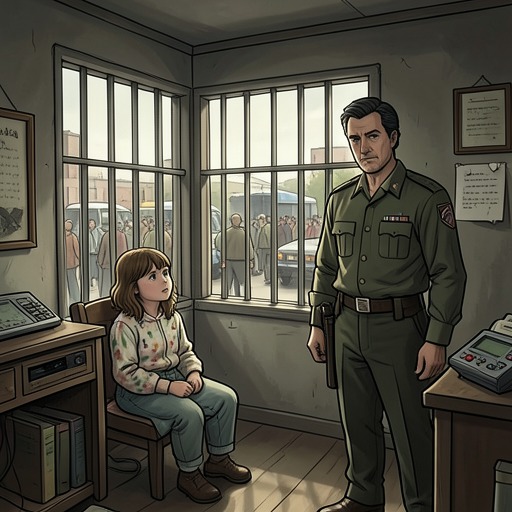
Andy McGee and Charlie McGee's father-daughter relationship
FirestarterAndy McGee and Charlie McGee's father-daughter relationship is the emotional center of their flight: Andy keeps moving for Charlie when pain and despair leave him little reason to continue for himself, and Charlie's distress repeatedly becomes something he must steady without denying the danger around them. Their bond is shown not only in emergencies but in small acts of care, where exhaustion, tenderness, and the wish for an ordinary childhood meet the facts of their hunted life.
Identity and Foundation
The relationship is plainly parental, but its circumstances have made ordinary parenthood impossible. Charlie is seven, and Andy is responsible for getting her through a flight in which they cannot assume that a place to rest will be safe or that their pursuers have given up. The burden is sharpened by what Charlie has inherited from both parents: an ability she did not choose, and a history whose consequences she is too young to have made sense of. Andy understands that her danger is not a fault of hers, even when she experiences it as something for which she must answer.
His own endurance is explicitly tied to her presence. In a moment of acute pain, Andy struggles to remain polite and to keep going; the thought that he would have killed himself long ago if he were alone makes clear how much his commitment to Charlie sustains him. This does not make his care abstract or easy. He is suffering, but still puts his attention toward what she needs next. When they reach the motel, he wakes her gently and avoids using her name, a caution that has become instinctive amid the danger. The small act carries the logic of their life together: even tenderness must be practiced with an eye to exposure.
Protection Under Pressure
Andy tries to prepare Charlie for the compromises survival may require. When she asks how he could get money, he implies that she knows what he means: using her extraordinary ability. Charlie breaks into tears at the prospect of stealing, insisting inwardly that it is wrong. Andy acknowledges the moral problem rather than dismissing it, but sets it against the continuing threat to them. He has explained, or tried to explain, why their pursuers' actions also make the situation unjust. Their disagreement is not a loss of affection; it is a child trying to preserve ordinary rules while her father tries to keep both of them alive within conditions that have already overturned them.
That tension becomes especially painful after Charlie accidentally sets a soldier on fire. She is devastated by what happened and fears that she could have hurt him badly. Andy first puts an arm around her, despite struggling to think through the pain in his head, and tells her that the soldier is all right and has been taken to the security office. He then lets her explain what led to the fire: she overheard the soldier on the phone, sensed that he was trying to trick the girl he was speaking to, and lost control of what happened as she returned to Andy. His response places immediate reassurance before judgment. Charlie can tell him what she did and how frightened she is; he does not withdraw from her at the moment when she feels most guilty.
Guilt, Inheritance, and Care
Andy sees the gap between Charlie's age and the life forced upon her. After her sobs fade, he recognizes that exhaustion has helped intensify both her distress and his own headache. Looking at her in the breakdown lane of a turnpike spur in upstate New York at one-fifteen in the morning, he feels guilt: instead of being in bed with a teddy bear and preparing for second grade, she is on the run and consumed by guilt over an ability inherited from her parents. The contrast makes his protectiveness more than an effort to escape immediate danger. He is also grieving the ordinary childhood she should have been able to inhabit.
The source of that inheritance is bound up with the parents' past. Andy knows that Charlie cannot be expected to understand that he and her mother once needed two hundred dollars, and that the people they approached told them it was all right when they had lied. In his mind, this history helps explain why Charlie has been placed in a situation she did not choose. His guilt does not erase his practical need to keep moving, and his reassurance cannot give her a complete understanding of what happened. The relationship therefore carries two truths at once: Andy acts to protect her, yet he knows that the choices made before her birth helped create the burden she now carries.
Intimacy in Flight
At the Slumberland Motel, the relationship briefly appears in the softer rhythm of morning. In Unit Sixteen, Charlie wakes in bright autumn sunlight while Andy remains motionless beneath the blankets. She smiles at him because he always does his best: when there is only an apple and both are hungry, he takes one bite and gives her the rest. The detail turns care into something measurable and familiar, not a declaration but a repeated act of putting her need first. Her fond observation that he steals all the blankets when asleep adds a child's teasing intimacy to a life otherwise governed by flight.
Even that quiet scene is framed by uncertainty. Andy's pain and fatigue leave him asleep while Charlie watches him, and the temporary ease of daylight does not settle what they should do next. At another motel, he looks at Charlie sleeping and wonders where they can go to be left alone and how the flight will end; no answer comes. The questions reveal the limit of what a loving parent can promise. Andy can wake her, hold her, comfort her, share food, and keep choosing to continue, but he cannot yet offer safety or certainty. Their relationship endures in that gap between what he cannot guarantee and what he continues to do for her.