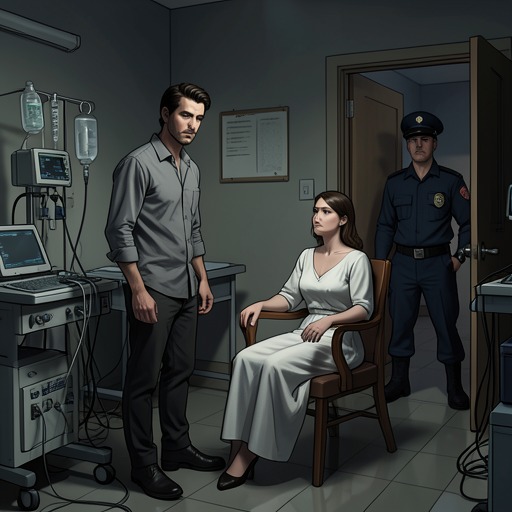
Andy McGee's brain damage caused by using the push
FirestarterAndy McGee’s brain damage caused by using the push turns his effort to protect Charlie into a struggle against his own failing body. The damage is not an abstract price: after he exerts his ability on Cap Hollister, Andy suffers worsening headaches and numbness, and later learns that a small rupture in his brain has killed brain cells. He nevertheless decides to keep going long enough to give Charlie a chance, even while recognizing that pushing further may kill him.
The Cost of Using the Push
Andy’s condition worsens during the office meeting in which he learns that Charlie has been setting fires in the Shop’s tests. The report that she has flamed a piece of sheet steel at an extreme temperature for four seconds shocks him. Before he can ask more, the intercom interrupts, and Andy uses the push on Cap Hollister with far more force than necessary. Cap visibly suffers from the exertion, but Andy pays for it too: his headache leaps in severity, and he warns himself to ease off even as he continues trying to secure time and cooperation.
The scene makes the danger immediate rather than theoretical. Andy is already struggling to control his thoughts, and the pain makes that harder. He is drenched in sweat; in his mind, the black horse kicks at its stable door, a recurring image of force gathering under restraint. The office intercom keeps bringing ordinary business into the room, including a request concerning Project Leap, while Andy tries to hold Cap’s attention and keep the interruption from derailing his purpose. His ability can alter another person’s behavior, but each use exacts a bodily and cognitive cost that threatens the plan it is meant to serve.
A Body Under Strain
The damage also compromises Andy’s ability to think through the escape arrangements. On the return journey, he knows that this is the crucial part, yet his head hurts so badly that he fears he may forget something and bring the whole plan down. His attention keeps returning to Charlie: he tries to hold on to her as his focus falters. His condition therefore endangers more than his immediate health. The physical effects threaten his memory and judgment at precisely the moment when the plan depends on his sustained concentration.
After the day’s exertions, Andy reaches his apartment, stumbles to bed, and sleeps for six hours, scarcely aware of what he is doing. During that sleep, blood seeps from a minute rupture in his brain, and brain cells die. When he wakes at ten that evening, the headache remains severe. The numb areas on his face have returned, now larger: one below his left eye, another on his left cheekbone, and a third just below his jawbone. Their reappearance and increased size make the consequences of using the push visible in a new way. The strain has not passed with the end of the meeting or with sleep.
Risk and Resolve
Andy’s response is a sober recognition of the limit he has reached. He understands that he cannot push much further without killing himself. That judgment does not make him stop immediately: he resolves to hold on long enough to see the plan through and give Charlie her chance, if he possibly can. His persistence is thus neither confidence that he can recover nor proof that the ability is safe. It is a deliberate choice made in full awareness that the next exertion could be lethal.
The following night, even after getting a glass of water and lying down again, Andy’s last waking thought is that Charlie must have read his note by then. The detail keeps his attention fixed on her while his own body demands rest. The note also marks the distance between what he can still do and what he can no longer supervise directly: he has to trust that Charlie has received his message while he lies incapacitated. His effort to protect her continues through planning and communication as well as through the push, but the damage makes each form of action precarious.
Narrative Significance
The black horse gives shape to the tension between Andy’s determination and the danger accumulating within him. As he tries to keep control in Cap’s office, the image suggests an urge to break free; at the same time, Andy is the one who must restrain his power, because unmeasured effort can destroy him. His bodily decline is not separate from the escape plot: pain may disrupt thought, exhaustion removes him from action for hours, and the brain damage forces him to acknowledge a boundary he cannot simply will away.
The episode places Andy’s devotion to Charlie beside the limits of his own agency. The push offers a means of influencing events, but it cannot make its use costless, and Andy cannot secure Charlie’s future by ignoring the consequences indefinitely. His resolve to continue is moving because it rests on a clear understanding of the risk, not because the damage has been overcome. At this point, he can only hope to endure long enough for the chance he is trying to create for her.