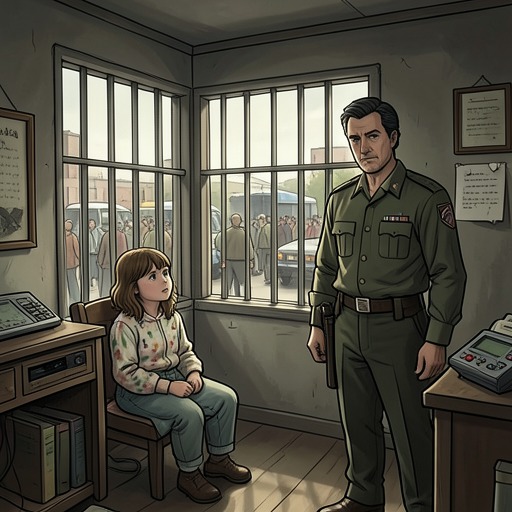
Andy McGee's hostility toward the Shop
FirestarterAndy McGee’s hostility toward the Shop is a response to an institution that treats the consequences of Lot Six as property to be recovered and controlled. Its pursuit turns his experimental past into an immediate threat to his family: first a reason to flee, then a danger to Charlie McGee and a source of lasting personal loss. As Andy tries to keep Charlie beyond the Shop’s reach, opposition becomes inseparable from his attempts to protect her and reclaim their life together.
Origins in Lot Six
Andy’s connection to the Shop begins with the experiment that brought him into the orbit of its research. Dr. Wanless explains that twelve students will receive injections under a double-blind procedure: six of them water, and six water mixed with Lot Six, a compound described as a mild hallucinogenic and hypnotic. Participants are to be supervised for forty-eight hours. Andy is among those in the lecture hall, where the classified nature of the compound prompts questions. The account establishes the research setting behind the abilities and institutional interest that later govern his life, though it does not specify which injection he received.
The Shop’s claim on the experiment’s consequences takes on a larger significance when its leadership considers Andy’s mental-control ability as a resource. Cap Hollister imagines how such influence might be used against political figures and insurgent leaders, and regards the possibility of making it happen again as a reason not to give up on Andy. In the same reflections, he considers Charlie a subject to document and study, with the hope that she might be persuaded to use her powers for the government. The contrast is central to Andy’s opposition: the Shop speaks in terms of national purpose and research, while he experiences its ambitions as a threat to the people it intends to control.
Pursuit and Flight
The conflict becomes a daily calculation when Andy suspects that men in a green car are tracking him in New York. He fears that they may have charted his use of the push and discovered how little ability he has left. In his view, money has briefly interrupted the pattern of unusual events that drew their attention, but it cannot make him secure. His fear is not simply of being followed; it is that the Shop can measure his weakness and choose the moment to seize him.
That danger has already shaped his choices as a father. Andy reaches Charlie at school and takes her from her second-grade class with an excuse, then spends the afternoon moving through the city with her. His relief at finding her there is sharpened by his memory of the previous occasion when she was taken and by the possibility that the Shop’s agents might have reached her first. The episode makes his hostility concrete: resistance means acting quickly, sometimes with little preparation, because ordinary routines such as school can become points of vulnerability.
Flight has not been continuous in appearance. Andy recalls that he and Charlie had spent time in Port City, Pennsylvania, where Charlie attended school and he worked in a weight-loss program. That ordinary arrangement had nearly allowed him to forget they were fugitives. The Shop’s pursuit, however, had not ended; Andy recognizes that a lapse in vigilance could expose them. Later, after escaping with Charlie, he tries to judge whether their pursuers remain in New York, have reached Albany, or may soon arrive in Hastings Glen. The geography of escape becomes part of his thinking, but uncertainty remains: he cannot know how far the Shop has progressed or how closely it has tracked them.
Loss and the Stakes of Resistance
The Shop’s pursuit is bound to a more intimate wound when Andy discovers Vicky Tomlinson McGee dead in the house. The scene confirms that the danger has reached his family, and the immediate next thought in his mind is Charlie. The account does not make his grief an abstract motive: his memories of Vicky as his wife and companion surface alongside the discovery, while his attention turns to the daughter who may also be in danger. His opposition to the Shop consequently carries the weight of bereavement as well as the urgent need to find and protect Charlie.
Charlie’s experience in Shop custody supplies another measure of the institution’s harm. She understands that the people keeping her there killed her mother, rejects the assigned live-in companion, and stops speaking until that companion is removed. She agrees to answer Hockstetter’s questions alone in exchange for this change, but the only companion she wants is her father. The five months she spends there feel detached from ordinary time. Her insistence on solitude and her longing for Andy show how the Shop’s control has damaged the possibility of safety and trust, while their separation gives Andy’s efforts a clear personal objective: being together again.
Warning and Continuing Opposition
Andy’s hostility reaches its clearest expression in the warning he sends Charlie about John Rainbird. He tells her that Rainbird was in charge of the men who captured them at Granther’s place, and explains that Rainbird’s apparent trustworthiness has been an act. The warning is also tactical: Charlie must not let Rainbird see that her feelings toward him have changed, because Andy believes their escape plan depends on preserving that appearance until Wednesday afternoon. Resistance therefore requires more than flight; it requires countering the Shop’s use of deception without allowing Charlie’s trust to put her in greater danger.
Andy’s proposed future is escape followed by public exposure. He hopes to take Charlie to Los Angeles or Chicago and arrange a press conference with help from his old friend Quincey, believing that public knowledge might prevent the Shop from keeping them apart. Even this plan does not promise freedom from institutional control; Andy allows that they may still be held somewhere, but insists that they could at least remain together. His hostility is thus neither a generalized rejection of science nor a contest for power on equal terms. It is a sustained resistance to an organization that claims people as research outcomes, pursues his family, and separates father and daughter. The relationship’s defining movement is from fear of being reclaimed to a deliberate effort to escape, protect Charlie, and make the Shop’s actions known.