Department of Scientific Intelligence
FirestarterThe Department of Scientific Intelligence, called the Shop, is a government science agency whose stated national-security mission becomes entangled with secret experimentation and the pursuit of Andy McGee and Charlie McGee. Its defining contradiction is that it presents scientific work as a matter of public protection while concealing the program that created Charlie and using the language of national security to suppress resistance and disclosure.
Identity and Stated Mission
Andy explains to Irv Manders that the Shop is not part of the CIA, but the Department of Scientific Intelligence. Its charter concerns domestic scientific projects with present or future application to national security. In the public mind, the organization is especially associated with energy research, including electromagnetic work and fusion power; Andy says that it is involved in much more. The name Shop is described as a nickname adopted in the early 1960s, rather than the agency’s formal title.
The organization’s scientific remit is visible in the Lot Six experiment. Dr. Wanless tells a group of twelve young participants that they will receive injections under a double-blind procedure: six will receive water and six water mixed with a small amount of Lot Six. He describes the compound as a classified hypnotic and mild hallucinogenic, and says the participants will be closely supervised for forty-eight hours. The announcement establishes a procedure framed as controlled research, while withholding the compound’s exact nature from both participants and investigators until later. Andy subsequently tells Irv that he and Charlie’s mother were injected with Lot Six, and that Charlie’s abilities emerged from changes he believes the drug caused and they passed on to her.
Pursuit and the Security Rationale
As the Shop tracks Andy and Charlie, the agency’s security framing is challenged from within. Dr. Wanless argues to Cap Hollister that Andy’s ability is limited and comparatively minor, whereas Charlie presents a far greater danger because she is frightened, on the run, and being pushed toward using her power. In Wanless’s view, the agency’s pursuit itself is helping create the peril it claims to manage: separating the family and forcing circumstances that could change Charlie’s understanding and use of her ability. His warning makes the conflict more than a question of what the McGees can do; it is also about what the Shop’s choices may provoke.
The pursuit reaches ordinary communities through covert surveillance and cooperation with local authorities. At the Manders farm, Andy tells Irv that agents are working with the police, though the police do not know that the family is wanted. He identifies the pursuers as Shop agents and explains that Charlie, rather than himself, has become their principal target. He believes the agency wants to study her and use her as an exhibit to revive the Lot Six program. That account makes the child both the consequence of earlier research and a possible instrument for renewing it.
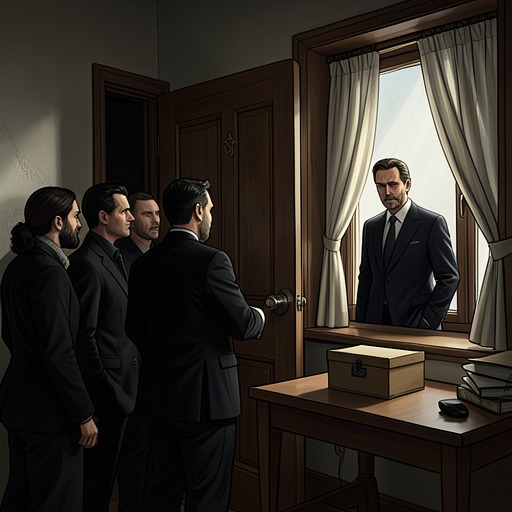
The Shop’s agents also assert authority against people who resist them. When Irv orders the agents off his property and asks for a warrant, Al Steinowitz says that one is unnecessary. Irv insists that they have no right to remain without one. The confrontation exposes the gap between the ordinary legal protections Irv expects and the agents’ claim to act under exceptional government authority. Their pursuit is not confined to official facilities: it presses into private property, putting a civilian who has sheltered the McGees in direct opposition to the agency.
Covert Operations and Civilian Consequences
The attempted seizure at the Manders farm ends in a major operational failure. Orville Jamieson reports that several agents are dead, others have fled, multiple cars are burning, and the farmhouse has been destroyed by fire; Irv is wounded. The scale of the outcome shocks Cap, who regards the failed operation as an extraordinary covert disaster on American soil. The incident also threatens the Shop’s secrecy because Irv is likely to tell others that agents tried to take the family without a warrant. The agency’s use of force thus produces not only immediate harm but a public-relations and concealment problem.
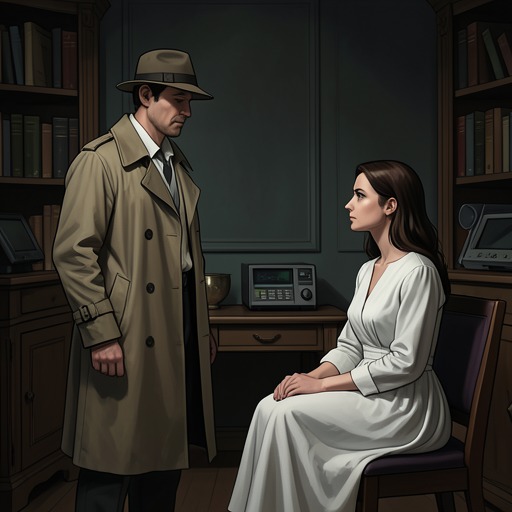
The conflict’s effects extend beyond the raid. After Charlie is held apart from her father, the Shop places a woman described as a motherly companion with her. Charlie rejects the arrangement and agrees to answer questions only from Hockstetter if the companion is removed; she wants her father, or to be alone. The episode shows the institution attempting to manage a child’s daily life as well as her abilities, while her response registers the collapse of trust between the captive and the organization responsible for her confinement.
The danger surrounding the family is also inseparable from the death of Vicky Tomlinson McGee. Andy tells Irv that the Shop was responsible for her murder, and later finds her dead in the family home. Those events make the agency’s pursuit a personal catastrophe as well as a research and security operation. Andy’s explanation to Irv places the murder within the history of Lot Six and the Shop’s interest in Charlie, though the available account does not establish every link in the chain of responsibility.
Secrecy, Control, and Institutional Conflict
The Shop’s secrecy depends on more than hiding the experiment. It also seeks to control what witnesses say and what information reaches the family’s supporters. On March 10, agents stop a postal truck carrying Andy’s six letters, present their credentials, and demand mail from the surrounding towns. The postman hands over the bag, and the agents sort through it at the roadside. The interception makes the agency’s reach concrete: ordinary mail becomes a target when it might carry information or a request for help beyond the Shop’s control.
The organization’s internal relationships are not simply unified by its mission. Andy’s note to Charlie warns her not to trust John Rainbird, explaining that Rainbird had led the men who captured them at Granther’s place even though he had gained her confidence. The warning reveals that an agent’s apparent personal bond with Charlie has served an operational purpose. Andy’s plan depends on Charlie continuing to behave as though that trust remains intact, turning their relationship into part of the escape strategy and showing how thoroughly the Shop’s pursuit has invaded private feeling.
After the Manders raid, the agency turns toward containing the aftermath. Whitney Tarkington meets with Irv and Norma Manders, presents files on the Manders and Breedlove families, invokes national security, and offers a tax-free check that would cover repairs and hospital bills while discouraging them from speaking. The approach recasts the civilians’ experience as a matter they should not discuss, while placing compensation alongside an implied threat of further unpleasantness. It is a quieter form of control than the raid, but it serves the same end: limiting the consequences of the Shop’s actions by managing the people who witnessed them.
Narrative Significance
The Department of Scientific Intelligence connects the novel’s scientific premise to its political and family conflicts. Lot Six begins as a classified experiment with an explicit procedure, but its consequences are carried by people whom the institution later pursues, separates, and attempts to study. The Shop describes the McGees through national-security concerns; Wanless’s objections expose the danger in treating that description as a sufficient guide to action. His warning that pressure on the family could intensify Charlie’s danger sets institutional conduct against the agency’s stated aim of managing threats.
The Shop is therefore defined not only by its formal scientific remit but by the means it uses to protect its secrecy: surveillance, forced separation, intercepted correspondence, assertions of authority, and efforts to silence witnesses. Each method narrows the space in which the McGees and their civilian allies can seek help or tell what happened. The recurring contrast between research language and coercive practice gives the agency its central narrative force: it claims to study and contain extraordinary power, yet its own pursuit helps create the conditions for catastrophe.