Pyrokinesis
FirestarterPyrokinesis is the ability to start fires through thought, a power Charlie McGee has difficulty controlling and that can grow more dangerous with use. It shapes her childhood, her parents’ attempts to protect her, and the Shop’s effort to study and contain her. Across the story, fire is at once an involuntary response, a prohibited act, and a deliberate means of resistance; the conflict over who can direct it is as important as the ability itself.
Definition and operation
Charlie’s parents learn the technical term pyrokinesis and explain it as the ability to light fires by thinking about fire. Andy McGee describes it to Irv Manders as a rare psi talent, distinct from ordinary fire-making and from telepathy, telekinesis, and precognition. He says Charlie has lesser traces of some of those other talents as well, but identifies pyrokinesis as the rarest and most dangerous. Its possible effects range from lighting a small object to setting a larger area alight, with no reliable assurance that the fire will stay within the intended target.
The power does not behave like a simple tool that Charlie can switch on and off. It is often associated with being upset, frightened, or angry, and can seem to arrive before she has chosen what to do. At other times, evidence suggests that intention matters: the Shop’s later study concludes that Charlie herself elected to set events in motion at the Manders farm when she understood that the agents were trying to kill her father. These two aspects remain in tension. Her power can escape the limits of her conscious control, yet her choices and will can also direct it.
Pyrokinesis is related to, but not identical with, the push, Andy McGee’s term for his own mental influence over other people. Charlie can push with greater force than her father and does not experience the headaches he does afterward; sometimes, however, fires follow. The abilities therefore overlap in the story’s account of psychic force without being interchangeable. Fire is the distinctive and especially hazardous expression of Charlie’s talent.
Childhood, fear, and family safeguards
Charlie’s parents try to give her an explanation while still treating the ability as a danger that needs care and restraint. They tell her that it may emerge when she is upset and that losing control could injure her or someone else. After an early incident in which anger at Vicky McGee is followed by fire reaching her mother’s hands, the family stresses that a fire should be directed away from people. A sink full of soapy water helps limit the consequences. Charlie responds with terror and remorse and promises not to let the power happen again.
The family’s rules are practical as well as moral. Andy and Vicky urge Charlie not to provoke the emotional state associated with fire; if she cannot prevent an episode, they tell her to direct it toward a wastebasket or ashtray, to get outside, or to aim toward water. They frame the distinction between an accident and a deliberate attack as something Charlie must learn to manage, while warning her that a person could be killed. For Charlie, the instructions become a prohibition: the ability is the Bad Thing, not simply because it is frightening, but because once released it may spread beyond what she meant to do.
The teddy-bear fire makes that risk visible in the home. After Charlie falls on the stairs, Andy senses a sudden, unseen force pass from her; the bear catches fire, and the flames reach the stair carpeting. Andy puts Charlie down and runs for the extinguisher. He and Vicky rarely discuss what their daughter can do, but extinguishers have been placed around the house. Their silence does not mean they have ignored the danger: the equipment records a domestic life reorganized around a possibility the parents struggle to name openly.
Power under pressure
As Charlie and Andy flee the Shop, the childhood prohibition collides with immediate danger. At a bank of pay phones, Charlie remembers that her father is hurt and that they need money, while fearing that the Shop’s agents will find them. She is also afraid to use her abilities: she understands that the fire power might harm her, another person, or many people, and that the Shop may learn more about what she can do. Her hesitation shows how the family’s safety rules persist even when the ordinary protections of childhood have fallen away.
A later episode gives Andy a different view of an uncontrolled use. After Charlie overhears a soldier speaking by telephone and suspects that he is trying to deceive the person on the other end, she sets him on fire before she can stop herself. She fears that she could have badly harmed him. Andy, despite his pain and the danger surrounding them, calls the episode the most encouraging thing that has happened in some time. The account does not make the event harmless; it marks a change in what he believes the power may signify. For Charlie, it remains alarming precisely because the act seems to have escaped her control.
At the Manders farm, the stakes become more extreme. Andy tells Irv Manders that Charlie can start fires by thought and that she is frightened because she cannot always control the result. When Charlie herself worries that she could kill the agents, Andy answers that the situation may have become one of killing or being killed. Soon afterward, cars used by the Shop’s agents explode, beginning at their rear ends. The Shop’s later report interprets the farm events as evidence that Charlie chose to act when she realized the agents meant to kill her father. The distinction is consequential: the power can be volatile without making Charlie merely a passive conduit for it.
The Shop’s study and Charlie’s refusal
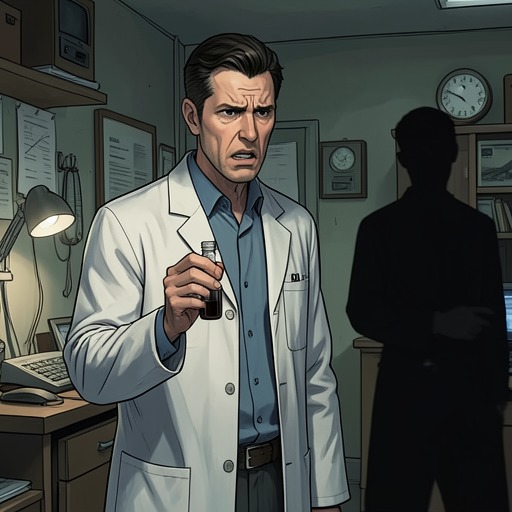
The Shop’s interest in pyrokinesis turns a family crisis into an institutional problem. Its officials already know that Charlie lights fires, and Joseph Wanless points out that they assume she inherited her mother’s telekinetic ability while strongly suspecting that she has it. Later, a large report prepared under Patrick Hockstetter’s direction treats will as the first cause of the abilities under study. Its researchers reason that the Shop needs to weaken Andy and Charlie’s capacity to choose: the report proposes Thorazine for Andy and Orasin for Charlie so that they will be too dulled to exercise their powers. The premise makes control of the people themselves part of the proposed method for controlling the abilities.
For Charlie, the tests are not abstract research. Hockstetter repeatedly asks her to make fires, presenting different materials and accompanying the requests with what she experiences as false sympathy. She refuses, but is afraid that pressure will eventually make her comply. At night she revisits the fires associated with her escape and imprisonment, including the men, cars, chickens, and teddy bear. She recognizes a disturbing pattern: the more she has used the power, the stronger it seems and the harder it is to stop. She also acknowledges that using it has become enjoyable. Her decision to refuse further fires is therefore not uncomplicated courage or simple fear; it is an attempt to resist both the Shop’s demands and the attraction she has begun to feel toward the power.
The Shop’s understanding is itself divided. Its report recognizes that Charlie’s power can jump the barriers of will, but also concludes that she makes a choice at the Manders farm. Elsewhere, agency reports deny the significance of pyrokinesis by offering alternative explanations for the fire there, including a gasoline spill or a broken kerosene lamp. Cap Hollister sees this as a dangerous refusal to accept what the evidence indicates. The contradiction exposes the Shop’s problem: it wants to classify and exploit a power whose workings it cannot confidently separate from the choices and circumstances of the person who possesses it.
Escalation and significance
During the final attack on the Shop compound, Charlie’s power becomes a direct response to armed violence. After Shop personnel kill horses, she stands by the stable as lines of fire spread toward the attackers. She redirects one line, setting several men’s clothing alight, and turns the force against an armed shooter. When an armored limousine emerges from a building used by the Shop, Charlie directs the power toward it; the car’s fuel tank explodes and the vehicle is consumed by the fire. The power is no longer confined to an accidental ignition or a controlled demonstration. Its reach and force are increasing as the confrontation continues.
Charlie does not direct the fire indiscriminately at everyone present. As secretaries flee, she could turn it on them, but instead makes an effort to direct the power toward the building where she and Andy had been held and where John Rainbird had betrayed her. That choice does not erase the destruction or make the ability safe; it shows that even amid escalation, the power’s target remains connected to Charlie’s understanding of threat and betrayal. The compound’s destruction is the starkest demonstration of what the Shop’s proposed control cannot guarantee.
The novel’s afterword places pyrokinesis beside the idea of so-called wild talents investigated by governments, including levitation and psychic phenomena. It notes reports of spontaneous combustion but explicitly avoids claiming that such an ability exists or that the novel’s events are likely or possible. This qualification preserves the concept’s double character: within the story, pyrokinesis is a consequential power with causes and consequences; outside it, the afterword leaves the phenomenon in the realm of unsettling possibility. The story’s central tension is not simply whether fire can be made by thought, but whether a dangerous capacity can be understood, restrained, or used without turning its possessor into an instrument.