Wild talents
FirestarterWild talents are psionic abilities that the afterword presents as objects of government investigation, not as phenomena the author confirms to be real. The term links Firestarter’s imagined powers to reported research into telekinesis, telepathy, levitation, and pyrokinesis, while the afterword maintains a deliberate distance between those claims and the novel’s fictional events.
Definition and Scope
The afterword identifies Wild talents as a term for psionic abilities coined by science-fiction writer Jack Vance. Its examples range across different purported capacities: influencing the Kirlian aura, telekinesis, psychic healing, communication by telepathy, levitation, and pyrokinesis. The category is therefore broader than any single power represented in the novel; it gathers together abilities that governments had reportedly spent money investigating.
The author also distinguishes the existence of research from proof that the abilities themselves exist. Reports of programs and experiments establish that institutions took the subject seriously enough to investigate, but do not settle whether the claimed powers are genuine. That distinction governs the afterword’s treatment of the concept throughout.
Government Research
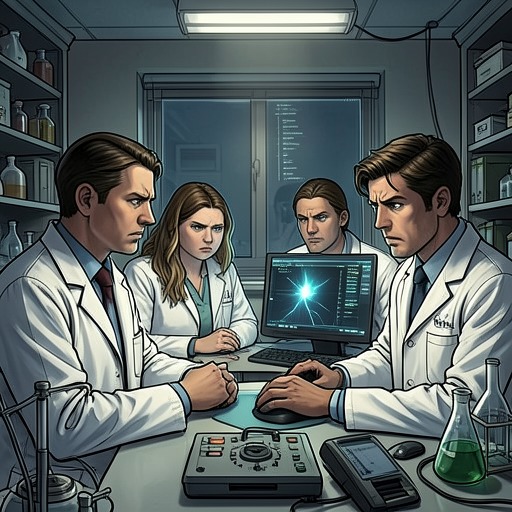
The afterword describes programs in both the United States and the Soviet Union aimed at isolating Wild talents and perhaps putting them to use. In the United States, government-funded experiments had centered on influencing the Kirlian aura and trying to prove telekinesis. Soviet experiments, by contrast, had focused largely on psychic healing and communication by telepathy.
Reports emerging from the Soviet Union suggested moderate success with telepathic communication, particularly in experiments using identical twins as communicators. The afterword presents this as a report, not as a verified conclusion: its phrasing preserves the uncertainty surrounding both the evidence and the interpretation of the reported results. The possibility of practical use gives the research an ominous edge, but the text does not claim that either government had established a reliable means of exploiting such abilities.
Pyrokinesis and Firestarter
Pyrokinesis is the form of Wild talent most directly connected to Firestarter. The afterword says that both governments had spent money investigating it, then points to accounts of real-life incidents catalogued by Charles Fort in Lo! and The Book of the Damned. Those reports generally involve spontaneous combustion and the generation of extraordinarily high temperatures.
The comparison supplies a real-world point of reference for the novel’s central power without treating the reports as confirmation of Charlie’s abilities. The afterword expressly declines to say that pyrokinesis exists and does not ask readers to believe that it does. It likewise disavows the suggestion that the sequence of events in the book is likely or even possible. The connection is one of eerie resemblance and imaginative provocation, not a claim that fiction documents fact.
Uncertainty and Significance
The afterword makes uncertainty part of the concept’s meaning. Government interest, reported experiments, and accounts of spontaneous combustion can make Wild talents seem less easily dismissed, but none is presented as conclusive proof. The reader is left between ordinary explanations and the possibility that some reported phenomena remain difficult to explain; the novel’s fictional certainty about its characters’ powers does not erase that distinction outside the story.
The idea ultimately supports the afterword’s closing image of a world that appears brightly illuminated yet retains obscure corners and unsettling recesses. Wild talents name one such recess: not a demonstrated supernatural fact, but a field where scientific attention, unexplained reports, and imaginative possibility meet. That carefully limited claim lets the novel draw on real-world unease without presenting its extraordinary events as an account of what actually happened.