the push
FirestarterThe push is the name Andy McGee gives his power to influence another person’s thoughts and behavior, an ability that helps him and Charlie McGee survive the Shop’s pursuit but exacts a growing cost from him. Its effects range from quiet compliance to abrupt changes in what a person will do; its limits depend on the target and on Andy’s depleted capacity, while its dangers reach beyond the immediate instruction. For Andy, using it is never simply a matter of issuing a command: each attempt tests how much control he has left, and how much the power may take from both its user and its target.
Definition and How It Works
Andy calls the ability the push. Its basic operation is suggestion: he directs a thought at someone and can make that person more likely to accept it as reasonable or act on it. It is not described as a universal power over every mind. Andy judges that some people resist more readily than others, and his practical calculations about whom to influence shape the way he uses it.
When Charlie is young, she understands that her father can push people, but knows that her own power is stronger. Andy has warned her that her ability is not quite like his and that she must not let the Shop discover more about it. The difference is consequential: after Andy uses the push, he can suffer headaches, whereas Charlie does not report that same effect. Her ability, however, is associated with fires. The comparison establishes that the shared family term does not mean their powers are identical, and that each has a different cost and danger.
The push can also affect confidence rather than simply prompt a single action. Cap Hollister recognizes that Andy’s talent is suited to making people feel confident: Andy can push them into that state. Its influence may therefore appear as a person’s own conviction, not as an obviously external command. That quality gives the power practical reach, but also makes its effects difficult to separate from the target’s ordinary judgment.
Practical Uses and Evasion
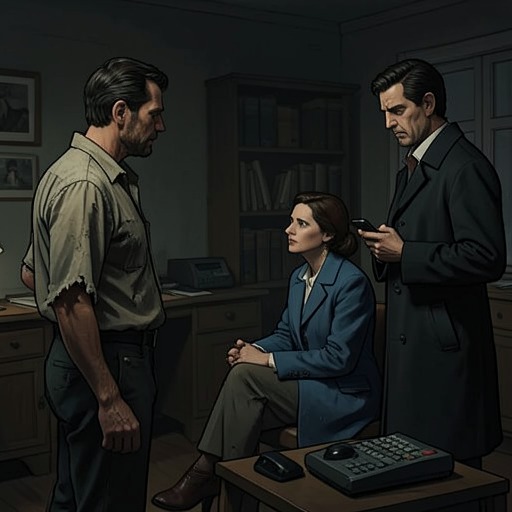
During the escape with Charlie, Andy’s use of the push is tied to immediate needs: transportation, concealment, and getting past people who might stop them. When Charlie is falling asleep, he folds his corduroy jacket and places it under her head. He then sees an opportunity in a cab driver he considers susceptible and offers the driver a five-hundred-dollar bill to take him and his daughter to Albany. Andy’s assessment is explicitly tactical and subjective: he thinks the driver’s age, intelligence, and other characteristics make him easier to influence. The calculation is not presented as a reliable scientific rule, but as Andy’s working estimate under pressure.
Once the driver looks down at the money, Andy pushes hard. He is afraid the attempt will fail because he may have little ability left; earlier, he had already spent some of that capacity making a driver see a nonexistent Black man in a checkered cab. The episode connects the power to ordinary objects and choices—the folded jacket, a large banknote, a cab—rather than to a visible display. The money helps create the opening, but it is the push that Andy hopes will turn an offer into a successful escape route.
In another encounter, Andy casually suggests that he be allowed to look around and that the person he addresses will not remember his visit. He steps inside, experiences a sharp pain in his head, and the pain fades to a low throb before disappearing about half an hour later. The episode shows both the unobtrusive form his influence can take and the bodily consequence that follows even a brief use.
The power becomes more forceful when Andy faces agents during the pursuit. He tells one that the agent’s gun is too hot to hold, then pushes again to make him believe he is blind; the effort brings severe pain. Andy follows with another push intended to make the man sleep, and the agent falls. He then uses further, lighter suggestions to manage the surrounding situation. By the time he gives another small push, he is beginning to feel sick and his head is pounding. These uses demonstrate his ability to adapt the push to an unfolding confrontation, but also the accumulating strain of repeatedly drawing on it.
Limits, Resistance, and Psychological Risk
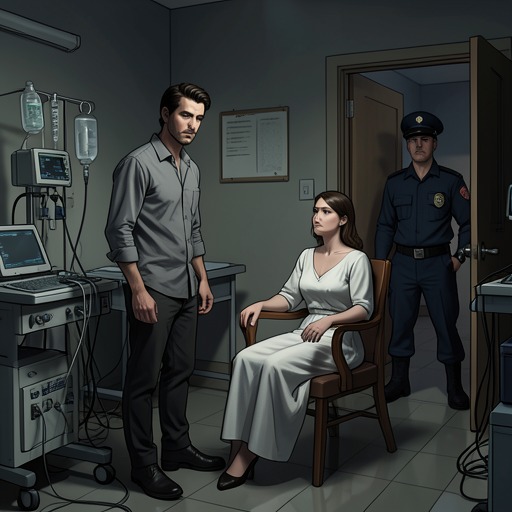
The push does not guarantee compliance. In a later test with Herman Pynchot, Andy tries to make Albright consider putting ink in his water a reasonable thing to do. Albright instead replies that Andy is crazy. The attempt feels unlike Andy’s familiar use of the ability: he notices neither the usual sensation of the push shifting or doubling nor a headache. He is disturbed not only by the failed suggestion but by the possibility that the talent itself has deserted him.
Andy explains that the target had been nervous and was not especially bright. In his experience, older people and people with low or low-normal intelligence are harder to push, while bright people are easier. These are Andy’s stated generalizations, not guarantees: Albright’s response shows that even when Andy believes he has concentrated his will on a suggestion, the person may reject it. The test turns his former confidence in the ability into uncertainty about whether it is still available at all.
The risk is not limited to failure. Andy has learned that the push can leave a person extremely suggestible, and that a suggestion may intensify fears, guilt, or other deeply rooted impulses. He recalls a participant in his Weight-Off program who began having frightening catatonic lapses, and a businessman who disclosed a disturbing self-endangering impulse associated in his mind with Edgar Allan Poe’s William Wilson. Andy had previously found ways to intervene in such cases. The examples make the push morally and psychologically hazardous: it can act on vulnerable material already present in a person, with consequences that may exceed the user’s immediate purpose.
Depletion, Recovery, and Aftereffects
The long escape from New York through Albany County Airport to Hastings Glen leaves Andy questioning whether he has used up the ability. He and Herman Pynchot both consider whether he has exhausted it or developed a psychological block. Andy wonders whether his mind is refusing to use the power as a defense against what further use might do to him. The concern is grounded in physical signs he has not forgotten, including numbness in his cheek and neck and a bloodshot eye. During this period his medication dosage is increased after those around him become convinced that his inability to push is real rather than feigned.
At another low point, Andy thinks that he might as well wish for the push to return. Later, he is astonished to recognize that he has pushed himself. That moment marks an altered relation to the ability: rather than directing it outward at another person, he turns it on himself. The evidence presents this as a discovery, not as proof that his difficulties are permanently over. He subsequently proposes one more series of tests with Pynchot and pushes lightly at him for safety’s sake, suggesting a cautious attempt to establish what he can do.
The power’s return does not erase its history of cost. During the pursuit, Andy had been grateful that he had not used it throughout the summer and considered himself fully charged again, but later uses bring pain and sickness. His own estimate of available capacity changes with circumstances: he can feel replenished after a period without using the talent and then find himself close to exhaustion when danger forces him to spend it. The push thus functions as a resource that Andy must ration, not an unlimited means of control.
The Shop and the Power’s Narrative Role
Andy’s ability is part of the reason he and Charlie are of interest to the Shop. He explains that the Shop is the Department of Scientific Intelligence and that the organization’s public responsibilities include domestic scientific projects with possible national-security applications. He identifies himself and Charlie as part of an experiment that took place before she was born, and notes that her mother was involved as well. In this account, the push is not merely a private talent: it belongs to a family history entangled with institutional research and pursuit.
The threat of discovery shapes how Andy and Charlie use their powers. He tells Charlie not to reveal more about her ability because the Shop may be watching or learning about them; he also distinguishes her stronger, fire-associated power from his own. Andy’s suspicion that the Shop may have been charting him reflects the same pressure. He notices that strange things stopped happening for a while after he obtained money and fears that, if the Shop has tracked the pattern, its agents may know how little of the push remains to him. The power is therefore both an instrument of evasion and a source of evidence that may expose its user.
Andy also experiences vivid hunches after the experiment at Jason Gearneigh Hall and has learned to trust them, while remaining unsure whether they amount to a low-grade form of precognition. The narrative keeps these hunches distinct from the push: one is an uncertain forewarning, the other a deliberate attempt to influence another mind. Together, they place Andy’s abilities within an uncertain aftermath of the experiment, without making every unusual perception an instance of the same power.
The push’s significance lies in this tension between agency and consequence. It can open a route to Albany, help Andy pass through an obstacle, or make another person feel confidence; it can also fail, deplete him, or magnify dangerous impulses in someone else. Each use promises control over an immediate situation, yet the continuing costs make that control precarious. Andy’s ability is thus both a means of protecting Charlie and a reminder that influence, even when used to survive, is not consequence-free.