The Breakdown of Wallander and Martinsson’s Relationship
FirewallThe breakdown of Wallander and Martinsson’s relationship turns a strained working partnership into an open conflict, and then into a friendship Wallander believes is irretrievably lost. Its decisive fault line is not simply disagreement over how to lead an investigation: Wallander comes to suspect that Martinsson has been covertly discrediting him, while Martinsson says Wallander has lost his grip and does not really listen. The case still requires them to work together, but cooperation can no longer restore the trust on which their relationship depended.
A partnership under pressure
The rupture begins before either man names it. Wallander has been told things about Martinsson by Ann-Britt Höglund, but his doubts are complicated by his own unwillingness to believe them. Losing Martinsson as a trusted friend would make work in the Ystad force feel impossible; Wallander sees their bond as both personal and institutional. He believes he trained Martinsson as Rydberg once trained him, yet insists to himself that he never wanted to displace Rydberg’s authority. That comparison makes Martinsson’s apparent impatience feel like more than ordinary professional friction: Wallander fears that a successor is turning against the person who helped shape him.
On Saturday morning, Wallander learns that Robert Modin has made an unexpected discovery and decides Martinsson must be told, despite his reluctance to have more contact with him than necessary. Martinsson has not yet heard from Modin. He questions how Modin could have reached his conclusion without access to the computer, then suggests that the young man might have copied material onto his own machine. Their brief call sounds entirely normal to Wallander. That normality unsettles him rather than reassuring him: he wonders whether Martinsson is concealing his hostility unusually well, or whether Höglund’s account is wrong.
Wallander’s private anxieties expand into a larger sense of professional displacement. He thinks of the police force as a place of envy, gossip and intrigue, and fears that he has been drawn into the very manoeuvring he believed himself to avoid. His suspicion is therefore joined to a question of authority: whether he can still lead his colleagues, and whether Martinsson is preparing to take his place. At this point, however, Wallander has uncertainty rather than proof, and he continues to depend on Martinsson as a colleague in the investigation.
The field confrontation
The conflict becomes explicit after Wallander survives a gunman’s attack in the mud. As the operation is dismantled, Lisa Holgersson tells him that she believes she has a fairly complete picture of what happened and that a full debriefing will be needed. She also raises a specific account of the pursuit: according to various reports, Wallander ordered Martinsson to stay behind rather than follow him into the field. Holgersson calls that decision irresponsible, especially because police should not act alone.
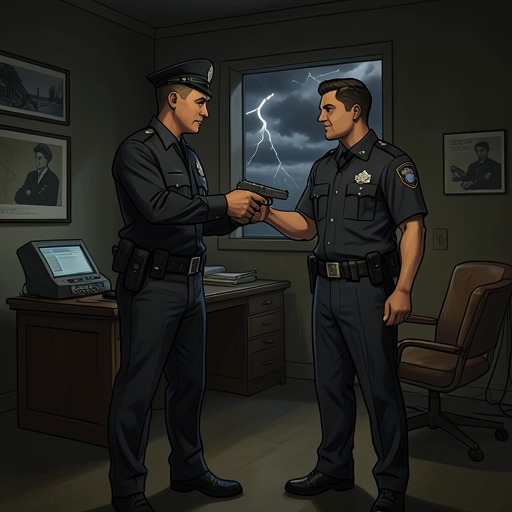
Wallander knows that Martinsson is the only possible source for this version; the other nearby officers had been too far away to hear the exchange. The allegation changes the meaning of the danger he has just endured. It is no longer only a near-fatal episode, but also a story about his conduct that may reach his superior and shape how the force judges him. When Martinsson and Hansson approach, Wallander asks Hansson to hold Martinsson’s flashlight, then steps forward and strikes Martinsson. The blow lands weakly in the shifting light, but Wallander throws himself at him, and both men fall into the mud.
Wallander accuses Martinsson of telling Holgersson that he had ordered him to stay behind and of spreading lies about him. He also says Martinsson has been going behind his back to complain that he is bad at his job. Martinsson denies knowing what Wallander means. Wallander does not pursue the argument at length; he says he has made his point, throws the flashlight at Martinsson’s feet and leaves in a patrol car. The physical confrontation gives visible form to a breach that had until then been expressed through suspicion, withheld communication and fear of betrayal.
At home, the memory of lying with his face in the wet clay and expecting to die returns alongside the fight. Wallander feels humiliated by the thought of dying without his shoes on, and exhausted by the confrontation. He wonders what will follow from striking Martinsson, particularly because he is already under scrutiny over another use-of-force allegation. He cannot honestly say he regrets the blow: he understands it as an act of personal dignity. But he also recognizes that the incident leaves their dispute vulnerable to competing accounts, with Holgersson already appearing to trust Martinsson’s version more than his own.
Cooperation without reconciliation
The next morning, Wallander and Martinsson meet in the station corridor at exactly eight o’clock. They approach from opposite ends, and Wallander experiences their walk toward the canteen as a duel. Martinsson has a black eye and a swollen lower lip. He says he will get Wallander for what he did, but first they must finish the case. Wallander admits that hitting him was wrong; it is the only part of his conduct that he takes back. The exchange establishes a narrow truce, not forgiveness: the investigation takes precedence, while the injury and grievance remain between them.
They proceed with the morning’s work in the canteen, with Hansson present and Ann-Britt Höglund arriving before the briefing. Martinsson has told her about the gunman’s death but, Wallander notices, has said nothing about their fight. Wallander continues to assign tasks and press the investigation forward. He asks Höglund to accompany Holgersson to hear what she says at a likely press conference, and openly criticizes the chief in a way that surprises the room. Then he returns to the urgent case: the team must concentrate on Tynnes Falk’s computer, because whatever has been programmed into it is due to take effect on October 20, less than sixteen hours away. Even at their point of greatest personal strain, Wallander and Martinsson remain joined by work that cannot wait for their reconciliation.
The friendship’s end
After the case meeting, Wallander is relieved when Höglund tells him that Eva Persson and her mother have recanted, but he does not want to pursue the accusations against him. He would rather let the affair fall silent, despite Höglund’s urging that he challenge his mistreatment for the force’s sake. When he encounters Martinsson afterward, he knows he can no longer postpone a direct conversation.
Wallander accuses Martinsson of covertly questioning his leadership and laying groundwork for his own career. Martinsson is calm and says Wallander has lost his grip; he maintains that his own fault was failing to say so earlier. He also says he tried to speak directly but was not listened to. Asked about the report that Wallander ordered him to stay behind, Martinsson says Holgersson must have misunderstood. Wallander still wants to hit him, but no longer has the energy, and he recognizes that he cannot make Martinsson change his official account. Martinsson leaves without retracting it.
Wallander experiences the result as the end of their friendship, though he wonders whether the friendship had ever been as real as he believed. Grief gives way to rage, but the loss weighs more heavily: he expects to remain in charge of difficult investigations in Ystad for at least a few more years and cannot see how he will find the energy to continue. The breakdown exposes the personal cost of leadership as Wallander understands it. His sense of betrayal is inseparable from his fear of professional exhaustion, and the two men’s final disagreement leaves no clear resolution—only a working relationship forced onward by the case, and a friendship Wallander considers broken.