Tynnes Falk’s secret double life
FirewallTynnes Falk’s secret double life is defined by a sharp disparity between the considerate husband and father known to Marianne Falk and the driven, secretive man glimpsed in fragments: a political demonstration, four missing years, an unexplained stay in Angola, violent outbursts, and a computer linked to the networks of major institutions. The facts reveal the shape of a hidden existence, but not a complete account of what Falk did or why. His secrecy persists even after his death, leaving others to assemble a portrait from photographs, recollections, and coded files.
The years that disappeared
Before Falk vanished, Marianne had seen no clear sign that he was drawn to radical politics. She recalled that he could speak confidently about political questions and theory, but she had not detected a political commitment in him. When she unexpectedly saw him among demonstrators marching about Third World issues, their banners attacked the World Bank and Portuguese colonial oppression. Falk was furious that she had witnessed him there. His anger was the first time she had seen his temper, and it made her suspect that there was more to him than she knew.
That June, Marianne ended their relationship at an outdoor café in Kungsträdgården. She told Falk plainly that she did not believe they had a future. He listened without speaking, left money for their coffees, and walked away with an expression she remembered as blank. About a week later, she decided she wanted to talk to him again, but he had moved out of his student room without leaving a forwarding address. Even his parents in Linköping did not know where he had gone. Falk had withdrawn from business school, and for four years Marianne had no idea what had become of him.
He reappeared on August 2, 1977, waiting outside Sabbatsberg Hospital with a large bouquet. Marianne had just accepted her first nursing position; her mother had recently died, and she remembered feeling lost and lonely. Falk’s return cheered her. Within days he asked her to marry him, but he offered no account of his absence. Instead, he proposed that neither ask about the other’s life during those four years, as though the interval could be set aside. Marianne accepted the silence as part of their renewed relationship, not as an explanation for it.
Angola and the marriage
Only by chance did Marianne learn that Falk had been in Angola. A doctor she worked with recognized him and said he had encountered him there the year before, shortly after the country became independent. Falk had seemed unfriendly, as if he did not want another Swede to recognize him. The doctor remembered that he paid from money kept inside his Swedish passport. The brief encounter was one of the few independent traces of Falk’s missing years.
Marianne tried to learn more without questioning her husband directly. Relief organizations had no record of him; the Swedish International Development Agency told her he had spent two months in Angola helping install radio towers. That account did not explain the four years he had been gone. Marianne and Falk married and had children, but, apart from what she learned by chance, she never knew what he had been or done during that period. The agreement not to ask had become a durable boundary in their marriage.
After Falk died, Marianne opened a locked steel trunk in the basement. It contained little beyond dust and a brown leather photograph album marked Angola 1973–1977. The album offered images rather than a confession: a burned-out bus northeast of Huambo in 1975; women gathered at a low, parched waterhole; and, in one photograph, a thin, tanned man standing before a power substation. Its final image showed the same man seated by the ocean in Luanda in June 1976. The photographs established a connection between Falk and Angola across several years, but did not explain his work there or identify the man at the substation.
The hidden temperament
Marianne’s account complicates the reassuring domestic image. She said Falk had treated her and the children well and could be good-natured, so she had not pressed him about the other parts of his life. At the same time, she sometimes felt she had married a fanatic, a person with two lives. His ideas about life, people, and the world could turn suddenly into fierce accusations aimed at no particular person. He seemed to be sending messages into space, she recalled, and then the rage would pass as quickly as it had come.
She did not ask him to explain these eruptions. They frightened her, and she thought Falk himself wanted to hide them, perhaps because they embarrassed him. Nor could she connect his behavior to a known political organization: he despised politicians, she said, and she did not think he voted. The earlier demonstration therefore remains an unresolved counterpoint to her later description. She had seen him in a political march, but in their life together he concealed his convictions and left her without a coherent account of them.
The computer and the larger secret
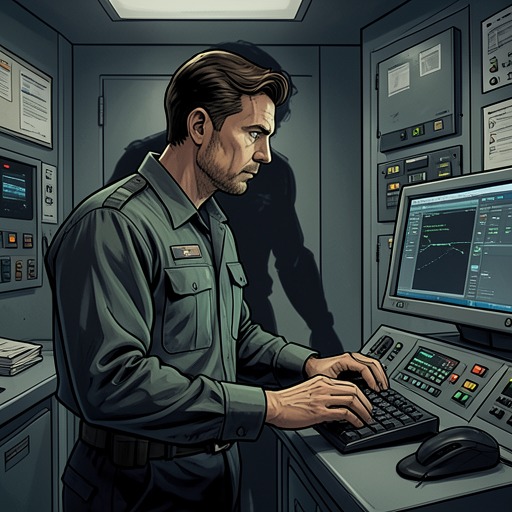
The investigation after Falk’s death disclosed another dimension of his hidden activities. Robert Modin and Martinsson bypassed the security on Falk’s computer by connecting Modin’s own computers to it. Inside a file named Jacob’s Marsh, they found ordered phone numbers, names, and codes. Some long number sequences appeared to function as code names for institutions in the United States, Asia, Europe, Brazil, and Nigeria.
One recognized code pointed to the Pentagon. The computer contained a substantial amount of classified information, some of it possibly obtained illegally, and the investigators concluded that Falk appeared to have hacked into institutional networks. Modin also identified a code associated with a World Bank branch dealing with global financial inspections. The discoveries enlarged the scale of the secret life: Falk’s hidden work was not limited to an unexplained past abroad or private ideological outbursts, but reached into protected electronic systems. Yet the purpose of the information remained unclear, and the file’s name and ordered codes did not by themselves disclose what Falk intended to do.
The limits of the reconstruction
Falk’s double life becomes legible through contrasts rather than a final revelation. Marianne’s memories establish both everyday kindness and frightening, unexplained anger; the album supplies a span of dates, places, and a striking image of a power substation; the computer supplies evidence of concealed access to powerful institutions. Each source answers one question while sharpening another. Even after the investigation uncovers the Pentagon and World Bank connections, the missing years in Angola and the motives behind Falk’s network activity remain unresolved. The secret is therefore not a second, fully documented biography, but the enduring gap between the life Falk allowed his family to know and the life the surviving clues suggest.