Tynnes Falk's diary
FirewallTynnes Falk's diary is at once an exacting household log and the clearest surviving sign that his orderly life concealed an unexplained communications network. Its entries measure weather and cleaning down to minutes, then abruptly refer to C-space, messages, and a silent correspondent. When the diary vanishes from Falk's flat, its private code becomes a focus of the investigation—and its disappearance suggests that someone fears what the police might learn from it.
Discovery and physical context
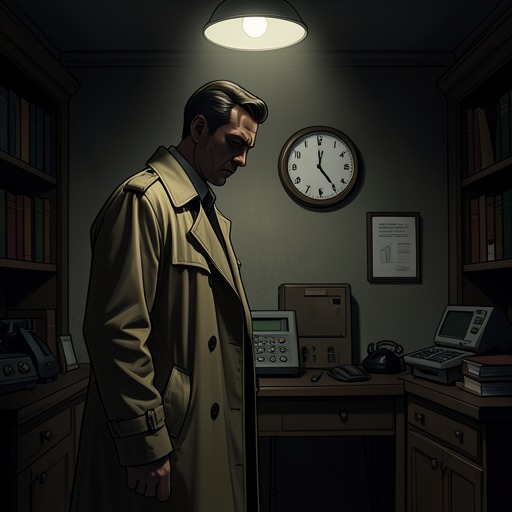
Wallander finds the diary in the third drawer of Falk's desk, among the carefully arranged contents of a flat that appears impersonal and difficult to penetrate. It is thick, and its entries continue the same meticulous order Wallander has noticed in the apartment. The diary is not an isolated scrap of writing: Falk has kept it alongside a green writing pad and ordinary household material, including a newspaper clipping about making fish fondue. The domestic setting makes the book's precision seem at first like an extension of his habits rather than a record of a crime.
The contrast between the diary's detail and its silences immediately unsettles Wallander. Falk records exact conditions but does not write down a single name—not even the names of his children. Wallander wonders whether the entries might have been written by someone manic or confused, but that possibility does not explain their repeated references to C-space. The diary gives him abundant data while withholding the relationships and meanings that would make the data intelligible.
Weather, cleaning, and routine
The last entry is dated Sunday, October 5. Falk notes that the wind has died down, the temperature is 3°C, the sky is clear, and he has cleaned the flat. The cleaning took 3 hours and 25 minutes, ten minutes longer than the previous time. The figures give an ordinary chore the form of a timed record, as though variation itself needs to be measured. The entry ends with the question “A short walk in the evening?” Wallander cannot tell whether Falk has already walked or is considering going out.
The preceding entry, for Saturday, October 4, 1997, is similarly exact. It records gusts of 8–10 metres per second according to the Meteorological Office, broken clouds, and temperatures of 7°C at 6 a.m. and 8°C at 2 p.m. The diary repeatedly preserves this kind of information about the weather and Falk's routines. Its numbers suggest a life organized around observation and comparison, but the record does not explain why this precision mattered to him. Even the most recent domestic details leave the central question open: what, beyond the condition of his flat and the sky, was Falk monitoring?
The C-space entries
Alongside the weather, the diary repeatedly records activity in C-space. Some days are quiet; on others there are messages. In the October 4 entry, Falk writes, “No activity in C-space today. No messages. C doesn’t reply when prompted. All is calm.” The short statements sound like a status report, but the diary supplies no key for interpreting them. Wallander cannot tell what the messages contain, who or what C is, or what it means for C not to reply. Their recurrence turns an otherwise mundane log into a record of an unseen exchange.
The expression later gains a possible technological context when Wallander recognizes that Martinsson's word “cyberspace” resembles Falk's C-space. At Falk's computer, Martinsson finds advanced programs and a system that appears to connect automatically to a server. When he tries to open a file, a blinking cursor suggests that someone may have been notified of the attempt. These discoveries do not establish exactly what the diary's messages refer to, but they make its unexplained entries harder to dismiss as private eccentricity. The log's silence and activity may belong to the same hidden digital world the police are beginning to uncover.
The missing diary and its significance
After Wallander has secretly examined the flat, he returns to find it ransacked: drawers have been emptied, paintings hang askew, and records lie shattered. The diary is gone, as is the photograph of a group of men that Wallander had found on his earlier visit. He realizes that the intruder has removed two items he personally saw in place. Because the diary's entries are cryptic and the photograph unidentified, their joint disappearance sharpens rather than resolves the mystery: someone appears to be selecting evidence, not merely destroying the flat at random.
Wallander concludes that whoever took the diary did not want the police to study it. The later computer investigation gives the C-space notation added weight, but the diary never identifies the person behind the messages or fully explains their purpose. Its importance lies in that unresolved gap. Falk's routine is recorded with almost obsessive exactness, while the most consequential part of his life remains coded; once the book is stolen, even the record of that hidden life is taken out of the investigators' hands.