over many generations before the narrative
The Evolution of Flatland’s Classes
[Flatland](entity:location-recall-location-flatland-49ed52b38688)’s social hierarchy rests on the shapes of its inhabitants. [Women](entity:character-recall-character-0ba43fd49a46) are straight lines; working soldiers and artisans belong to the [Isosceles Class](entity:character-recall-character-isosceles-cb48ed927ae5); equilateral triangles form the middle class; and figures with more sides rise through the professions and nobility toward the Circle-like priests. Men’s offspring ordinarily gain a side each generation, while lower-class families may rise only through rare, carefully regulated changes in their descendants’ angles.
The hierarchy presents itself as natural law, but its institutions actively manage the population: promising children are separated from their families, irregular figures are punished, and the Circle-like rulers use the hope of advancement to head off revolt. These arrangements establish the unequal order that Square will describe and that his encounter with a higher dimension will eventually challenge.
before the narrative
The Laws of Flatland Life
[Flatland](entity:location-recall-location-flatland-49ed52b38688)’s inhabitants orient themselves by a southward attraction, rain from the north, and the alignment of buildings. Their houses are generally pentagonal, with separate entrances for men and women; sharper-cornered homes are restricted because their points could injure passersby. The ordinary world is thus shaped by physical dangers and strict regulation alike.
[Women](entity:character-recall-character-0ba43fd49a46)’s pointed, nearly invisible forms make them especially dangerous in a collision, so the law requires them to announce themselves with a constant peace-cry and imposes other safeguards. These rules belong to a wider gender hierarchy that denies women education and treats their safety and conduct as matters for male authorities to control.
before the narrative
Recognition by Touch and Sight
Because every figure appears as a line when viewed from within the plane, Flatlanders rely on hearing, touch, and, in foggy regions, subtle differences in brightness to identify one another. Touch is common among lower classes, while educated and wealthy figures cultivate visual recognition, an art taught through years of study at the [University of Wentbridge](entity:location-recall-location-university-of-wentbr-7854703a12c9).
The methods reflect and reinforce the class system: the poor cannot afford advanced training, and contact can be dangerous when a figure moves unexpectedly. Regularity is therefore treated as essential to social trust and public safety, giving the state grounds to criminalize irregular shapes and present discrimination as necessity.
centuries before the narrative
Chromatistes Introduces Colour
According to [Flatland](entity:location-recall-location-flatland-49ed52b38688)’s tradition, a Pentagon named [Chromatistes](entity:character-recall-character-chromatistes-4c6497af3f7d) discovers how to make and apply colour. Painting spreads rapidly from individuals and households to nearly every class except women and priests, whose shapes do not fit the claim that differences of sides should correspond to differences of colour.
Colour makes people easier to distinguish without touch or specialized visual training. Its appeal brings an extraordinary artistic liveliness to Flatland, but it also weakens the skills and institutions on which the ruling order depends. The innovation therefore begins as a source of beauty and convenience while quietly preparing a political crisis.
after colour spreads across Flatland
The Colour Revolt Era
As colour recognition replaces the older arts, geometry and trained sight fall into neglect, while the [Isosceles Class](entity:character-recall-character-isosceles-cb48ed927ae5) grows more assertive. Its leaders argue that colour has erased meaningful differences between classes and demand equal rights, then push further: the [Universal Colour Bill](entity:rule-recall-rule-universal-colour-bill-0ab65ecfb40e) would require women and priests to be painted as well.
The proposal threatens the authority of the priestly order and risks making women indistinguishable from priests in certain views. The Circle-like rulers recognize that the Bill could dismantle both social hierarchy and the intellectual disciplines that preserve their power. Their resistance turns a popular innovation into a struggle over the constitution of [Flatland](entity:location-recall-location-flatland-49ed52b38688).
during the three-year agitation
The Painted Isosceles’s Fraud
An Isosceles of low ability paints himself to resemble a twelve-sided figure and uses a counterfeit voice to deceive an orphaned young woman of noble Polygonal family. He succeeds in marrying her through a chain of deceptions and the carelessness of her relatives; when she discovers the fraud, she takes her own life.
The tragedy makes the danger of colour-based misidentification immediate to women, who had been drawn to the [Universal Colour Bill](entity:rule-recall-rule-universal-colour-bill-0ab65ecfb40e) by the prospect of receiving the deference shown to priests. Their support begins to collapse, giving the Circles an opening to turn the movement against its own leaders.
near the end of the three-year agitation
Pantocyclus Turns the Assembly
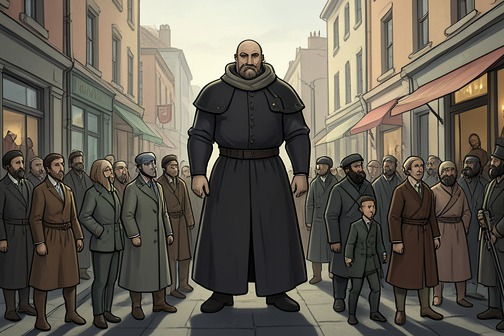
At an extraordinary assembly attended by an immense crowd, Chief Circle [Pantocyclus](entity:character-recall-character-pantocyclus-e9528fe85ec9) appears to concede that the hierarchy will accept the Colour Bill. He then makes a carefully staged appeal, directing attention to the risks the proposal poses to tradesmen, workers, women, and the possibility of social advancement.
His speech divides the coalition behind the Bill. Workers are reminded that universal colour would blur distinctions they hope their descendants might cross, while women are warned that imposture could make marriage and personal safety uncertain. The apparent concession is a tactical maneuver that prepares the rulers to suppress the revolt.
the climax of the agitation
The Chromatic Sedition Is Suppressed
At [Pantocyclus](entity:character-recall-character-pantocyclus-e9528fe85ec9)’s signal, Isosceles convicts kill [Chromatistes](entity:character-recall-character-chromatistes-4c6497af3f7d) as women, moving backward under the Circles’ direction, strike the soldiers. The trapped crowd panics and turns on itself; within half an hour, the Isosceles multitude has been annihilated by its own violence.
The rulers extend the purge to suspected irregulars and reduce the working population, restoring the balance of classes through force. Colour is prohibited, its manufacture restricted to a single secretive source, and workers involved in its production are periodically replaced. The revolt ends, but the fear of its return remains embedded in the state’s repression.
before Square’s encounter with the Sphere
The Circle Doctrine
[Flatland](entity:location-recall-location-flatland-49ed52b38688)’s priestly rulers teach the maxim “[Attend to your Configuration](entity:expression-recall-expression-attend-to-your-con-4966d709435c),” arguing that bodily form determines conduct and that moral praise or blame has no independent basis. Irregularity is treated as both a physical defect and a threat to public order, while the state regulates marriage through carefully maintained pedigrees.
Square criticizes the system’s contradictions, especially its treatment of women and the rulers’ careless choices of wives despite their claims to protect hereditary regularity. He also worries that forbidding women an education may weaken men by forcing them to learn separate languages of emotion and reason. His unease foreshadows the distance between the society he inhabits and the broader understanding he will gain.
the night before the third Millennium
The Square’s Vision of Lineland
On the eve of the year 2000, Square dreams that he enters [Lineland](entity:location-recall-location-lineland-8f5d00779fbf), where everyone is confined to a single line and can see only a point. He speaks with the ruler, who insists that his line is all of space and that its inhabitants’ lives are governed by voices, not by any world beyond their narrow path.
The King explains Lineland’s marriage chorus, through which distant lovers recognize one another by the harmony of their voices. Square tries to explain directions and dimensions the King cannot conceive, but the ruler rejects his account as absurd. The dream gives Square a vivid miniature of the blindness he himself will soon display toward a higher dimension.
the final evening of 1999
The Grandson’s Geometric Question
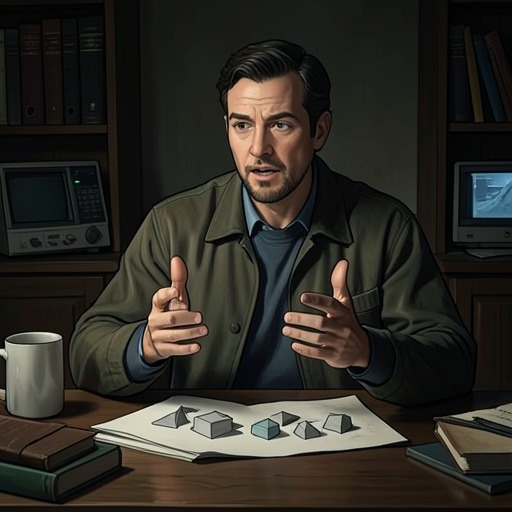
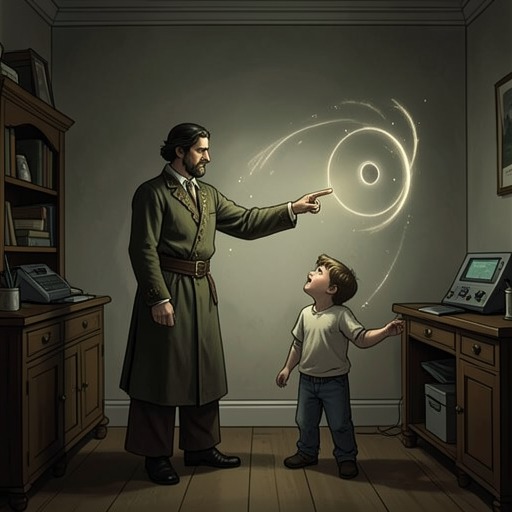
At home, Square teaches his youngest grandson how a point moving makes a line and a line moving makes a square. The boy asks what a square moving in a further direction would produce, suggesting that the third power of a number might have a geometric meaning.
Square dismisses the question as nonsense because he believes geometry has only two dimensions. Although the boy’s reasoning unsettles him, Square scolds him and sends him away. The question becomes the first clear challenge to Square’s own assumptions before the [Sphere](entity:character-recall-character-sphere-3ca80d86a2bb) arrives to answer it.
the final evening of 1999
A Stranger Enters the House
As Square sits with his wife, an unseen presence contradicts his dismissal of the grandson’s question. A shifting figure appears, at first seeming like a woman or a Circle, and Square’s wife tries to identify it by touch. The visitor calls himself a perfect Circle in one sense, but says he is many Circles in one.
After Square’s wife withdraws, the stranger reveals that he comes from Space and challenges Square’s belief that space has only two dimensions. Square demands a direction or measurement for the alleged third dimension, treating the claim as either a joke or an impossible assertion. The visitor has reached [Flatland](entity:location-recall-location-flatland-49ed52b38688), but words alone cannot yet make Square understand what he is seeing.
just before the year 2000
The Sphere’s Sections
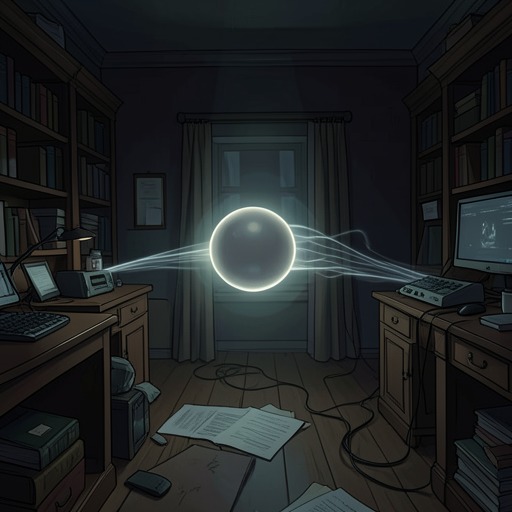
The visitor explains that Square sees him only as a circle because [Flatland](entity:location-recall-location-flatland-49ed52b38688) can display only a cross-section of a three-dimensional being. As the [Sphere](entity:character-recall-character-sphere-3ca80d86a2bb) rises out of the plane, his visible section shrinks until it vanishes; as he returns, it grows again.
Square witnesses the changing circle but cannot grasp the cause, interpreting the demonstration as trickery. The episode makes the difference between seeing a phenomenon and understanding its dimensional explanation central to their encounter, and the Sphere turns to analogy in an effort to reach him.
just before the year 2000
The Cube by Analogy
The [Sphere](entity:character-recall-character-sphere-3ca80d86a2bb) asks Square to imagine a point moving to form a line, then a line moving to form a square. By analogy, a square moving in a direction other than north would generate a solid with eight terminal points: a cube.
Square follows the numerical pattern but cannot picture the new direction or accept that it produces a solid. He takes the explanation as mockery and attacks the Sphere, unable to distinguish a limit in his own imagination from a limit in reality. The failure of analogy alone forces the Sphere to demonstrate his power directly.
just before the year 2000
The Sphere Enters the Locked Cupboard
The [Sphere](entity:character-recall-character-sphere-3ca80d86a2bb) slips into a locked cupboard without opening its door and removes an account tablet. He then returns it to the room, proving that he can move into and out of [Flatland](entity:location-recall-location-flatland-49ed52b38688) in a way Square’s ordinary spatial assumptions cannot explain.
He tells Square that he can see the interiors of closed things and can reach objects without passing through their visible boundaries. He also touches Square from within, causing sudden pain. The demonstration convinces Square that the visitor possesses an extraordinary power, but he still does not understand its true source.
the turn of the year 2000
Square Is Carried into Spaceland
When Square continues resisting and calls the [Sphere](entity:character-recall-character-sphere-3ca80d86a2bb) an impostor, the visitor warns that he must either listen or be taken out of his plane. He lifts Square from [Flatland](entity:location-recall-location-flatland-49ed52b38688), and Square experiences a disorienting new kind of sight and space before recognizing that he has entered [Spaceland](entity:location-recall-location-spaceland-2259939b845a).
There he sees the Sphere as a complete solid form rather than as a changing circle. He also learns that what he had regarded as the Sphere’s interior is its surface, and that even this new vision has limits. The journey transforms a mathematical conjecture into direct experience and begins Square’s apprenticeship.
the first day of the year 2000
Flatland Seen from Above
The [Sphere](entity:character-recall-character-sphere-3ca80d86a2bb) takes Square back above [Flatland](entity:location-recall-location-flatland-49ed52b38688), where Square can see the interiors of his house, its rooms, and the people within them. He sees his wife searching anxiously and glimpses a servant investigating a cabinet, while the familiar city becomes an open, miniature world beneath him.
As they rise farther, Square sees streets, buildings, mines, and caverns that had been hidden from him. He mistakes this wider vision for divine omniscience, but the Sphere warns that seeing more does not itself make anyone just, merciful, or divine. Square’s discovery expands his knowledge while exposing the limits of his earlier ideas about wisdom.
the first hour of the first day of the year 2000
The Sphere Appears at the Council
The [Sphere](entity:character-recall-character-sphere-3ca80d86a2bb) and Square descend to the [Metropolis](entity:location-recall-location-metropolis-f0521b2adcb3) during a meeting of the [Flatland Grand Council](entity:organization-recall-organization-flatland-grand-c-925d0d37c3fa). The council’s records show that on each millennial beginning it has ordered the suppression of people claiming revelations from another world, prescribing punishment according to social rank.
The Sphere enters the council chamber and announces that a land of three dimensions exists. Low-ranking guards rush at him, but his section expands and disappears from their view. The presiding Circle recognizes the incident from secret archives, orders witnesses silenced, and has Square’s brother condemned to perpetual imprisonment under the established policy.
after the council scene
Lessons in the Solid World
The [Sphere](entity:character-recall-character-sphere-3ca80d86a2bb) continues Square’s instruction by showing him a cube assembled from squares placed one above another. At first Square mistakes the solid for an irregular plane, but by touch and explanation he comes to distinguish a plane figure from a solid and to understand the cube’s six faces and eight corners.
Square celebrates the achievement as the high point of his history. Yet the Sphere’s lesson has also given him a new habit of asking what lies beyond the visible world. Having learned that a being can occupy a higher dimension than the one he knows, Square now turns that logic against his teacher.
after Square learns about solids
Square Appeals for a Fourth Dimension
Square asks the [Sphere](entity:character-recall-character-sphere-3ca80d86a2bb) to reveal his interior and argues that there must be a fourth dimension above [Spaceland](entity:location-recall-location-spaceland-2259939b845a), just as the third dimension had existed beyond [Flatland](entity:location-recall-location-flatland-49ed52b38688). He applies the Sphere’s own analogy: points, lines, squares, and cubes follow patterns of increasing terminal points and bounding forms, so a moving cube should generate a higher solid.
The Sphere rejects the proposed destination as inconceivable and says there is no known land of four dimensions. Square presses further, citing reports of unexplained appearances and disappearances, but the Sphere dismisses those accounts as uncertain or products of the mind. Their teacher–student relationship fractures when the pupil refuses to accept the limits his teacher sets.
after the appeal for a fourth dimension
Square Is Cast Back into Flatland
Square continues imagining dimensions beyond the fourth, fifth, and sixth, carried away by the prospect of endless ascent. A crash interrupts his speech, and the [Sphere](entity:character-recall-character-sphere-3ca80d86a2bb) sends him hurtling back toward [Flatland](entity:location-recall-location-flatland-49ed52b38688).
He wakes in his study as an ordinary Square, listening for his wife. His return ends the direct experience of [Spaceland](entity:location-recall-location-spaceland-2259939b845a), leaving him with knowledge that is already becoming difficult to hold in his mind and with no authority in Flatland to make others believe it.
during Square’s sleep after returning to Flatland
The Vision of Pointland
In a dream, the [Sphere](entity:character-recall-character-sphere-3ca80d86a2bb) shows Square [Pointland](entity:location-recall-location-pointland-f54fb12fe382), where a solitary point takes itself to be the whole of existence. The point’s own thoughts, utterances, and perceptions seem to confirm its absolute completeness, so it cannot recognize the existence of anything beyond itself.
Square tries to tell the [Monarch of Pointland](entity:character-recall-character-2cfb51c3e9eb) that its universe is only a speck, but the creature absorbs the insult as further proof of its own creative power. The Sphere explains that a being incapable of conceiving another cannot be rescued from self-satisfaction by words. The vision makes the problem of dimensional prejudice also a problem of closed understanding.
during the same dream
The Sphere Encourages Further Aspiration
On the return journey, the [Sphere](entity:character-recall-character-sphere-3ca80d86a2bb) acknowledges that he had been too quick to reject Square’s ambition to imagine dimensions beyond the third. He teaches him to conceive of still higher solids generated by the motion of solids, extending the analogical sequence beyond what Square has physically experienced.
The encouragement does not grant Square access to those realms, but it confirms that questioning a known limit can itself be intellectually valuable. Square wakes with renewed resolve to communicate what he has learned, even though he must now do so without the Sphere’s presence or the safeguards of direct demonstration.
the morning after Square returns
The Attempt to Teach the Grandson
Square decides to begin spreading the teaching of three dimensions with his clever youngest grandson, hoping a child will be safer to approach than the politically loyal adults around him. He repeats the sequence from point to line and line to square, then tries to explain a square’s motion in a direction other than north.
A public proclamation warns that claims of revelations from another world are forbidden. The grandson, frightened by the danger and unable to conceive of the new direction, denies that he meant anything by his earlier question. Square tries to demonstrate with a movable square but cannot make the motion clear, and the boy laughs and runs away. His first attempt at conversion fails for the same reason Square once resisted the [Sphere](entity:character-recall-character-sphere-3ca80d86a2bb): words and gestures cannot easily overcome an unimagined dimension.
the months after the failed lesson
The Treatise on Thoughtland
Unable to teach by conversation, Square spends months writing a treatise called “Through [Flatland](entity:location-recall-location-flatland-49ed52b38688) to [Thoughtland](entity:location-recall-location-thoughtland-f52dabae4c1a).” To evade the law, he describes a supposed realm of thought rather than openly advocating a physical third dimension, but Flatland’s linear tablets make the diagrams he needs impossible to draw clearly.
Meanwhile, his experience of [Spaceland](entity:location-recall-location-spaceland-2259939b845a) grows harder to recall. He neglects his work and becomes increasingly troubled by the gap between what he sees in Flatland and what he knows those things would be from above. The effort to preserve and communicate knowledge becomes a source of isolation rather than a path to immediate persuasion.
about eleven months after his return
Square’s Public Proclamation
As his memory of the cube and [Spaceland](entity:location-recall-location-spaceland-2259939b845a) weakens, Square becomes more willing to speak openly about what he experienced. At a meeting of a local speculative society, he recounts his journey with the [Sphere](entity:character-recall-character-sphere-3ca80d86a2bb) and urges his listeners to believe in the third dimension, dropping his attempt to disguise the story as fiction.
He is arrested and brought before the council. The President asks whether he can specify the direction of “upward, not northward” or provide a diagram that makes the cube intelligible. Square cannot do either, and he accepts that his case depends on truth eventually prevailing without proof he can make persuasive to his judges.
after his public proclamation
Square Receives a Life Sentence
The council sentences Square to perpetual imprisonment, treating his teaching as a forbidden revelation. The President presents the sentence as compatible with faith in truth: if Square is meant to leave prison and enlighten the world, truth will bring it about. He is allowed occasional visits from his brother, who had already been imprisoned after witnessing the [Sphere](entity:character-recall-character-sphere-3ca80d86a2bb)’s appearance at the council.
Seven years later, Square remains confined and without converts. His brother has heard repeated accounts of the Sphere and the arguments from analogy, yet still does not believe in a sphere. Square’s lasting consequence is not simply punishment, but the painful discovery that even a witness may fail to understand what lies beyond his habitual world.