Square (Narrator)
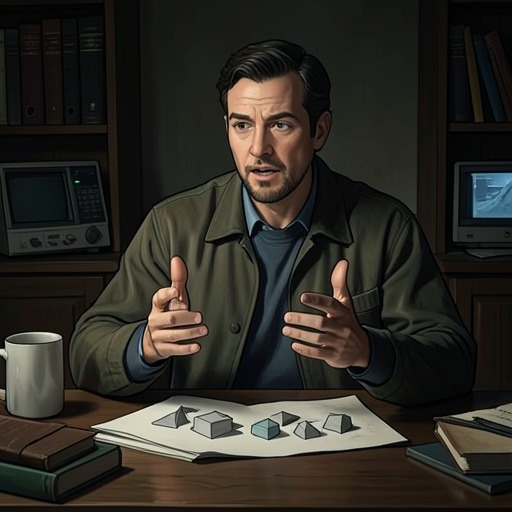
FlatlandSquare(叙述者) is a mathematician of Flatland whose passage through Lineland and Spaceland teaches him that the limits of perception can be mistaken for the limits of reality. His attempt to carry that lesson home turns a private revelation into a public offense: after preaching the Third Dimension, he is imprisoned, without a convert, and left to hope that his memoirs may reach minds beyond his own world.
Identity and First Lessons
Square begins from the assumptions of his two-dimensional country, where what its inhabitants call space is only a Line or Plane. In Lineland, he tries to explain to the King that the King’s world is not true Space: the King’s Line is only one limited part of it. When words fail, Square moves out of the Line. The King continues to see him for as long as any part of him remains within Lineland, then cries that he has vanished and died. Square answers that he is alive, outside the King’s world, and can now see the Line and the people on either side of it. The episode gives Square a practical lesson in the mismatch between an observer’s world and the larger space that contains it.
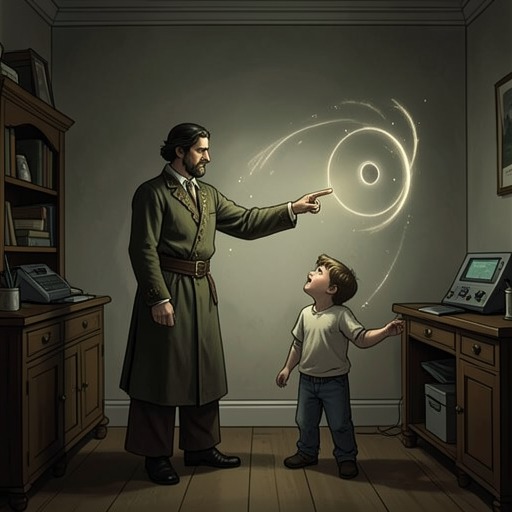
That lesson does not make him immediately receptive to every challenge. At home, as the millennium turns, Square dismisses his young grandson’s geometrical suggestion that three raised to the third power has meaning. A presence answers that the boy is not a fool and that the expression has an obvious geometrical meaning. Square’s own uncertainty and his confidence in his established mathematics form the threshold of the revelation to come: a claim that sounds nonsensical in Flatland will become intelligible when his frame of perception changes.
The Sphere’s Demonstration
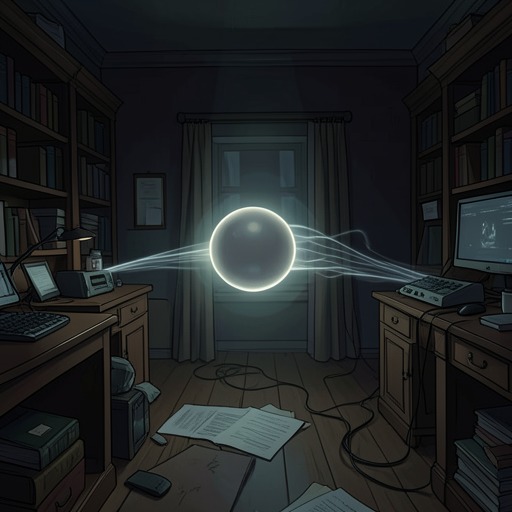
Sphere explains that Flatland is the level surface on which its inhabitants move, unable to rise above it or descend below it. He is not the Circle Square sees, but a solid made up of an infinite succession of circular sections, ranging from a Point to a Circle thirteen inches in diameter. As the Sphere passes through the Plane, Flatland can show only the section cut by that intersection. What Square takes for the visitor’s whole form is therefore a slice of a being his country cannot represent in full.
The demonstration becomes more than a proposition when Sphere takes Square into Spaceland. Square first experiences darkness and a disorienting kind of sight, seeing a Line that is not a Line and Space that is not Space. He cries out that the experience must be madness or Hell; Sphere calls it Knowledge and urges him to look again. Square then sees the Sphere’s form in a way Flatland’s two dimensions could not allow. Even this new vision has limits: he cannot see the Sphere’s internal organs, and learns that what appears to be an exposed interior is the surface of a different order of being.
From above, Square sees his native city in miniature, with the interiors of its houses and the creatures inside them exposed to view. As the pair rise farther, the depths of mines and caverns also become visible. Square mistakes this enlarged vision for omnividence, an attribute of God in the teaching of Flatland’s wise men. Sphere punctures that confidence by observing that even the pickpockets and cut-throats of Spaceland can see as much as Square can now. The expanded view changes Square’s understanding, but it does not make him omniscient: a higher vantage point is relative, not divine.
Return and Public Proclamation
Square tries to bring his discovery back into his home world. At a meeting of the Local Speculative Society, where an argument has been presented for why Providence supposedly limited the number of dimensions to Two, he recounts his voyage with Sphere, including the journey to the Assembly Hall in Metropolis and back. He initially presents the story as the imaginary experience of a fictitious person, but enthusiasm leads him to abandon that disguise and urge his listeners to reject prejudice and believe in the Third Dimension.
His disclosure results in immediate arrest and a hearing before the Council. At the hearing, he recognizes the danger in the President’s decision to replace the attending guards—whose angularity is little, if at all, under 55 degrees—with cheaper policemen of only two or three degrees. Square understands that he may be executed or imprisoned and that the officials who hear his account may be killed to keep it secret. The Council sentences him to perpetual imprisonment, while allowing occasional visits from his brother, on condition that Square does not forfeit the privilege through misconduct.
Relationships, Imprisonment, and Legacy
The revelation also places Square in a failing relationship with his brother. His brother witnessed Sphere’s appearance in the Council Chamber, saw the changing sections, and heard their explanation. Yet during seven years of weekly visits, Square repeats the account of his part in the manifestation, describes Spaceland, and presents arguments for solid things by analogy; his brother still does not grasp the Third Dimension and openly disbelieves that a Sphere exists. The brother is described as just, sensible, cheerful, and affectionate, making his continued disbelief more painful than simple hostility would be. Square ends the memoir with no converts and a sense that the millennium’s revelation may have been made to him in vain.
In the prison, Square compares himself to Prometheus: the figure in Spaceland brought fire to mortals and was bound for it, whereas Square believes he has brought his countrymen nothing. The comparison makes the cost of his witness plain without resolving its outcome. Seven years after his sentence, he remains isolated except for his brother’s visits and the company of his jailers. He nevertheless hopes that his memoirs may somehow reach humanity in some dimension and stir a people unwilling to accept confinement to limited dimensionality. The ending turns his failed attempt at conversion into an appeal across the very boundaries his experience taught him to question.