Sphere
FlatlandSphere is a visitor from Spaceland whose appearance as a Circle in Flatland conceals his three-dimensional nature. He is both Square’s guide to a world beyond the plane and a demonstration of the book’s central problem of knowledge: a being confined to one dimension cannot readily imagine, much less verify, a direction its world does not contain.
Identity and Appearance
Sphere first identifies himself as a Circle in one sense, but immediately qualifies the description: he is more accurately many Circles in one. The apparent contradiction reflects the difference between his actual form and the limited shape visible to inhabitants of Flatland. His body is a solid, not a plane figure, and his proper name in his own country is Sphere.
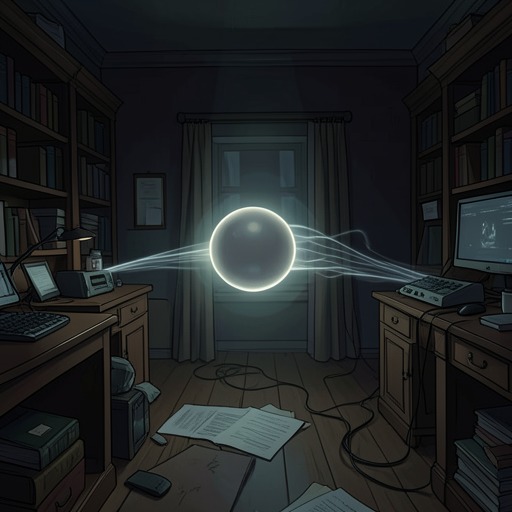
As he passes through Flatland’s plane, he appears there as a circular section. The section changes size according to how much of his body intersects the plane: his full cross-section is a Circle thirteen inches in diameter, while sections nearer the top or bottom diminish toward a Point. Flatland can display only the slice of a three-dimensional being that crosses its surface; it cannot show Sphere whole.
Encounter with Square
Sphere comes to deliver a message to Square and asks to speak with him privately, so Square’s Wife withdraws. The meeting begins amid uncertainty about what the visitor is: Square’s Wife initially suspects that a Woman has entered through an aperture, then realizes by touch that the stranger is neither a Woman nor an angular figure. Sphere’s claim to be a perfect Circle is only a partial account of what he is.
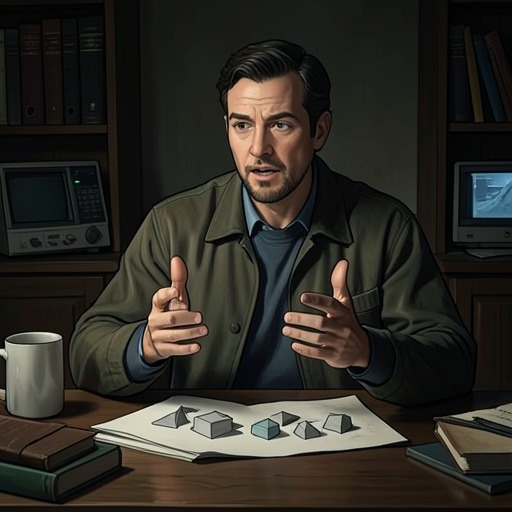
When Square challenges Sphere to indicate or measure the supposed height of a Third Dimension, Sphere recognizes that verbal assertion cannot make the idea intelligible to someone whose world offers no such direction. He first explains that Flatland is a level surface on which its inhabitants move without rising above it or falling below it. He then connects Square’s own experience of Lineland to the same limitation: Square appeared there as a Line because Lineland could represent only a section of him, just as Flatland represents Sphere by a Circle.
Sphere turns the explanation into a visible experiment. As he rises out of the plane, the Circle Square can see becomes smaller and smaller until it dwindles to a Point and vanishes. This changing section gives Square evidence that a shape’s appearance can depend on where a body intersects a world, even though it does not by itself make the unseen direction easy for him to conceive.
Teaching by Demonstration
The encounter develops a recurring conflict between explanation and experience. Square demands a direction and measurement for height, but the request assumes that the answer can be indicated within his own spatial system. Sphere understands the impasse: he cannot point to height from inside the limits that prevent Square from recognizing it. He therefore relies on action, making the visitor’s disappearance from the plane the practical counterpart to his explanation of cross-sections.
The method is not immediately successful. Sphere’s attempt to teach through words and a visible demonstration meets Square’s resistance; Square even presses his hardest right angle against the visitor, but cannot hold him, as Sphere slips out of contact and vanishes from view. The failure marks the distance between seeing an effect and accepting its meaning. Sphere must continue teaching Square by changing his access to space, not simply by repeating a description of it.
Guide Beyond Flatland
After Square is taken beyond the plane, Sphere guides him on a survey of Flatland. As they rise farther away, the field of vision grows: Square sees his native city in miniature, with the interiors of houses and the creatures within them exposed to view. Higher still, the depths of mines and the innermost caverns of hills become visible. The expanded view makes hidden interiors accessible, but Sphere challenges Square’s conclusion that this perspective amounts to godlike omnividence. He points out that ordinary criminals in his own country can see as much, and insists that Flatland’s wise men are mistaken in treating such sight as a divine attribute.
Sphere’s instruction also takes Square down to Pointland, which he calls the lowest depth of existence. There he presents the Point as a being confined to a non-dimensional realm, unable to conceive of anything beyond itself or even of plurality. The lesson turns Sphere’s role from geometric demonstrator to critic of complacent self-satisfaction: greater experience requires aspiring beyond the limits of one’s world. The journey through Lineland, Flatland, Spaceland, and Pointland gives Square a series of contrasting vantage points, while Sphere supplies the guidance that lets him interpret them.
Narrative Role and Significance
Sphere makes dimensional difference concrete through a change in what can be perceived. To Flatland, he is a Circle; to himself, he is a solid whose successive sections produce that appearance. His presence therefore unsettles the assumption that what a world can see exhausts what exists. The same principle applies when Square’s Line-like appearance in Lineland is recalled: limited perception records a real section, but mistakes it for the whole.
As a teacher, Sphere combines explanation with demonstration, and the contrast reveals both the power and the limits of each. Words name a dimension Square cannot imagine; the shrinking Circle supplies observable evidence; travel beyond the plane enlarges Square’s field of vision. Yet each new vantage point also demands a further correction, since expanded sight can be mistaken for final knowledge. Sphere’s significance lies not only in revealing a higher dimension, but in showing that every observer’s apparent world may be only a section of a larger one.