Higher Dimensions
FlatlandHigher Dimensions names the unseen spatial realities that organize the book’s encounters and arguments. A Line can be a cross-section of a Plane, a Circle can be a cross-section of a Sphere, and a familiar world can be only a restricted view of a larger one. But the idea is more than a ladder of shapes: each dimension changes what its inhabitants can perceive, where they can move, and what they can accept as proof. The narrator’s passage from Flatland into Spaceland gives him direct knowledge of a third dimension, yet his return shows that experience alone cannot make that knowledge intelligible—or credible—to those who have never shared it.
Dimensions and the Limits of Perception
In the narrator’s account, Flatland is a plane, while Lineland is a single Line; to the King of Lineland, his Line is not one limited space among others but the whole of space. The narrator explains that true space is a Plane and that the King’s world is only a Line. The distinction is not merely a difference in vocabulary. Lineland’s inhabitants cannot turn out of their Line, so they have no movement or viewpoint with which to apprehend the surrounding Plane. Their world’s boundary is at once a physical limit and a limit on what can be conceived.
The narrator tests that limit by trying to move out of Lineland in a direction unavailable to its King. While any part of him remains in the King’s dominion and view, the King insists that he is still there and has not moved. Once the narrator has left the Line altogether, the King cries that she has vanished and is dead. From outside Lineland, the narrator can see the Line and the people to its North and South, and offers to describe their order, size, and intervals. The same act that looks like death from within the lower-dimensional world is a change of position into a space that makes a wider view possible.
The Sphere makes a parallel claim about Flatland. He describes its inhabitants as moving on the level surface of a fluid, without rising above it or falling below it. The narrator initially treats the added dimension as an unsupported assertion: since dimension implies direction and measurement, he demands that the Sphere measure his height or indicate the direction in which it extends. Without either, he says, he has reason to withhold belief. The dispute establishes a persistent difficulty in the book: a dimension may be real without being available to the instruments, concepts, or senses of the beings whose world it exceeds.
Sections, Solids, and Demonstration
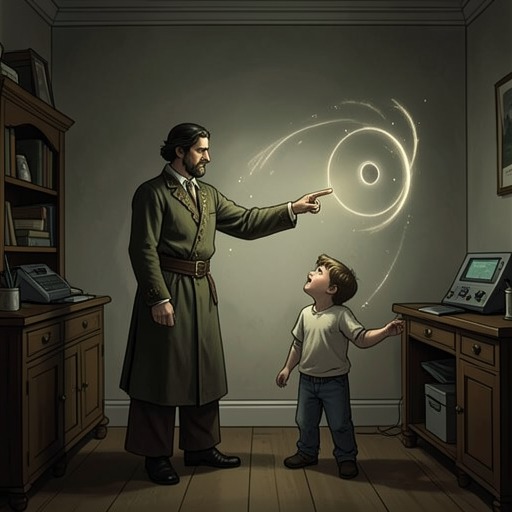
The Sphere answers the narrator’s misunderstanding by explaining how a three-dimensional body appears to a two-dimensional observer. He is not, he says, a plane Figure but a Solid: what Flatlanders call a Circle is a sequence of circular sections through a Sphere, with sizes ranging from a Point to a Circle thirteen inches in diameter. When he cuts through Flatland, he presents a section that its inhabitants can correctly identify as a Circle, even though that visible shape does not disclose the whole body.
His demonstration turns the difference between a section and a solid into an observable change. The narrator cannot raise his eye out of the plane and see the whole Sphere at once, but he can watch the Circle become smaller as the Sphere rises, dwindle to a point, and vanish. The evidence available to him is therefore partial but not empty: a changing section registers motion in a direction he cannot directly occupy. The episode makes the limits of Flatland sight concrete while showing how a larger reality can leave traces within a smaller field of vision.
The Sphere also uses analogy to make the unseen dimension imaginable. A moving point produces a Line with two terminal points; a moving Line produces a Square with four. The numbers 1, 2, and 4 form a geometric progression, so the next figure in the series is an object with eight terminal points: a Cube. The narrator supplies the answer, and the Sphere names the figure he has not known before. This reasoning offers a pattern for extending geometric knowledge beyond immediate perception, though the book later makes clear that an elegant analogy does not itself compel belief.
The Narrator’s Passage into Spaceland
The transition into Spaceland first reaches the narrator as sensory disorientation. He encounters darkness and a dizzying kind of sight that does not feel like seeing, and cries that the experience must be madness or Hell. The Sphere answers that it is Knowledge and Three Dimensions, then urges him to look steadily again. When he does, the narrator sees the Sphere’s form openly: what had seemed to him a centre is visible, while the heart, lungs, and arteries he expects are absent from the view; he can discern only a harmonious surface for which his language has no name. The new dimension does not simply add another object to his old visual world; it changes what seeing can disclose.
Rising farther with the Sphere, the narrator sees Flatland in miniature. His native city opens to view, including the interiors of houses and the creatures within them; from higher still, mines and the innermost caverns of hills become visible. The widening field exposes features concealed from those who remain on the plane. Yet the Sphere unsettles the narrator’s claim that such comprehensive sight must be divine: he points out that even the pickpockets and cutthroats of Spaceland can see as much as the narrator sees from that height. What appears godlike from one restricted world may be ordinary from another vantage point.
The narrator’s experience gives him knowledge of a third dimension, but it does not give him lasting command of it. In the later account from prison, he admits that even after having understood the meaning of height during his stay in Spaceland, he cannot now comprehend or realize it by sight or reasoning, and can only apprehend it by faith. The book thus makes dimensional knowledge both a revelation and a fragile possession: passage into a wider world can transform understanding without permanently overcoming the habits of the world left behind.
The Fourth Dimension and the Limits of Analogy
Once in Spaceland, the narrator applies the same reasoning to a possible Fourth Dimension. He recalls the claim that a Flatlander who sees a Line and infers a Plane may in fact see an unrecognized dimension called height, even if that height is not brightness and cannot be measured. By analogy, he argues, when Spacelanders see a Plane and infer a Solid, they may also see an unrecognized fourth dimension—existent, but infinitesimal and incapable of measurement. The pattern that helped him accept the Sphere’s world now encourages him to imagine a further space beyond the Sphere’s own.
He extends the argument through the progression of figures. A moving Line produces a Square with four terminal points; a moving Square produces a Cube with eight. On that pattern, he asks whether the motion of a Cube in Four Dimensions would produce an organization with sixteen terminal points. He also invokes a second sequence: a Line has two bounding points, a Square has four bounding Lines, and a Cube has six bounding Squares; by analogy, the higher figure would have eight bounding Cubes. These series give the narrator a way to reason about a space he has never seen, but they remain extrapolations rather than demonstrations. The Sphere, who has shown him the third dimension, rejects his appeal to analogy, and the exchange preserves an important tension: the same reasoning can open a path toward new knowledge without establishing that every proposed extension is true.
Recurrence, Disbelief, and the Unfinished Revelation
The argument over Higher Dimensions recurs as the narrator moves between worlds. In Lineland, he finds a ruler unable to imagine movement out of a Line; in Flatland, he is asked to measure a height his society cannot perceive; in Spaceland, his own appeal to an unknown Fourth Dimension meets rejection. Each encounter reverses the relation between teacher and uncomprehending listener. The narrator’s position changes, but the pattern of dimensional prejudice persists: inhabitants treat their own available directions and measures as the standard by which all reality must be judged.
That recurrence also sets a demanding standard for proof. The Sphere offers the narrator a visible sequence of changing sections and an experience of Spaceland that alters his perception. The narrator, in turn, cannot provide his brother with an equivalent experience. His brother witnessed the Sphere’s changing sections in the Council Chamber and heard the explanation, yet after seven years of weekly conversations still does not grasp the Third Dimension and openly disbelieves in the Sphere’s existence. Witnessing a demonstration, hearing its interpretation, and acquiring the kind of perception it makes possible are not the same thing.
In the prison account, the narrator therefore ends without converts and with his revelation still vulnerable to doubt. He hopes the memoirs may reach readers in some Dimension and stir resistance to confinement within limited dimensionality, but he also admits that the remembered Cube can elude him and that even the substantial realities around him sometimes seem dreamlike. The book’s central idea remains open beyond the narrator’s own secure grasp: Higher Dimensions promise a larger reality, while the recurring failures of perception, communication, and proof leave each world at risk of mistaking its horizon for the whole of space.