Thoughtland
FlatlandThoughtland is a hypothetical vantage beyond Flatland’s two-dimensional limits, imagined as a realm from which a figure could look down upon the country and see the insides of everything at once. After direct attempts to explain higher dimensions fail, Square recasts what he learned in Spaceland as a theory of Thoughtland, hoping that writing about an abstract realm will let him communicate the insight without openly violating the law.
Definition and imagined properties
In Square’s treatise, Thoughtland is a place from which a figure could view Flatland from above and see its contents simultaneously. He also presents the possibility of a figure surrounded by six Squares and containing eight terminal Points. These imagined arrangements translate the experience of three-dimensional space into forms that can be approached through geometrical thought, even though Flatland’s inhabitants lack the dimensions needed to represent them directly.
Thoughtland is therefore not simply another country described through ordinary geography. Its defining feature is a changed relation between observer and observed: the figure in this imagined realm can see interiors that remain hidden from an observer confined to Flatland. The idea echoes Square’s earlier lesson that his own apparent space was not true space, but only a Line, and that Flatland itself was a Plane on which its inhabitants moved without rising above or falling below it. Each realm’s limits govern what its inhabitants can perceive and what they accept as space.
From demonstration to written theory
Square’s initial teaching depends on demonstration. In Lineland, he moves out of the King’s Line to show that a direction unavailable within that world can nevertheless exist; the King mistakes his disappearance for death. Later, the visitor who reveals three dimensions explains that Flatland is a vast level surface and that a Sphere can appear to its inhabitants only through sections, which they see as Circles. These encounters establish the perceptual problem that Thoughtland is meant to address: a resident of a restricted space cannot easily grasp a dimension that the resident cannot directly see or enter.
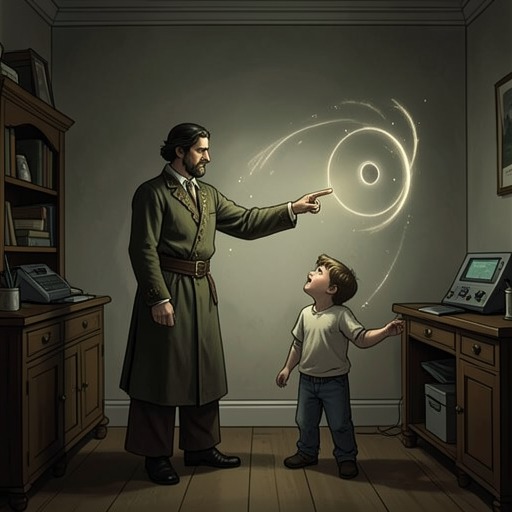
After failing to teach his Youngest Grandson, Square decides not to rely on the slogan “Upward, not Northward.” He spends several months privately writing a treatise, avoiding the explicit claim that he is discussing a physical dimension. Instead, he describes Thoughtland as a theoretical realm and uses its imagined geometry to suggest a view of Flatland from beyond its plane. This change of method is also a response to danger: the theory gives him an indirect vocabulary for ideas whose direct expression could be treated as unlawful.
Representation and limits
The written argument is hampered by the material limits of Flatland’s diagrams. Its tablets and diagrams consist only of Lines, all arranged in one straight line and distinguishable only by size and brightness. Square cannot draw the figures he needs to make his explanation clear, and when he finishes the work, he remains uncertain whether many readers will understand it. Thoughtland thus names both a proposed expansion of knowledge and a problem of representation: the imagined realm exceeds the visual tools available to describe it.
This difficulty parallels the earlier dimensional lessons. A Line cannot display an entire figure that has dimensions beyond its own, just as a two-dimensional country cannot display a three-dimensional visitor except as a section. In the treatise, the mismatch shifts from what the observer can see to what the writer can draw. The reader must mentally complete forms that Flatland’s linear diagrams cannot show, while Square himself cannot be certain that his own account adequately preserves what he experienced.
Reception and narrative significance
The idea remains private at first, but Square’s effort to spread it does not end with the treatise. At a meeting of the Local Speculative Society in the Prefect’s palace, he recounts his voyage with the Sphere and urges his hearers to believe in the Third Dimension. He initially presents the account as the imagined experience of a fictitious person, then abandons the disguise as his enthusiasm takes over. In this later public appeal, Thoughtland belongs to a larger struggle to communicate forbidden dimensional knowledge, rather than serving as a safe substitute for it.
Thoughtland brings the book’s spatial hierarchy into the problem of knowledge and authority. The ability to see inside what appears opaque from below is not treated as a mere change of scenery: it exposes the restricted character of established explanations and challenges the claim that Flatland exhausts reality. Yet the concept’s indirectness also marks the limits imposed on Square. He can propose the higher viewpoint, evoke its geometry, and testify to what he has seen, but neither the diagrams of his country nor its prevailing assumptions can readily contain the evidence.