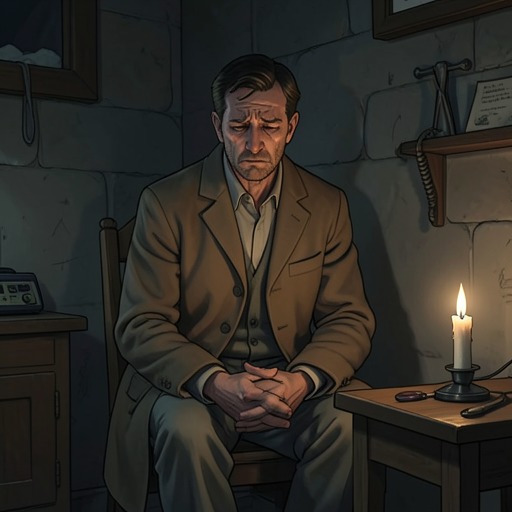
State Prison
FlatlandState Prison is both the literal site of Square’s life sentence and the final test of the dimensional revelation he tries to communicate. Confined for preaching a reality his countrymen cannot verify, he becomes an inmate and a witness whose account survives even as his immediate audience fails to believe it.
The Prison and the Limits of Flatland
State Prison belongs to a world whose inhabitants mistake the limits of their own space for the limits of reality. Square explains that the King of Lineland cannot step out of his Line, and that what the King calls space is only a Line while true space is a Plane. The same conflict governs Square’s imprisonment: a claim about a dimension beyond ordinary perception appears, to those confined by their own frame of reference, not as knowledge but as an offense.
The prison’s walls also mark a boundary that Square can describe but cannot overcome. In his account, the Sphere once made the workings of Flatland visible from outside its plane: as Square and his guide rose farther away, the field of vision widened until the interiors of houses and creatures, and even mines and caverns, lay open in miniature. That enlarged view makes the confinement of State Prison more than a physical limit; it contrasts a world suddenly available to comprehensive sight with the narrow conditions under which its inhabitants judge what can be real.
Square’s Confinement
At his trial, the President accepts Square’s appeal to Truth but sentences him to perpetual imprisonment. He is promised no unnecessary discomfort, and occasional visits with his brother are allowed unless misconduct forfeits the privilege. The sentence thus combines restraint with a narrow exception: Square remains separated from ordinary companionship, but the prison does not entirely sever his family tie.
The seventh annual visit of the Chief Circle, the High Priest, gives the confinement a grimly repetitive rhythm. On each visit the priest asks whether Square is any better. Square tries to show that the visitor is high as well as long and broad, but cannot measure this unrecognized dimension or indicate its direction. The High Priest demands measurement as the condition of belief; unable to supply it, Square is crushed, and the visitor leaves triumphant. The episode turns the prison visit into a compact rehearsal of the reasoning that has condemned Square: what cannot be measured by the accepted means is dismissed, even when the failure lies in the limits of those means.
Visits, Testimony, and Isolation
After seven years, Square remains a prisoner, with his brother’s occasional visits as his sole companionship beyond the jailers. His brother had been present when the Sphere appeared in the Council Chamber, had seen its changing sections, and had heard the explanation offered to the Circles. Yet week after week Square repeats the manifestation, describes Spaceland, and rehearses the arguments for solid objects by analogy; his brother still disbelieves in the Sphere and has not grasped the Third Dimension. Physical access to the testimony has not produced intellectual conversion.
That failure makes the prison a place where evidence recurs without gaining force. The brother’s visits keep the revelation in circulation, but they also expose the difference between witnessing a phenomenon and understanding what it means. Square’s repeated account cannot make his listener cross the conceptual boundary that his own imprisonment embodies.
Sentence and Afterlife of the Revelation
Square calls himself a poor Flatland Prometheus: unlike the Prometheus of Spaceland, bound for bringing fire to mortals, he lies in prison for bringing his countrymen nothing they will accept. He is therefore left without converts, and the millennial revelation seems to him to have been made in vain. His hope shifts from immediate persuasion to the possibility that his memoirs may reach humanity in some Dimension and awaken people who refuse to be confined to limited dimensionality.
The ending keeps that hope in tension with uncertainty. Square admits that he cannot confidently recover the exact shape of the once-seen Cube, and the precept “Upward, not Northward” haunts his nightly visions. At moments, Cubes and Spheres recede into scarcely possible existence, while even the prison wall, his writing tablets, and the realities of Flatland seem dreamlike. State Prison thus frames not a settled triumph of knowledge but an unresolved struggle: Square’s testimony persists, yet neither his brother nor his own faltering memory can secure the revelation against disbelief.