The deceased Kinsella boy’s clothes
FosterThe deceased Kinsella boy’s clothes begin as useful garments for Unnamed girl, but become an unspoken record of the loss that shaped the household she has joined. Their meaning changes when a woman on the road tells her that the clothes belonged to John Kinsella and Edna Kinsella’s dead son. The revelation does not make the clothes disappear: a jacket is later placed on the girl, accompanies her back to the well, and remains caught up in the care and grief surrounding her stay.
First Use and Practical Care
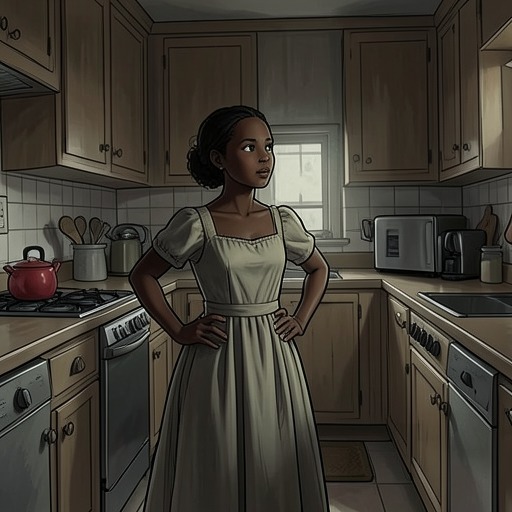
Soon after arriving at the Kinsellas’ home, Unnamed girl is taken to a bedroom beyond the couple’s, where Edna Kinsella searches a chest of drawers. She offers a pair of old-fashioned trousers and a new plaid shirt. Both are too long, so she rolls up the sleeves and legs and tightens the waist with a canvas belt. The adjustments make the clothes wearable without making them seem originally hers; their fit records the work of another person’s hands.
The girl responds by explaining that her mother says she must change her pants every day. The remark places the new arrangement beside the rules and habits of her previous home, while Edna’s immediate attention to fit supplies a different kind of care: she does not simply hand over clothing but alters it around the child’s body. At the well, the girl sees herself clean and in different clothes, a changed appearance set against the way she looked when she arrived. Before she knows their history, the garments belong to this visible transition into a household where she is being looked after.
The Clothes as Hidden History
Later, on the road after leaving the Kinsellas’ house, Mildred questions the girl about the rooms, the couple’s habits, and whether the child’s clothes are still hanging in the wardrobe. The girl understands the question only after Mildred explains that, if she slept in the boy’s room, she must have seen them. The clothes have been present as an ordinary detail of the house, but their connection to the dead child has not been made clear to her.
The girl explains that she wore clothes supplied during her stay, but that she and the Kinsellas went to Gorey that morning and bought new things. Mildred looks at the outfit she is wearing and comments on how grand it seems, then adds that the girl has been living in the dead boy’s clothes. The new purchases and the earlier garments are therefore distinct: the outfit that prompts Mildred’s remark is new, while her words disclose the history of what the girl had worn before. An everyday question about a wardrobe abruptly changes the meaning of the girl’s clothes, and of the bedroom where she has been staying.
Mildred identifies the dead child as the Kinsellas’ young son and says he drowned after following their hound into a slurry tank. She also repeats a different piece of local talk: that John Kinsella took the dog down the field with a gun but could not bring himself to shoot it. The girl is left with a death she had not known about and with an account partly framed as what people say happened. The clothes make that newly disclosed past intimate: the dead child is not only a story about the farm but the absent wearer of garments that have been fitted to her.
The Jacket and the Kinsellas’ Care
When the girl returns home, she tells John Kinsella what Mildred said: that he and Edna Kinsella had a little boy who followed the dog into the slurry tank and died, and that she had worn his clothes to Mass. The hound comes out to greet them. John Kinsella sighs and goes to milk; later, he says there will be no visitors that night because of a wake and that he does not want any. Edna Kinsella goes upstairs to change, while John takes off the girl’s shoes and puts what she now understands to be the boy’s jacket on her.
The jacket is not introduced with an explanation. Its identity is carried by the girl’s recent discovery, and its placement on her makes the knowledge of the dead boy present within an otherwise practical act of dressing. Edna Kinsella asks what John Kinsella is doing and warns that the girl will break her neck in her shoes. He goes out, returns with sandpaper, and scuffs the soles so she will not slip. The jacket and the shoes sit within the same scene of physical care, but the jacket also bears a history that the girl has only just learned. John’s care is concrete and immediate; the garment’s association with his son gives that care an additional, unspoken weight.
John Kinsella takes the girl by the hand as they set out. She recognizes that her own father has never held her hand, and initially wants John to let go so she will not have to feel the difference. As they walk, he takes small steps to keep pace with her, and she begins to accept the contrast between the life she knew at home and the one she has found there. The jacket belongs to this wider pattern of attentive acts, though the girl’s knowledge of its former wearer means that the household’s welcome can no longer be separated from its bereavement.
Return to the Well and Lasting Meaning
Near the end of her stay, Edna Kinsella goes to the milking parlour while the girl remains in the house. Seeing the light fall across the scullery and shine off the zinc bucket, the girl thinks she could fetch well water for Edna’s tea. She puts on the boy’s jacket, takes the bucket, and follows the familiar track past the cows and electric fences. At the well, the water has risen: where she stood on the fifth step on her first evening, she now stands on the first, with the water almost reaching the step below. She makes sounds and listens to them return, then bends to lower the bucket. When she reaches to lift it, a hand like her own seems to emerge from the water and pull her in.
The jacket’s return to this scene links the clothes to the girl’s changing sense of home without turning them into a simple symbol. They have been altered to fit her, worn as part of her daily life, identified as belonging to the dead boy, and put back on her for a final errand of care. At the well, the clothing is present as a material part of her journey; the danger comes through the water and the reaching hand, not through any stated power in the jacket. Its significance lies in how it carries two histories at once: the dead child’s place in the Kinsellas’ home and the girl’s growing attachment to the people who have cared for her.
After the girl returns home, she says nothing when her mother asks what happened. John Kinsella and Edna Kinsella later visit; he calls the girl a credit to her mother, kisses her, and gives her books to continue studying. She does not tell her mother what happened at the well. When John Kinsella turns back at the gate, the girl runs to him and is lifted into his arms. The text does not say that she is wearing the jacket during this reunion, but its earlier appearances have already made clothing one of the means through which the dead son’s absence and the girl’s place in the household meet. The garments do not explain the family’s silence about their loss; they make its presence tangible, first before she understands it and then after she does.