The narrator’s nighttime beach walk with Kinsella
FosterThe narrator’s nighttime beach walk with John Kinsella turns a night of bereavement and painful disclosure into an encounter shaped by care, play, and silence. After the Unnamed girl learns that the Kinsellas’ son drowned and that she has worn his clothes to Mass, John leads her out of the house toward the strand. The walk makes the difference between her life at home and her life with the Kinsellas newly tangible: he holds her hand, adjusts his pace to hers, carries her into the water, and finally embraces her as though she were his own child.
Departure from the house
When the pair return home, the hound rises to greet them. The Unnamed girl realizes that she has not heard either John or Edna Kinsella call him by name. John sighs and goes to milk; when he comes inside, he says he is not ready for bed and that there will be no visitors because of the wake, adding that he does not want any. The ordinary work of milking continues beside the household’s grief, while the wake gives the evening its immediate context.
Edna Kinsella changes into her nightdress. John has taken off the girl’s shoes and put the dead boy’s jacket on her. When Edna questions what he is doing and where he means to take the girl, John answers that the shoes need breaking in and that they are going only as far as the strand. Before leaving, he goes out and returns with sandpaper, scuffing the soles of the new shoes so she will not slip. The practical attention is small but exact: rather than merely taking her out, he anticipates a danger posed by the shoes and prepares them for the walk.
The road and the sea
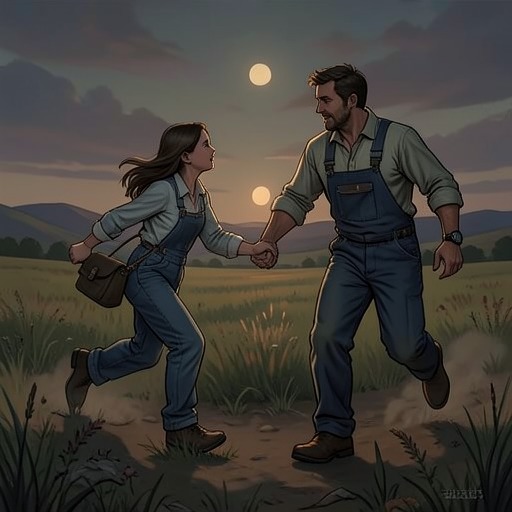
John takes a lamp, though he remarks that a night like this hardly needs one. Moonlight falls across the yard and guides them onto the lane and road. He takes the girl’s hand. She recognizes in that gesture something absent from her home life: her father has never held her hand. At first she wants John to let go, because the contrast itself is difficult to feel; as they continue, she settles and allows the difference between her two lives to exist. John takes small steps so they can walk in time. The walk thus begins not with an explanation of care but with its physical practice: a hand held, a pace shared.
At the crossroads they turn down a steep road toward the sea. The wind moves through dry branches; the road slopes away beneath them, and the sky seems to brighten as they approach the shore. John makes a few inconsequential remarks and then falls quiet. They pass through a sandy parking area marked by tyre tracks and potholes, with a rubbish bin that appears long unemptied. From there he leads the girl up a steep dune through tall, shaking rushes. She sinks into the deep sand, and the climb leaves her breathless. At the crest, the land ends at a long strand and dark water; far out, two lights blink in the distance.
John lets the girl run down the far side of the dune toward the waves. She races toward the black water as it hisses up the shore, then runs back shrieking when a wave crashes in. Once John catches up, they take off their shoes. At some points they walk with the edge of the sea moving against the sand beneath their bare feet; at others, he lets her run ahead. They go into the water until it reaches his knees, and he holds her on his shoulders. The scene’s earlier caution about slippery shoes gives way to a more exposed kind of movement: the girl can run, retreat, and enter the water because John remains with her.
Talk among the washed-up things
Beyond a crooked line in the sand, the clean strand is interrupted by objects washed ashore: plastic bottles, sticks, a mop handle without its head, and a stable door with a broken bolt. John jokes that some man’s horse must be loose. As they walk farther from the noise of the waves, he tells her that fishermen sometimes find horses at sea, recalling a man who towed a colt in and watched it lie down before getting up, tired but unharmed. This story places the night’s odd debris within a world where strange occurrences are met with observation and patience rather than immediate explanation.
John then addresses the girl’s distress over what Edna Kinsella has told her. He says Edna meant no harm, describing her as too good and as someone who trusts others in the hope of finding good in them, though that trust sometimes disappoints her. His explanation does not undo the shock of the disclosure; it distinguishes Edna’s intention from its effect. John laughs, but the laugh is sad, and the girl does not know what to say. He tells her that she never has to say anything and that silence can be wiser than speech. In a night when information about the dead boy has arrived through another person’s words, his reassurance makes silence a form of permission rather than a demand for concealment.
Footprints and embrace
John shines the lamp along the strand to find their tracks and follow them back. He can find only the girl’s footprints. He jokes that she must have carried him there; she laughs at the absurdity before recognizing the joke. The missing prints make their return legible through an absence: although he has walked beside her, the sand records only her passage. The moment also shows the girl understanding and joining his humor, a small ease reached after her earlier uncertainty.
When John asks whether she can see the lights, she confirms that she can. He puts his arms around her and gathers her into them as though she were his. The embrace closes a walk that has moved from the dead boy’s jacket and the girl’s painful new knowledge toward an intimate, bodily assurance of belonging. The scene does not erase the Kinsellas’ bereavement or the difference between their home and hers. Instead, its significance lies in the care John offers within that difference: he holds her hand, makes the shoes safer, carries her in the water, allows her silence, and turns back toward her in an embrace.