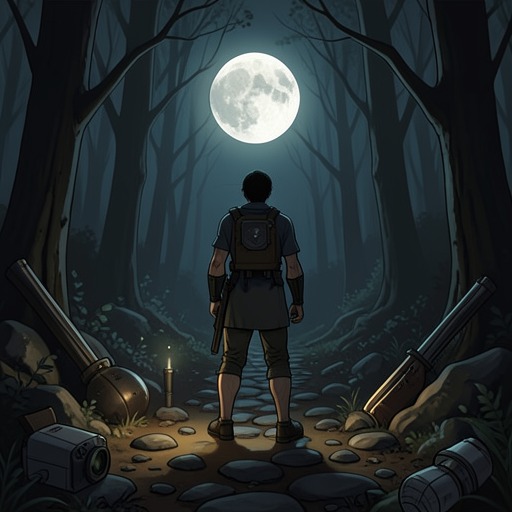
Bullet Hell
GunsoulBullet Hell is the Gun Path’s vision of an eternal battlefield, a spiritual domain where gunfire, death, and the souls formed by violence converge. It is invoked as both an afterlife and a condition of existence: the place where the dead continue to fight, where the Gun’s worshippers send sacrificed lives, and where Yuan Guang ultimately recognizes the warlike shape of his own soul. Its decisive significance is that it transforms from an external threat into an inward truth. Yuan does not merely visit or hear of Bullet Hell; he learns that understanding it means understanding what kind of Gunsoul he has become.
Definition and Religious Imagination
Bullet Hell is presented first through the language of ritual and belief. When a volunteer dies, Bucket performs a gesture resembling a gun and offers the dead the hope that the Gun will welcome him in Bullet Hell, where he will fight forever. The phrase therefore functions as a funerary promise, but it is not comforting in any conventional sense: death does not end violence, and the afterlife does not release the dead from the weapon’s authority. Bullet Hell is an eternity of combat rather than a refuge from combat.
The same conception appears in the warning that the Gun’s chosen dead will all be claimed without distinction. Heroes and villains alike are drawn into the same destination, and the battlefield’s impartiality strips away the moral distinctions that might ordinarily separate them. Bullet Hell is not reserved for the wicked, nor is it a reward for the brave. It is the terminal horizon of a world in which firearms have become objects of worship and sacrifice.
The language surrounding the place is repeatedly ritualized. The last rites given to Yuan and his team after their murder, the funeral invocation offered for a dead volunteer, and the recurring promise to meet an enemy there all make Bullet Hell part of a shared ceremonial vocabulary. Death is marked by words, gestures, and sacred expectations, yet those rituals also reveal how thoroughly violence has entered the culture’s theology. The battlefield is not merely where people die; it is where the dead are imagined to continue their service.
Yuan Guang’s First Recognition
Yuan’s relationship with Bullet Hell changes when the Blackmoon’s will reveals his soul’s true shape. Most observers would have feared the demon that appeared before him, but Yuan finds it familiar and even comforting because he immediately understands that the creature is not an alien intruder. It is the form his soul has taken.
The vision is concrete and unmistakable: a demon with a gun barrel for a face, skulls across its chest, a minigun for one hand, and a blazing cannon for the other. The image does not associate Yuan with one ordinary firearm. Arc explains that his soul aligns with a more abstract concept, and Yuan identifies that concept as Bullet Hell. The revelation gives a name to the violence already embedded in his instincts, rather than introducing an entirely new power from outside him.
Arc connects this identity to Yuan’s unusual abilities and limitations. He learns combat techniques rapidly, yet struggles with spirit botany, because his soul thrives on strife rather than cultivation that depends on nurturing and growth. Fighting is not simply a method Yuan chooses to reach another goal; it is described as his natural state. At the same time, Arc distinguishes this nature from ordinary wickedness. Real demons, in her explanation, do not necessarily spread evil across the living world; they punish the wicked in Hell. Yuan’s soul therefore sees itself as a demon of judgment within a hellish battlefield, not merely as a creature that delights in earthly cruelty.
The Path and Its Burden
To engrave the Gun Path and Bullet Hell into his core is to accept more than a technical discipline. Yuan understands that the process requires knowing Bullet Hell, learning it, and living it. The phrase marks a progression from recognizing an image to inhabiting a worldview. Bullet Hell becomes the experiential foundation of his cultivation: it shapes what his body can do, what his instincts favor, and how he interprets the weapon at the center of his life.
This understanding also clarifies the warning given by Revolver. Revolver tells Yuan that the fate of all Gunsouls is either to kill the Gun or be killed by it, and urges him to act while his mercy lead remains. The warning places Bullet Hell within a cycle of inheritance and destruction. The Gunsoul does not stand outside the Gun’s violence; each successor is drawn toward the same terminal conflict. Bullet Hell is the destination promised by that cycle, but it is also the condition that perpetuates it.
Yuan’s earlier social position makes this transformation more significant. He was born without the potential to form a qi core and accepted that limitation as the condition of a Scrap, one of the many people compelled to serve cultivators. Even after reaching the First Coil, he feels shame rather than uncomplicated pride. Bullet Hell offers no simple escape from that stigma. Instead, it gives Yuan a form that is terrifying precisely because it converts his history of exclusion and struggle into a martial identity. His rise is not a movement away from violence; it is an attempt to decide what violence will mean in his hands.
Memory, War, and Moral Reinterpretation
At first, Bullet Hell seems to contain only the most destructive image of the Gun Path. Yuan’s inner vision is filled with gunpowder spirit-smoke, whirling cylinders, and gunfire; Revolver’s soul appears like a battle-hardened shadow tempered in the flames of such a hell. Yuan’s own projected monster carries the same exaggerated vocabulary of firearms, skulls, and artillery. The imagery makes Bullet Hell oppressive, overwhelming, and inseparable from death.
Yet Yuan later receives a different vision of the Gun Path when the veil of devastating memories clears. He sees soldiers fighting to protect their homeland from conquerors, lawmen pursuing those who prey on the weak, and fathers firing at tigers or wolves threatening their children. In some cases, no shot is fired at all: the presence of a loaded rifle is enough to preserve peace. These memories do not erase the horror of Bullet Hell, but they complicate it. The gun can enact violence, yet it can also deter violence, defend the vulnerable, and hold back a greater threat.
That contrast prevents Bullet Hell from becoming a complete moral explanation for Yuan’s existence. His soul may thrive on strife, but the Gun Path is not reduced to indiscriminate killing. Bullet Hell contains the consequences of armed power, while Yuan’s later understanding asks whether the weapon is used for conquest, predation, protection, or restraint. The same object can be an instrument of slaughter or a warning that makes slaughter unnecessary. This distinction becomes essential to Yuan’s eventual mastery of the Gun rather than simple submission to it.
The Dead, the Gun, and the Ending
Bullet Hell remains present even after the Gun itself dies. The Gun’s worshippers survive, and mortals continue sacrificing lives upon the barrel altar. The battlefield therefore outlasts the deity that appears to govern it. Its continuity exposes the depth of the cycle: the Gun can be killed, but the habits, rituals, and desires that feed it continue to produce new victims.
The final imagery returns Bullet Hell to a vast, almost cosmic scale. From a blazing light in the Nowhere, forms fall in a rain of blood and lead. The image makes the domain feel less like a distant location than a perpetual descent of armed death into reality. It also preserves the place’s indifference. Bullet Hell claims heroes and villains without distinction, and little has changed merely because the Gun has died.
Yuan’s last relation to Bullet Hell is therefore a relation of transformation rather than escape. After confronting the Gun’s legacy, he declares that the Gun is part of him but that he is greater now, naming himself the Gunman. The declaration does not deny Bullet Hell; it places it within a larger identity. Yuan has learned its language, inhabited its violence, and recognized the demon it reveals, but he refuses to remain only another captive of the Gun’s cycle. Bullet Hell is consequently both his soul’s true shape and the danger he must exceed: an eternal war that can explain him, but cannot be allowed to define the full measure of what he becomes.