Thunderlands
GunsoulThunderlands is a realm where the boundary between the material world and the spirit world has become permeable. Marked by golden auroras, multicolored lightning, altered landscapes, and overwhelming qi, it functions both as a perilous route through the Unmade World and as the clearest surviving trace of Spiral Dancer’s union with the Dao. Its terrain does not merely surround the characters: it changes cultivation, creates spirits, distorts reality, and leaves lasting marks on those who pass through it.
Definition and Boundaries
Thunderlands first appears as a region whose border is visible but not safely traversable. Near Gatesville, Yuan Guang sees booming lightning striking beneath golden auroras while space itself has grown thin, producing refractions and mirages. A multicolored, kaleidoscopic veil marks the boundary, and the road deliberately turns north-west rather than cutting through the region. The detour implies that Thunderlands is not an ordinary stretch of wilderness but a hazard requiring avoidance, even when the surrounding roads lead through their own ruins and poisoned air.
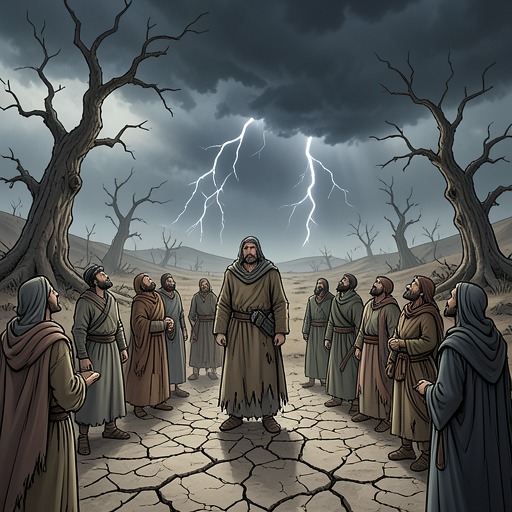
Crossing the veil confirms that its danger is metaphysical as well as physical. Yuan Guang experiences the transition as moving through a shower and then touching a live electrical outlet: a faint lightning shock passes through his body and announces that he has entered a realm of concentrated power. The change is immediate. The blue sky becomes golden, the sun ripples like liquid mercury, and multicolored lightning strikes without the support of black storm clouds. Dunes collapse to reveal primeval badlands, towering rock formations, rust-colored dunes, and the cadavers of immense metal beasts from the Lost Age. The air becomes colder and carries the smells of oil, rusting metal, and rot, making the region feel like both a natural environment and the exposed remains of a dead technological age.
A Landscape of Qi and Cultivation
Thunderlands is saturated with qi. Yuan Guang can feel it in the stones and the wind, and opening his mouth to breathe makes him feel closer to the Dao. The region therefore has a paradoxical character: it threatens the body while accelerating cultivation. Yuan Guang recognizes that cycling qi there could drastically reduce the time required to reach the Second Coil, a decisive advantage while pursuing Slash’s warband. When Kyung-sun explains that herds of wild spirit-cars roam through Thunderlands, the region becomes not only an obstacle but also a possible shortcut. A tamed spirit-car could carry Yuan Guang directly to Fleshmarket along the shortest route, while the abundant qi would strengthen his advancement.
The same power that makes Thunderlands useful also makes it unstable. Orient explains that only Thunderlands normally generates enough qi to manifest a caretaker spirit, a statement that frames the region as an active spiritual environment rather than passive scenery. Its influence can extend beyond its apparent boundaries: when Arc leaves her valley, her qi remains behind, saturating the ground with lead and giving the blasted trees sheets of steel for bark. Her Authority later returns the valley to its full form, a bog of rifle-trees and gunpowder ponds, as though the landscape recognizes its owner. Thunderlands thus establishes a pattern in which spiritual power becomes geography, and geography retains the history of spiritual power.
Origin in Spiral Dancer’s Ascension
Thunderlands is the legacy of Spiral Dancer’s Thunderdance. Orient states that she rose by Spiral Dancer’s will when Spiral Dancer practiced the Thunderdance and joined the Dao. Spiral Dancer sought to return spirituality to a world that had lost it, and that desire infused the Thunderlands created by her ascent. Sutras could be woven into Orient’s frame because of this origin, showing that the region’s power is not merely electrical or atmospheric: its qi carries formulas and intentions inherited from an ascended cultivator.
Mordiggian places Spiral Dancer’s achievement within the history of cultivation. She was the only person in the modern age to awaken her core through meditation successfully and the first in history to ascend through the Seven Coils of Infinity and unite with the Dao. His memory presents the Thunderdance as both spectacle and revelation: every step called lightning from the sky, every movement unraveled illusions that obscured the Way, and her ascent carried her up a spiral staircase of shooting stars until she became one with the sky. Thunderlands is therefore the material remainder of a cosmic transformation. It is not simply named after Spiral Dancer; it is the world altered by her Path after that Path became part of reality’s governing order.
Spirits, Authorities, and Distorted Reality
The existence of Orient demonstrates Thunderlands’ power to generate autonomous spiritual beings. Yuan Guang initially considers it impossible that the spirit-train itself could possess a caretaker spirit outside Thunderlands, because he believes only Thunderlands can supply enough qi for such a manifestation. Orient’s presence confirms both the rule and its exception: the region is the known source of caretaker spirits, but its influence can apparently travel through or inhabit a spirit-train beyond its ordinary borders. Orient can also produce sutras instinctively, teach Yuan Guang their methods, and restore damaged objects through her spiritual abilities.
Thunderlands also provides the closest comparison for higher forms of Authority. When Orient senses the Ammobog, she describes it as clogging the leyline like a quagmire of lead and gunpowder and identifies it as a true imaginary space rather than merely a cursed patch of Thunderlands or another supernatural disturbance. Yuan Guang understands the distinction through the Fifth Coil: a cultivator at that level expands the core beyond the body, overwrites the world’s qi, and temporarily gains Authority over part of the Dao. Thunderlands is consequently the measure against which other altered realms are judged. Crossing an Authority later feels much like entering Thunderlands, with a veil between realities that closes behind the entrant, reinforcing the region’s role as the narrative model for spatial and spiritual transformation.
Contamination, Ruins, and Narrative Significance
Thunderlands is not an untouched sacred inheritance. Orient finds that a scroll received from Manhattan has been tainted by the same poison that corrupted her predecessor’s Thunderlands. She restores the document toward an earlier state to prevent Holster from becoming sick or transforming into a rad-hag, though the restoration may erase some sentences. The episode reveals that Thunderlands can be poisoned, that its spiritual ecology can produce monstrous corruption, and that even knowledge connected with the region may carry contamination.
Its landscapes also place the Lost Age inside the same field as ancient cultivation. The metal carcasses and ruined cities surrounding the region evoke a civilization whose technological remains have been weathered into myth, while the auroras and lightning expose a deeper spiritual order beneath them. This fusion makes Thunderlands a threshold in both plot and theme: Yuan Guang enters it to travel faster and cultivate more efficiently, but each crossing brings him closer to questions about the Dao, ascension, the destructive residue of great powers, and the price of rewriting reality. Thunderlands is therefore both a dangerous place and a living historical trace—the continuing afterimage of Spiral Dancer’s attempt to awaken a spiritually exhausted world.