Nowhere
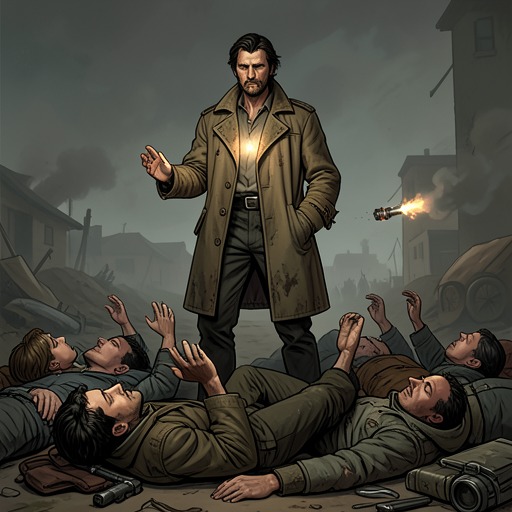
GunsoulNowhere is the metaphysical void separating death from whatever existence comes next. It is not merely an afterlife or a place of punishment, but a disorienting interval in which bodies cease to function, identities loosen, and spirits descend toward reincarnation—or toward a more uncertain fate. Because the novel repeatedly sends its characters to its edge and back, Nowhere becomes the clearest measure of what death costs and what survival changes.
Definition and Experience
The world’s inhabitants describe Nowhere as a darkness through which the dead fall until they reach their new selves. Those who have returned from death before reincarnation speak of it as a void rather than a furnished realm, while souls guilty of great sins may suffer in wasteful skins. Its logic therefore combines transition and judgment: death strips away the former life, but the destination of the spirit may still reflect what preceded it.
Yuan Guang first approaches Nowhere after being murdered and buried in a ditch. His killer gives him and his team the Last Rites Sutra, an act that reveals the setting’s place in everyday supernatural belief: killers perform funerals so their victims will not return as Hungry ghosts. The ritual does not prevent Yuan’s passage, but it establishes the fear surrounding incomplete death. Even in a world where murder is ordinary, the dead remain active possibilities, and Nowhere is the threshold through which that danger passes.
Yuan’s own descent is marked by the silence of the body. He can barely feel his limbs; his heartbeat has stopped, his lungs are still, and his mind drifts downward through pitch-black darkness. The experience initially seems almost peaceful, but that calm is inseparable from the erasure of sensation and agency. Nowhere is frightening not because it immediately attacks him, but because it removes the ordinary signs by which a person knows that he is alive.
Yuan Guang’s Thresholds
At the first boundary between death and possible rebirth, Yuan weighs certainty against possibility. Death is already established, while a new life is only a hope, yet he chooses the light and moves toward it without surrendering his ground. His decision turns Nowhere from a passive destination into a test of will. He does not know whether the light leads to reincarnation or to a demon, but he is prepared to confront either possibility.
That passage does not restore him as an ordinary human. Yuan returns as a Gunsoul, an existence in which a former human life becomes only the trigger for a cursed life as a weapon. The recurrence of Nowhere thus gives the novel a brutal metaphysical continuity: death is not the end of violence, because a spirit may be drawn back into the cycle in another material form. Yuan’s later identity is inseparable from the void he crossed.
His relationship with Nowhere remains physically and psychologically active after resurrection. When the Gun’s attack drives a terrible sensation through his bullet-core, he recognizes the pain as the same metal-piercing agony he experienced immediately before death and rebirth. The memory is not abstract recollection; it is reproduced through the core and the iron nerves of his new body. Nowhere therefore survives inside him as a bodily trace, making resurrection a continuation of trauma rather than a clean beginning.
Souls, Reincarnation, and Damage
Arc’s history shows that reaching Nowhere does not guarantee an intact return. After defeating a death-worshiping cultivator, Arc suffers the destruction of his body and damage to his soul on the way to the void. The injury challenges the comforting belief that the spirit naturally survives bodily death and simply proceeds toward another life. A soul can be wounded before reincarnation, and the damage can remain consequential after return.
Yuan later enters an even more unstable condition. His body becomes trapped between an evanescent soul and solid iron flesh, while qi threatens to return to the Dao as mindless, formless energy. Each cycle weakens the bullet-core’s hold on reality, raising the possibility that his spirit will come unbound and drift into Nowhere. In this state, the void is no longer only behind him or ahead of him; it presses against the structure of his being, waiting for the material form that contains him to fail.
The threat is intensified by the novel’s repeated association between death and recurrence. Yuan experiences dozens of deaths at once rather than a single final ending, and later mistakes a flood of nuclear light for the end of his half-life and a return to nothingness. These episodes make Nowhere the conceptual background to every transformation. The question is not simply whether a character dies, but whether the self can remain coherent across death, return, and repeated destruction.
Other Routes Through the Void
Revolver’s history expands Nowhere from Yuan’s personal threshold into the shared destiny of the Gunsouls. Before becoming a Gunsoul, Revolver barely remembers his first life and recalls putting a bullet into his own chest to escape prolonged agony from radiation poisoning. He has spent more time as a Gunsoul than as a Scrap, and understands his human existence as only the trigger for a longer cursed existence as a weapon. His return from Nowhere is therefore both escape and entrapment: the bullet saves him from one form of suffering while binding him to another.
Revolver also articulates the cycle’s governing paradox. The fate of Gunsouls is said to be either killing the Gun or being killed by it, while the Gun itself cannot be permanently eliminated even when it is destroyed. Nowhere stands behind both alternatives as the place where death might lead to succession, resurrection, or renewed conflict. The void does not break the cycle; it helps carry the cycle forward into new bodies and new weapons.
The setting also touches beings whose identities have escaped ordinary human categories. Manhattan describes himself as radiation, an emanation of the nuclear light of creation that has experienced death many times. He remembers awakening at a Siberian nuclear test site half a century earlier, while different nations attach mortal names—Czar Zoa and Manhattan—to a being that cannot be confined by them. His repeated deaths make Nowhere less a single personal episode than a condition through which an inhuman force can continue to manifest.
Narrative Significance
Nowhere gives the novel’s ruined world a vertical dimension. On the surface, characters cross wastelands, stations, buried railways, and the remains of the Lost Age; beneath those material ruins lies a deeper passage where bodies, names, and histories fall apart. Yuan’s world is built from remnants, and Nowhere is the ultimate remnant-space: what remains when the body has stopped, the name has loosened, and the next identity has not yet formed.
The contrast between Nowhere and movement through the living world is especially sharp. Spirit-machines can carry travelers across ruins, phantom tracks can appear over buried railways, and even the spirit-train can pass through the Barrier. Nowhere offers no such vehicle or route. The dead simply fall. This difference makes the void a final limit on mobility: the living may travel, flee, compete, or rescue one another, but death suspends all chosen direction until the spirit reaches whatever new form awaits it.
Yet the void is not presented as wholly separate from moral action. Yuan enters it after murder, returns with a renewed capacity to choose, and ultimately dies saving a friend, sparing the Unmade World from a gun-blazing calamity, and fulfilling Arc’s final wish. His final descent is therefore contrasted with his first one. At the beginning, he hopes merely to be reincarnated as a cultivator; at the end, he dies satisfied because his life has made a difference. Nowhere remains dark and unknowable, but the meaning of Yuan Guang’s passage through it is clarified by what he does before falling again.