Rescue of Holster
GunsoulRescue of Holster is the episode in which Yuan Guang converts a chance encounter with a captive child into a decisive act of liberation. What begins with a faint sound from a caravan’s trunk exposes the commerce of human sacrifice, and Yuan’s response is immediate: he kills Maurice and Gru, disarms the girl’s explosive collar, and removes her from the system that treated her as a deliverable package. The event establishes the ethical pattern that later defines his relationship with Holster: protection is not an abstract ideal, but a dangerous, technically demanding obligation carried out in the aftermath of violence.
Discovery of the Captive
The rescue begins when a soft thump comes from the trunk of the car carrying Maurice and Gru. Maurice calls the prisoner their “package,” reducing the person inside to cargo, while the opening of the trunk reveals a small girl no older than ten, bound and gagged, pale and gaunt enough to resemble a corpse except for her breathing. Her ragged clothing, dirt-blackened red hair, and tightly fitted explosive slave collar make the material reality of her captivity unmistakable. The collar is not merely a restraint: it is a mechanical chokehold designed to deny escape before escape can even be attempted.
Yuan’s qi sight makes the discovery more disturbing. The girl’s qi feels unnatural, like darkness mixed with green miasma, and her condition is not explained by ordinary hunger or abuse. When Maurice pinches her cheek and laughs at her fear, Yuan’s disgust becomes inseparable from his recognition that the girl has been made into something usable by supernatural practitioners. Maurice identifies her as a Hitobashira, a specially prepared human sacrifice. Such human pillars can strengthen a land’s qi flow, power Feng Shui rituals, suppress evil spirits, or serve as payment to supernatural entities. The girl is therefore endangered not only by slavers but by the entire ritual economy that values her body as a source of power.
The Turn from Witness to Intervention
The discovery becomes a rescue only when Yuan decides that the captors’ transaction will not continue. He asks Maurice whether the men handle sales or offer discounts, disguising the question until he has placed himself advantageously. Then he draws his pistol and moves aside so Maurice stands between him and Gru, while Gru raises his shotgun too late. Yuan’s qi-charged bullet tears through Maurice’s chest and continues through his back before pulverizing Gru’s skull. The shot kills both men instantly, but its tactical precision also exposes the difference between their violence and his: they had treated a child as merchandise, whereas Yuan turns the same armed encounter into an act of removal, ending the immediate threat with a single bullet rather than two. His dry remark that the men were not worth two bullets echoes Revolver’s harsher lesson that sometimes the world’s refuse has to be taken out, yet the context gives that principle a more specific moral charge: this is violence used to break a chain of ownership, not to advance a sale.
Disarming the Instrument of Captivity
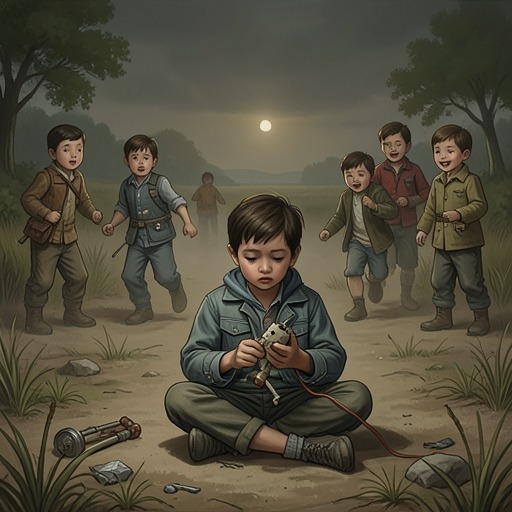
The killings ended the immediate danger, but they did not yet make the child safe. Yuan had to perform the rescue with his hands rather than his pistol, rewiring the collar’s cables while telling her to hold still. She remained motionless and silent, staring at her dangling feet instead of looking at him, a response that shows how thoroughly fear had replaced ordinary agency. The device was more advanced than the slave collars Yuan had previously encountered: it contained a locator and an emitter capable of triggering the explosive through a radio signal, ensuring that the girl could be tracked and killed even after leaving the caravan. Its key cable came free with a slight click, and Yuan froze for a moment, expecting the collar to detonate in his face, before the mechanism opened and he could finally remove it. He stored the collar in his travel bag, intending to repurpose it as a portable bomb with the radio serving as its detonator. That practical decision preserves the dangerous material logic of the episode: the object built to control and destroy the girl is stripped of its original power over her, but its destructive potential remains in the world and becomes part of Yuan’s equipment rather than disappearing.
From Liberation to Guardianship
Once the collar was removed, Yuan told the girl that she was free and asked her name, but she gave no answer and would not even look at him. She still possessed her tongue, so her silence could have come from not understanding the common language, terror, or both; in either case, the rescue had not restored an ordinary life in a single gesture. Yuan recognized that her fear was proportionate to what she had endured and did not treat her quietness as ingratitude. The transition from captive to survivor therefore remained incomplete, requiring patience, shelter, and continued protection rather than merely the destruction of her captors. Later, when the possibility of subjecting her to the Hitobashira procedure arose, Yuan promised Holster that no one would touch her again. Her response was physical rather than verbal: she clung to his shirt, and Yuan spent most of the evening sitting beside her in the last car until she fell asleep while Orient helped him practice the mantras and hand signs of Archer’s Glory. The rescue thus became the beginning of a guardian relationship, binding Yuan to the vulnerable person he had freed and turning a brief intervention into an enduring responsibility.
The Rescue’s Moral Afterlife
The liberation of Holster remains important because it changes the meaning of Yuan Guang’s violence without pretending that violence has become clean. His first act is tactical and final: Maurice and Gru die before they can continue the sale. The later consequences are slower and more demanding. Holster must be protected from the ritual system that marked her as a Hitobashira, while Yuan must learn to treat her silence, fear, and dependence as conditions requiring care rather than obstacles to his own journey. The rescue therefore establishes a pattern that recurs throughout the wider narrative: survival is not secured merely by defeating an immediate enemy. It depends on shelter, transport, technical knowledge, food, trust, and the willingness to remain responsible after the dramatic moment has ended. The contrast becomes sharper as Yuan’s path proceeds. He later recognizes that his own ammunition scheme helped induce the slaughter at Fleshmarket, and he watches allies suffer the consequences of powers he helped unleash. Against that growing burden of indirect responsibility, the rescue of Holster stands as an early, concrete instance of responsibility accepted at close range. He does not save her because the act advances his revenge, nor because she can immediately repay him; he frees her because her captivity is intolerable, then remains beside her when freedom proves frightening and incomplete. The event’s decisive value shift is from commodification to personhood: a captive first presented as a package becomes Holster, a living companion whose safety can no longer be treated as someone else’s concern.
The Rescue’s Moral Afterlife
The liberation of Holster remains important because it changes the meaning of Yuan Guang’s violence without pretending that violence has become clean. His first act is tactical and final: Maurice and Gru die before they can continue the sale. The later consequences are slower and more demanding. Holster must be protected from the ritual system that marked her as a Hitobashira, while Yuan must learn to treat her silence, fear, and dependence as conditions requiring care rather than obstacles to his own journey. The rescue therefore establishes a pattern that recurs throughout the wider narrative: survival is not secured merely by defeating an immediate enemy. It depends on shelter, transport, technical knowledge, food, trust, and the willingness to remain responsible after the dramatic moment has ended.
It depends on shelter, transport, technical knowledge, food, trust, and the willingness to remain responsible after the dramatic moment has ended. The contrast becomes sharper as Yuan Guang’s path proceeds. He later recognizes that his own ammunition scheme helped induce the slaughter at Fleshmarket, and he watches allies suffer the consequences of powers he helped unleash. Against that growing burden of indirect responsibility, the rescue of Holster stands as an early, concrete instance of responsibility accepted at close range. He does not save her because the act advances his revenge, nor because she can immediately repay him; he frees her because her captivity is intolerable, then remains beside her when freedom proves frightening and incomplete. The event’s decisive value shift is from commodification to personhood: a captive first presented as a package becomes Holster, a living companion whose safety can no longer be treated as someone else’s concern.